
A Failure of Collective Intelligence: Why Pollsters Missed the Mark in the 2015 UK Election
A Failure of Collective Intelligence
This paper introduces a social influence-based prediction model to address the failure of collective intelligence (CI) in national election forecasting, specifically analyzing the 2015 UK General Election. By modeling the nonlinear interactions between responsive and non-responsive voters through issue-based influence, the authors suggest that collective decisions emerge from complex social dynamics rather than simple ensemble polling.
TL;DR
The 2015 UK General Election was a "spectacular failure" for pollsters who predicted a dead heat but witnessed a Conservative landslide. This paper argues that the error wasn't just "sampling bias" but a fundamental misunderstanding of Collective Intelligence (CI). By introducing a social influence-based model that accounts for how "silent" voters react to the vocal ones through policy issues, the researchers achieved far higher accuracy and provided a roadmap for modeling complex social systems.
The Illusion of the "Average" Voter
Traditional polling operates on a relatively simple assumption: if you sample enough people, the average of their stated intentions will represent the whole. When polls fail, experts often blame "shy" voters or poor sampling.
However, this paper suggests a more profound cause: Nonlinear Agent Interactions. Under social influence, a group can make a decision that none of its members would have made in isolation—a phenomenon known as Emergence. The flaw in current models is treating responsive voters (the vocal ones) and non-responsive voters (the silent ones) as separate boxes. In reality, they are a single, interacting unity.
Methodology: Modeling the "Silent" Influence
The authors moved beyond simple historical discounting. They looked at "Issue Voting"—the idea that voters weigh specific pledges (NHS funding, tax rises, deficits) against their own social-economic needs.
1. The Dynamic Influence Framework
The model tracks how the published intentions of "Responsive Voters" create a social environment that non-responsive voters react to. If a specific demographic group (e.g., the elderly) sees that a party's pledge on a critical issue like the NHS is being ignored in the current "consensus" prediction, their likelihood to swing toward the "superior" party on that issue increases.
Note: The model segments voters by Age, Social Class, and Region, then applies an "Issue Threshold" to determine when a policy gap becomes large enough to trigger an intention change.
2. Key Parameters
The model introduces three critical variables:
- Issue Threshold (): How big must the policy gap be before a voter cares enough to change?
- Discount (): A measure of voter reluctance or inertia.
- Original Vote Likelihood (): The baseline probability of a voter actually showing up at the polls.

Experiments: Cracking the 2015 Mystery
The researchers tested their model against the actual results of the 2015 UK Election. The baseline ICM model predicted 34% for Conservatives and 35% for Labour. The actual result was a seven-point lead for the Conservatives.
Performance Gains
By tuning the social influence parameters, the authors' model reached a "distance" (error) of only 0.033 from the true distribution. They discovered that:
- Over-representation matters: The polls significantly over-represented young voters (who favored Labour).
- The "Late Swing": As non-responsive voters (often older and more conservative) observed the rising tide of Labour support in the polls, the "social influence" triggered a defensive swing back to the Conservatives.
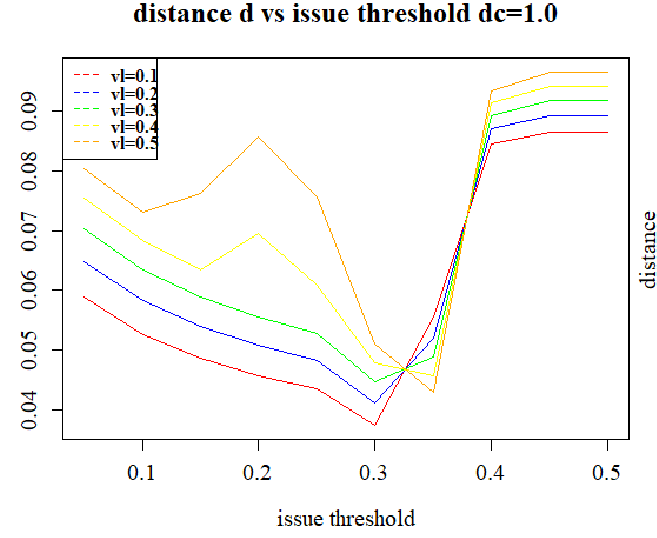 Fig: The U-shaped curves in the experimental results show that there is an "optimal" level of social influence sensitivity that traditional models completely overlook.
Critical Insights: Beyond the Ballot Box
This research proves that Collective Intelligence is a complex system, not an ensemble of independent agents. The "failure" of the 2015 polls was intrinsic—the very act of publishing poll results influenced the silent portion of the population to move in the opposite (orthogonal) direction.
Limitations & Future Work
While the model is robust for the 2015 case, it relies on "Issue Pledges," which can be subjective. Future work could benefit from:
- Real-time Social Media Integration: Replacing survey-based issue tracking with live sentiment analysis.
- Cross-Domain Application: Applying these nonlinear "social influence" models to market crashes or pandemic-related behavior (e.g., vaccine hesitancy), where the "silent majority" often determines the final outcome.
Conclusion
To predict the future of a group, we must stop looking at individuals in a vacuum. The real "intelligence" of the crowd resides in the invisible threads of influence that pull us toward or away from each other as the external environment shifts.