
CSPC: Curbing Unfair Pricing in IoT Networks via the Wisdom of the Crowd
8375_Fair Pricing in Heterogeneous Internet-of-Things Wireless Access Networks Using Crowdsourcing.
The paper introduces CSPC (Crowdsourcing Price Control), a novel three-tier game-theoretic framework designed to ensure fair pricing in Heterogeneous IoT Wireless Access Networks (HWAN). By leveraging crowdsourced client preferences, a regulator dynamically adjusts service price caps to prevent anti-trust behaviors and keep costs just above the marginal costs (MC) of providers.
TL;DR
In the emerging Era of IoT, a few wireless giants often dominate the market, leading to "unfair" pricing. This paper proposes a Regulator-Provider-Client three-tier game that uses Crowdsourcing to sniff out unfair prices. By observing how clients want to allocate their data across providers, a regulator can force prices back down to near Marginal Cost (MC) without ever actually knowing the providers' internal cost structures.
The Oligopoly Trap: Why Regulation is Hard
In a perfect market, if a provider overcharges, clients simply leave. However, in Wireless Access Networks (HWAN), the spectrum is limited. You can't just switch if other networks are at capacity. This creates an Oligopoly, where providers can fix prices high.
Current solutions like Auctions maximize the seller's profit, not the user's welfare. Pure Game Theory (Stackelberg models) often fails because it assumes the "Leader" (Provider) will behave, or it requires the Regulator to know the Marginal Cost (MC)—a piece of private data no company would ever share.
Methodology: The Power of Crowdsourced Feedback
The core insight of the CSPC (Crowdsourcing Price Control) mechanism is that while clients don't know the "fair price," their collective behavior reveals it.
1. The Interaction Loop
The system operates on three time scales:
- Long-term: Spectrum allocation.
- Medium-term (Price Control Cycle): The regulator sets a Price Ceiling ().
- Short-term (Allocation Cycle): Clients request bit-rates based on current prices and Quality of Service (QoS).
2. Identifying Unfairness
The regulator asks clients for a Perfect Request Bundle (PRB)—an "ideal world" scenario where capacity is infinite.
- If a network's Actual Load () is significantly lower than the Crowdsourced Ideal Demand (), it implies the provider is overcharging or providing poor service.
- The Punishment Rule: The regulator slashes the price cap for that provider using the ratio .
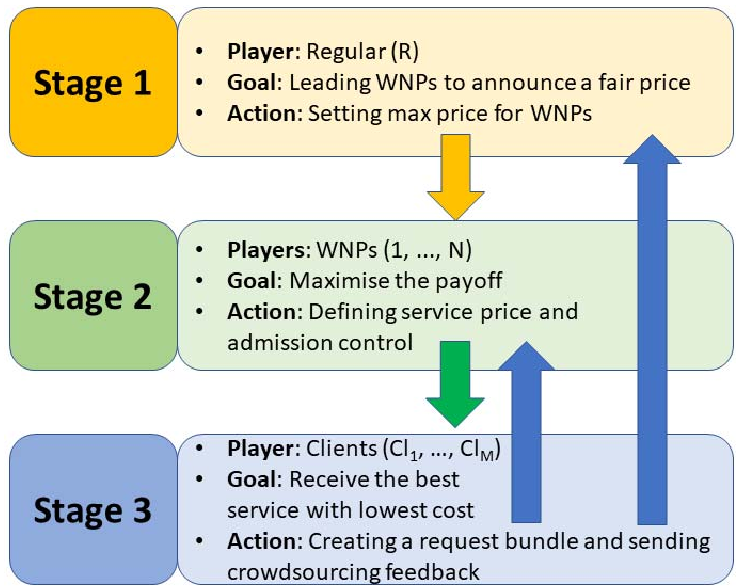 Figure 1: The Three-Tier decision process involving Regulator, WNPs, and Clients.
Experiments: Can One Honest Player Save the Market?
The authors tested the system under four scenarios. The most profound finding is the "One Honest Network" rule.
Key Findings:
- Convergence to MC: If all networks are honest, prices naturally settle at the Marginal Cost.
- Robustness: If even just one network out of many remains honest, the regulator can use its price as a benchmark to detect and punish the remaining "unfair" networks.
- Adaptive Detection: The system successfully detected providers who switched from "Honest" to "Unfair" midway through the simulation, correcting their price caps within a few iterations.
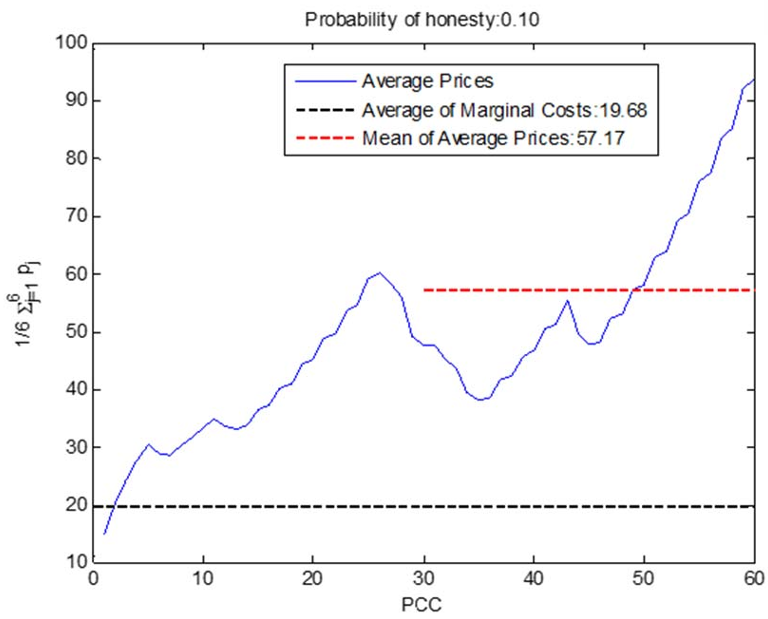 Figure 2: Price convergence across different providers. Notice how the regulator adjusts the "unfair" prices (WNPs 2 and 3) to match the honest baseline of WNP 1.
Critical Insight & Conclusion
The CSPC mechanism elegantly bypasses the information asymmetry of the wireless market. By treating the "wisdom of the crowd" as a proxy for market value, it forces competition even in an oligopolistic setting.
Limitations: The system has a critical "Achilles' Heel"—if all providers collude to be unfair simultaneously, the regulator loses its "honest anchor" and prices may drift upward. However, in real-world scenarios, marketing pressures or financial strategies usually lead at least one provider to break the collusion to gain market share.
Future Outlook: Integrating this with Blockchain-based smart contracts could allow these price adjustments to happen autonomously, creating a truly self-regulating IoT ecosystem.