
MSMRA: Balancing Expertise and Social Distance for Fairer Peer Review
Fair Reviewer Assignment Considering Academic Social Network
This paper introduces the Maximum Sum of Matching degree Reviewer Assignment (MSMRA) problem, a novel framework for peer review that incorporates academic social networks. It proposes two algorithms, SASA (Simulated Annealing) and MMMD (Maximum Matching and Minimum Deviation), to achieve a confident, fair, and balanced assignment.
TL;DR
The integrity of peer review rests on the objectivity of reviewers. While current systems focus on matching expertise, they often ignore the "who-knows-who" factor beyond immediate collaborators. This paper proposes MSMRA, a reviewer assignment framework that utilizes Academic Social Networks to maximize both topic similarity and social distance, ensuring reviews are competent yet impartial.
Background: The Hidden Bias in Your Network
In the academic world, "fairness" is usually enforced via simple Conflict of Interest (COI) checklists: same institution, recent co-authorship, or advisor-advisee relationships. However, social influence spreads like a ripple. If Author A is a close collaborator of Scholar B, and Scholar B is a close friend of Reviewer C, can Reviewer C truly be objective?
The authors argue that as the distance in a social graph increases, the influence decreases. By quantifying this "Collaboration Distance," we can move away from binary "Can/Cannot Review" rules toward an optimized assignment that favors reviewers who are both experts and "socially distant" from the authors.
Methodology: The Core Mechanism
The authors define the Matching Degree as a weighted sum of two components:
- Topic Similarity (): Standard expertise matching based on keywords.
- Collaboration Distance (): The shortest path in an academic social graph between any author of paper and reviewer .
1. Modeling Social Distance
The system maps out a massive graph (using DBLP) where nodes are scholars and edges represent co-authorship. Influence is assumed to dissipate after three degrees of separation.
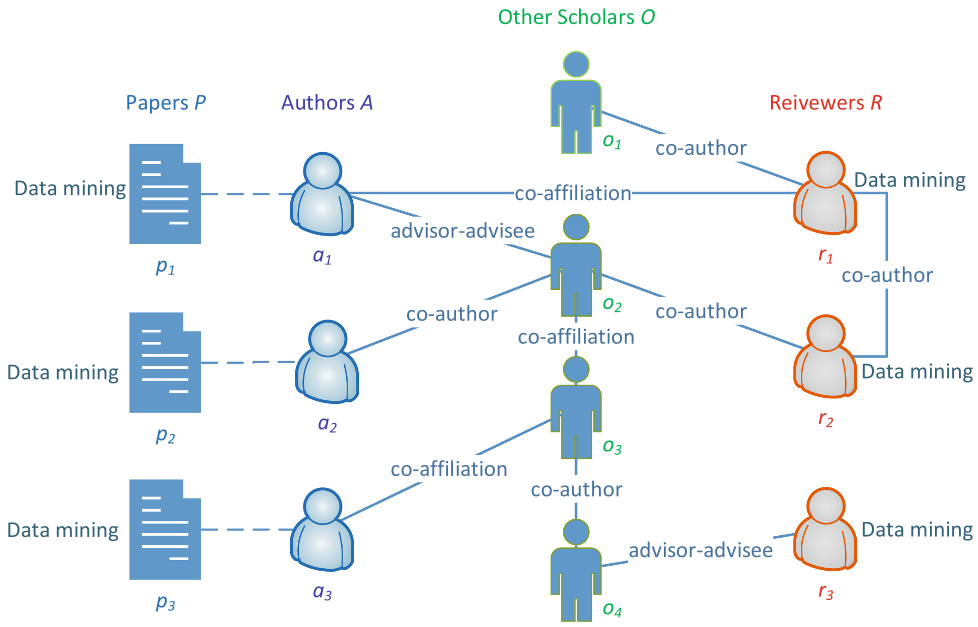 Figure 1: Illustration of how social distance (4 degrees vs 1 or 2) provides a safer, fairer buffer for assignment.
2. The Algorithms
To solve the optimization problem (MSMRA) under constraints (workload balance, group size), two approaches are presented:
- SASA (Simulated Annealing-based Stochastic Approximation): A probabilistic approach that swaps reviewers to find a global optimum.
- MMMD (Maximum Matching and Minimum Deviation): An exact polynomial algorithm that starts with a greedy matching and intelligently "adjusts" assignments that violate workload balance by minimizing the "Matching Degree" loss (deviation).
Experiments & Results
The researchers tested their methods using SIGMOD conference data.
SOTA Comparison
Compared to a standard Similarity-Greedy approach, both MMMD and SASA achieved a much more balanced distribution of fairness. While the Greedy method might assign a reviewer with a distance of only 2 (socially close), the proposed methods consistently pushed that distance to 3 or higher without sacrificing topic expertise.
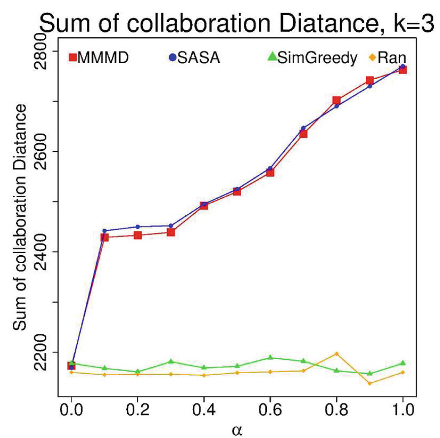 Figure 2: Performance across Sum of Matching Degree (SM), Collaboration Distance (SD), and Topic Similarity (SS).
Efficiency
Even though the theoretical complexity of MMMD is , the actual running time remains extremely low (under 2.5 seconds for typical conference sizes), making it practical for real-world deployment.
Critical Insight: Why This Matters
The primary value of this work lies in the mathematical formalization of social distance as a continuous variable rather than a hard constraint.
- Perspective Shift: Instead of asking "Does a conflict exist?", the system asks "How much distance is sufficient for objectivity?"
- Trade-off Management: Through the parameter, conference chairs can decide whether they prioritize the most specialized expert () or the most impartial reviewer ().
Limitations
The current model relies on the completeness of the DBLP graph. Factors like professional rivalries (negative edges) or private social ties (not reflected in co-authorship) are not captured. Furthermore, as the distance increases, the computational cost of finding shortest paths in massive graphs can grow, although the authors avoided this through preprocessing.
Conclusion
The MSMRA approach represents a significant step toward "Algorithmic Fairness" in science. By integrating academic social networks directly into the assignment logic, we can reduce the subconscious biases that plague the peer-review process, leading to a more meritocratic scientific community.