
FAC: Balancing Equity and Efficiency in Mobile Social Network Caching
Fairness-aware cooperative caching scheme for Mobile Social Networks
This paper introduces FAC (Fairness-Aware Cooperative Caching), a caching scheme designed for Mobile Social Networks (MSNs). It utilizes a "close friend set" mechanism and a heuristic algorithm for the Minimum Dominating Set problem to balance high data access performance with individual user fairness.
TL;DR
In the world of Mobile Social Networks (MSNs), high performance usually comes at the cost of "the little guy." Current caching schemes prioritize central hubs, leaving edge users with poor data access. This paper proposes FAC, a scheme that uses social "close friend sets" to ensure every user—no matter how isolated—has a fair shot at accessing data, all while keeping network-wide performance at SOTA levels.
The Fairness Gap in Opportunistic Networks
In infrastructure-less networks (like those based on Bluetooth or WiFi-Direct), data moves through opportunistic encounters. Traditional cooperative caching identifies "VIP" nodes—those that see everyone—and stuffs them with data.
The Problem: While this optimizes the average delay, it creates a digital divide. Users who don't frequently meet these global hubs are left in the dark. In a peer-to-peer ecosystem, if users feel the system is "unfair," they lose the incentive to share their own resources.
Methodology: High-Probability Friendship
The authors shift the perspective from Global Centrality to Local Coverage.
1. Defining the "Close Friend"
A node is a "close friend" of node for a specific file if the probability of them meeting within the file's lifetime exceeds a threshold .
2. The Minimum Dominating Set (MDS) Approach
To be fair, the caching set must ensure that every node has at least one close friend who is a cacher. Finding the absolute minimum number of nodes to satisfy this for the whole network is an NP-Complete problem (MDS). The authors solve this with a greedy heuristic:
- Count how often each node appears in the "close friend sets" of others.
- Pick the most frequent node.
- Remove the nodes now "covered" by this cacher.
- Repeat until everyone is covered.
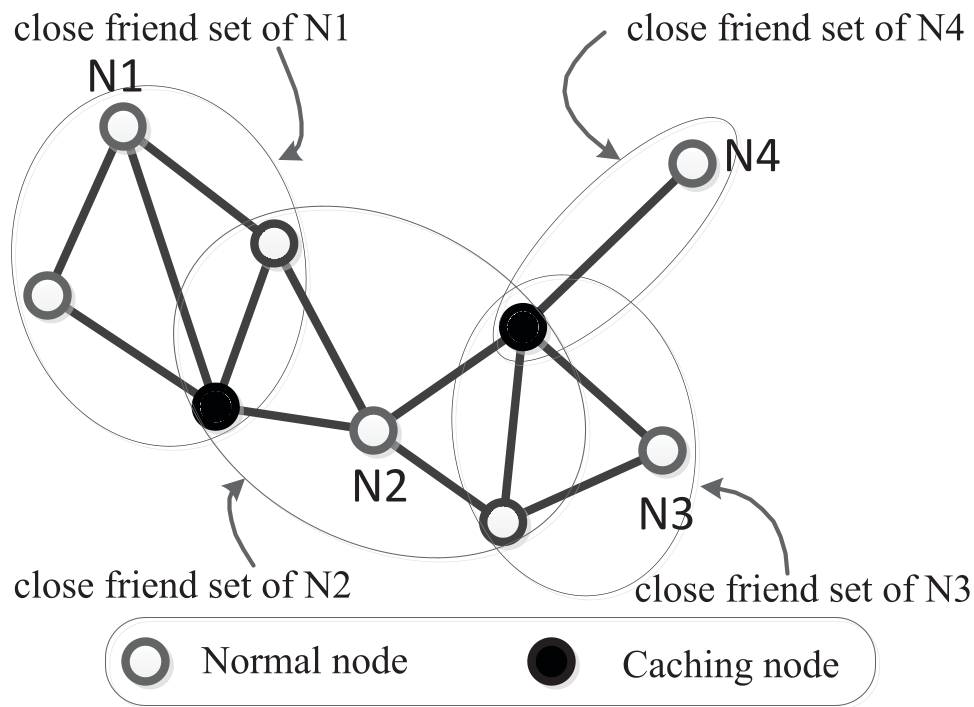 Fig 1: Selection strategy based on overlapping close friend sets ensures all nodes have access candidates.
Experimental Validation
Using real-world mobility traces (Infocom05 and Infocom06), the authors compared FAC against Intentional Cache (performance-focused) and Random Cache.
Key Findings:
- The Fairness Win: Using the Jain Index (where 1.0 is perfect equality), FAC consistently outperforms Intentional Cache, especially when caching resources are scarce.
- Zero Performance Loss: Remarkably, FAC achieves nearly the same delivery ratio as Intentional Caching. This proves that you don't need to sacrifice the network's total throughput to be fair to individual users.
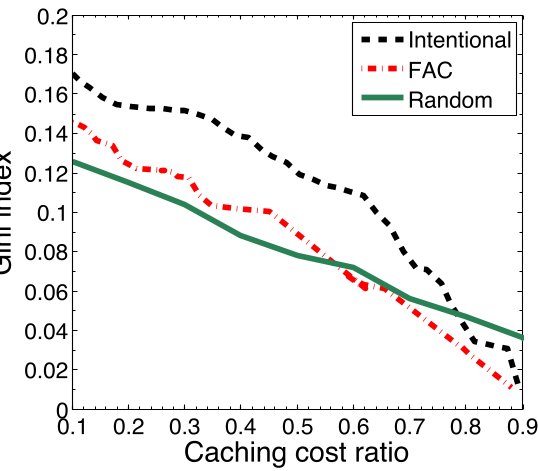 Fig 2: Gini Index results on Infocom05 - lower values signify better fairness.
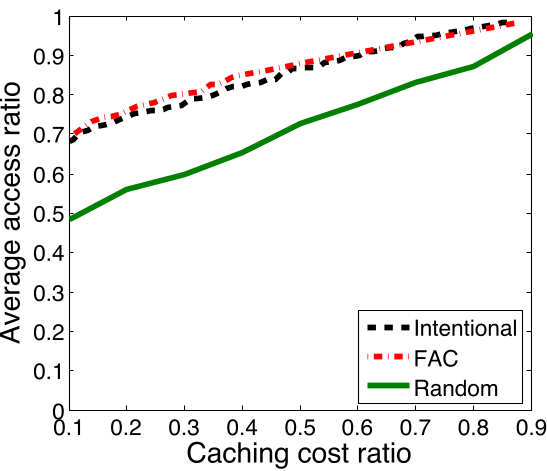 Fig 3: Delivery ratio comparison - FAC matches the SOTA performance of Intentional Caching.
Critical Insight & Conclusion
The "magic" of FAC lies in its intersection logic. Because nodes that are "close friends" to many people often coincide with "social hubs," FAC naturally picks high-performing nodes. However, by explicitly searching for coverage of the remaining marginalized nodes, it fills the fairness gaps that purely probabilistic models ignore.
Future Directions: The current algorithm is centralized (requires a "network administrator"). For true MSNs, a distributed version of this friendship-negotiation protocol is the next logical step. Furthermore, accounting for contact duration (can the file actually finish transferring before they move apart?) will add another layer of reality to this fairness model.