
Diversity Searcher: Moving Media Fairness from Mathematical Equality to Socio-Political Visibility
Fairness beyond “equal”: The Diversity Searcher as a Tool to Detect and Enhance the Representation of Socio-political Actors in News Media
The paper introduces "Diversity Searcher," a Web-based tool that utilizes Natural Language Processing (NLP) and Linked Open Data (LOD) to analyze the representation of socio-political actors in news media. It implements a multi-dimensional "Stirling diversity" metric to evaluate content beyond simple outcome equality, achieving a functional pipeline for detecting both named and unnamed entities across English and Dutch texts.
TL;DR
Researchers have developed Diversity Searcher, a sophisticated NLP-driven platform that quantifies how "diverse" news articles truly are. Moving beyond the "equal space" trope, the tool uses an ecological diversity metric called the Stirling Index to measure the variety, balance, and—most importantly—the disparity (the actual difference) between the political actors appearing in the news.
Background: Why "Equal" Isn't Enough
In the world of Machine Learning, "Fairness" is often reduced to a series of equations ensuring group A and group B get similar outcomes. However, in sociology and media studies, fairness starts with visibility. If a group (like "Amazon warehouse workers" or "refugees") doesn't even exist in the text, they cannot be treated fairly.
The authors argue that a truly fair news landscape requires Polyphony (many voices) rather than just Balance (two sides of a coin). To achieve this, we need tools that can identify not just famous politicians (Named Entities) but also collective social actors (Unnamed Entities) and calculate how much "space" they occupy relative to their socio-political distance.
Methodology: The Anatomy of Diversity
The core of the Diversity Searcher is based on Andy Stirling’s Diversity Framework. Diversity is not a single number but a composite of three vectors:
- Variety: How many different types of people/groups are mentioned?
- Balance: Is the coverage distributed evenly, or is one actor dominating?
- Disparity: How different are these people? (e.g., mentioning two Republican politicians is less "diverse" than mentioning one politician and one labor union leader).
High-Tech Ontology Mapping
The tool uses a "Feature-based representation" to calculate disparity. Instead of a simple tree, it extracts RDF triples from DBpedia (the structured version of Wikipedia) to build feature vectors for actors.
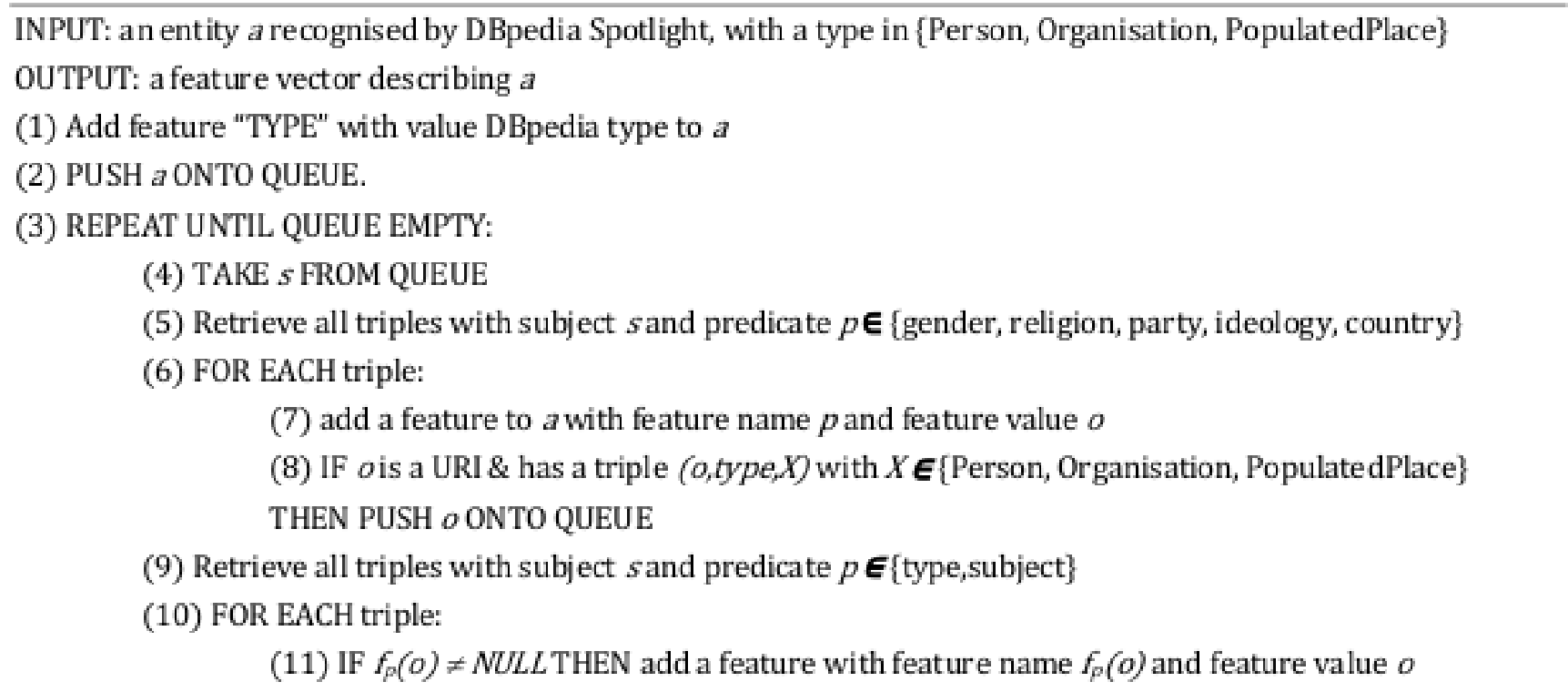 The algorithm for transforming DBpedia URIs into socio-political feature vectors.
If the system identifies Donald Trump and Tayyip Erdogan, it doesn't just see two "Persons." It looks at their party ideologies, government roles, and geographic locations to calculate a Jaccard Disparity score.
Human-in-the-Loop: Contesting the Machine
One of the paper's strongest insights is that "automated fairness" is a trap. Since DBpedia is crowdsourced, it contains its own biases (e.g., gender bias). Diversity Searcher solves this by providing a "Rich User Interface" where journalists can:
- Manual Override: Correct the machine if it mislabels an entity (e.g., correcting "Black voters" from a Location to a Person category).
- Adjust Disparity: Manually define how "different" they believe two groups are for a specific analysis.
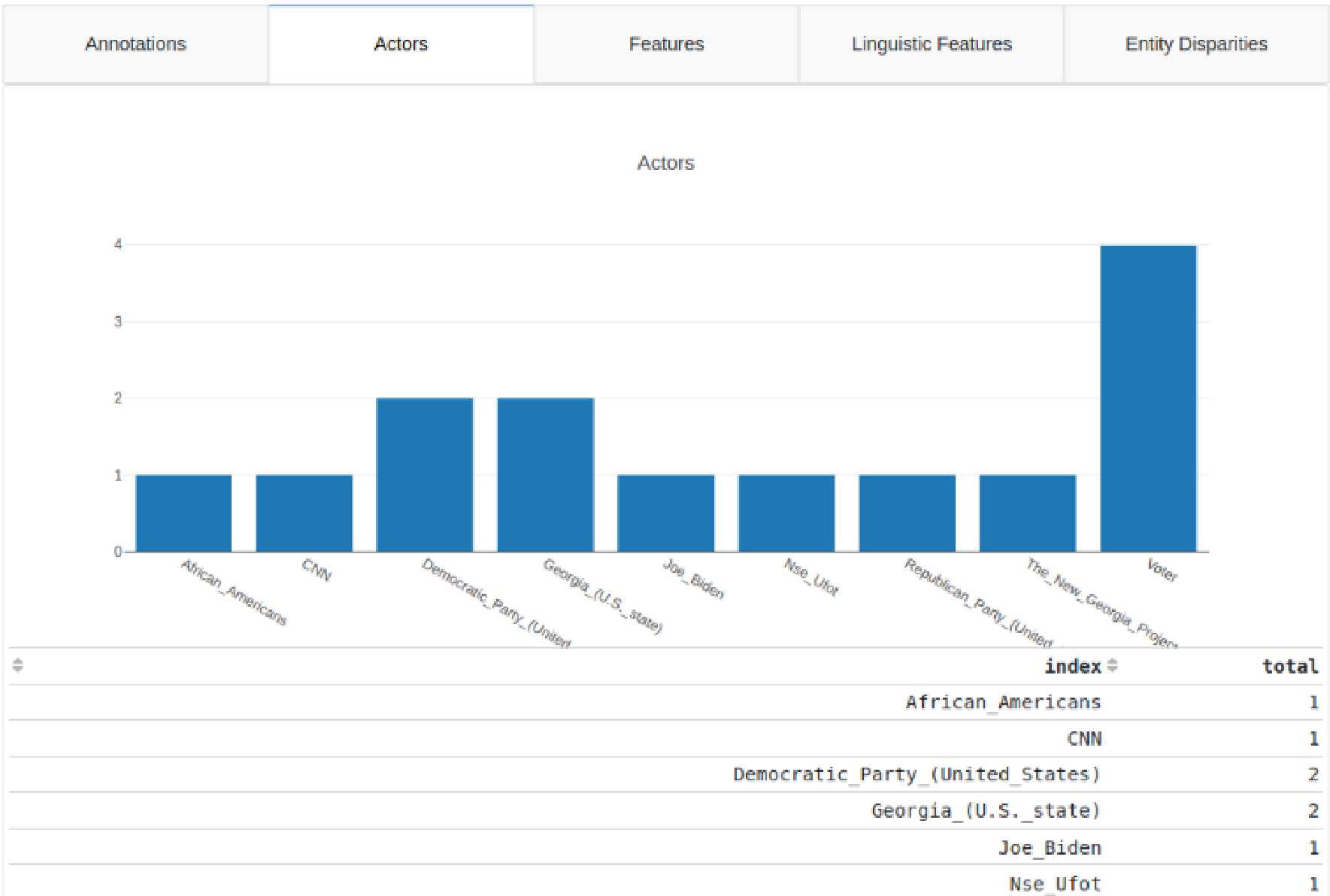 The tool uses Histograms and Multi-dimensional Scaling (MDS) to show users where the "gaps" in their reporting reside.
Experiments and Practical Results
The tool was tested using a case study of the "Timnit Gebru / Google" firing. While most news focused on the "Lone Researcher vs. Goliath" narrative, Diversity Searcher was able to highlight whether articles included the perspectives of broader "tech workers" or stakeholders like "the policed" and "the homeless."
Key findings from user workshops included:
- Actionable Insights: Journalists were less interested in the final "Diversity Score" and more interested in the Entity Disparity charts which showed them which viewpoints they were missing.
- Scalability: By using spaCy's rule-based matcher alongside DBpedia, the tool captured unnamed social groups that standard NER systems usually ignore.
Critical Insight & Future Outlook
This work represents a shift from "AI as a judge" to "AI as a mirror." By exposing the categories through which we view the social world, the Diversity Searcher allows journalists to reflexively engage with their own biases.
Limitations: The system currently tracks presence, not sentiment or agency. Being mentioned is the first step, but being mentioned as a "passive victim" vs. an "active agent" is the next frontier for fairness research. The authors plan to integrate dependency parsing and verb-action analysis to track these nuances in future versions.
Final Takeaway: Diversity is a catalyst for democratic health. Tools like Diversity Searcher prove that NLP can do more than summarize—it can hold the "fourth estate" accountable to its own ideals of pluralism.