
Beyond the Echo Chamber: Balancing Fairness and Diversity in Social Recommenders
Fairness and Diversity in Social-Based Recommender Systems
The paper introduces a novel social regularization framework (W+C) for social-based recommender systems. It aims to balance recommendation accuracy with fairness and diversity by protecting "cold-start" users and preventing the formation of social echo chambers.
TL;DR
Social-based recommenders often fall into a trap: in an attempt to leverage "homophily" (the idea that friends like similar things), they inadvertently silence the unique voices of new users and create digital echo chambers. This paper introduces a selective regularization technique (W+C) that only applies social constraints where evidence is strong (warm users) and explicitly promotes diversity within social communities.
The "Friendship" Trap: Problem & Motivation
In modern social networks, we assume that if Alice and Bob are friends, they likely share tastes. Recommender systems exploit this through Social Regularization, mathematically forcing Alice’s and Bob’s "latent vectors" (their digital signatures) to be close to each other.
However, the authors identify a critical flaw: unfairness toward cold-start users. When a user has few ratings, the social constraint overwhelms their actual data. They aren't recommended what they like; they are recommended what their friends like. Furthermore, this leads to Social Echo Chambers, where a community's influence becomes so strong that any internal diversity is erased.
Methodology: The Core Innovations
The researchers propose a two-pronged mathematical strike against bias and isolation.
1. Selective Social Regularization (W)
Instead of forcing all friends to be similar, the W component only applies regularization when both users are "warm" (active). This prevents the system from "bullying" cold users into a consensus that doesn't reflect their nascent preferences.
2. Community Diversity Regularization (C)
To fight echo chambers, the authors introduce a diversity term. While standard social CF tries to push users toward their friends, the C term calculates a "Community Latent Representation" (the average of the group) and encourages individuals to remain distinct from that average.
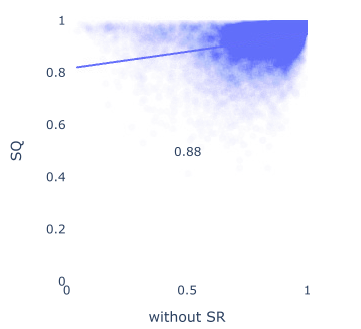 Figure: Note how standard methods (S, Si, SQ) concentrate similarities near 1.0 (top right), while the proposed W+C (e) maintains a healthier, diagonal distribution.
Experiments & Results
The authors tested their approach on the Douban and Epinions datasets. The results were telling:
- Accuracy: W+C didn't just maintain accuracy; in several metrics like nDCG@20, it outperformed the baseline Matrix Factorization and traditional social methods.
- Fairness: By measuring LF-sim (Latent Factor Similarity), they proved that W+C prevents the artificial "clumping" of users that plagues methods like SQ and Si.
- Novelty: W+C achieved some of the highest scores in Community Novelty (C-Nov), proving it can surface items that the whole community hasn't seen yet.
 Table: Comparison of W+C against baselines. W+C achieves superior nDCG while keeping novelty (I-Nov/C-Nov) high.
Critical Insight & Conclusion
This paper serves as a vital reminder that "more data" (social links) isn't always "better data" if used indiscriminately. The W+C approach proves that we can have the accuracy benefits of social signals without the sociological side effects of polarization and user suppression.
For developers and researchers, the takeaway is clear: Inductive bias in social networks should be applied with a "safety valve"—specifically one that protects the under-represented cold-start users and enforces a minimum threshold of group diversity.