
Fairness in Social Influence Maximization: Why "Color-Blind" Algorithms Fail
Fairness in Social Influence Maximization
This paper investigates Fairness in Social Influence Maximization, proposing a framework to ensure equitable information diffusion across demographic groups. The authors introduce two definitions of fairness (seeding and outreach) and demonstrate that "feature-aware" strategic seeding outperforms "feature-blind" heuristics in both diversity and efficiency.
TL;DR
In the quest to make information go viral, algorithms often choose "influencers" based purely on their number of connections. This paper reveals that such "feature-blind" strategies systematically exclude marginalized groups due to the "algorithmic glass ceiling." The authors prove that by being feature-aware—specifically, by adjusting thresholds for different demographic communities—we can achieve a more diverse spread of information and increase the total number of people reached.
Background: The Hidden Bias in Topology
Social influence maximization (SIM) is the engine behind modern advertising, public health campaigns (like vaccination drives), and news propagation. For years, the gold standard was to find a set of "seeds" (early adopters) that would trigger the largest cascade of information.
However, human networks are not neutral. They are shaped by homophily (the tendency to connect with those similar to ourselves) and historical biases. When an algorithm picks seeds based on high degree-centrality (the "most popular" people), it doesn't just find the best spreaders; it often amplifies existing social inequalities.
The Problem: The Glass Ceiling Effect
The authors analyzed a massive Instagram dataset (over 115 million photos and 500k users) to verify this. They found a striking disparity: although women constituted 54% of the population, men consistently held the highest degrees.
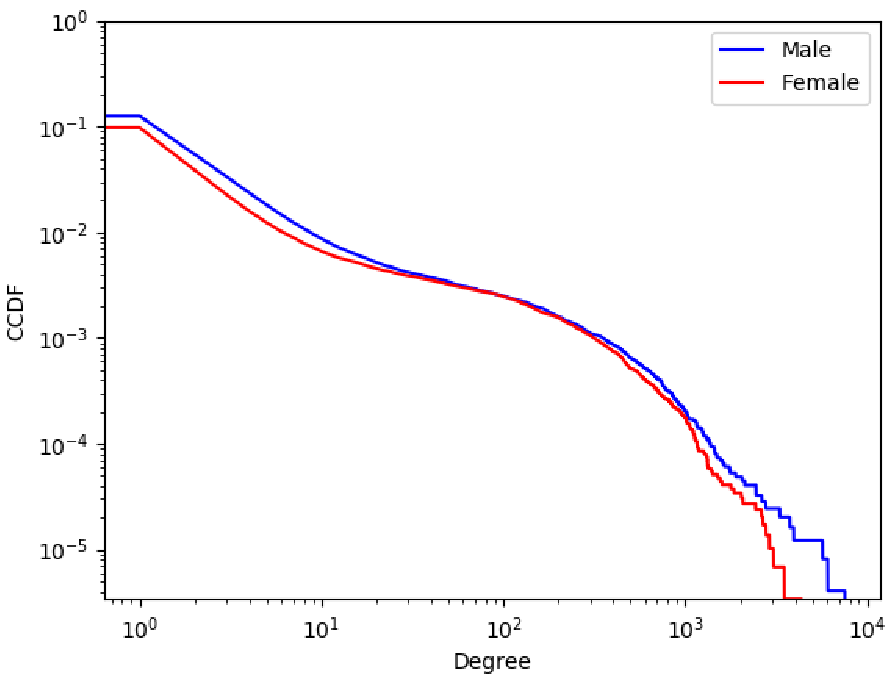 Figure 1: Comparison of degree distributions shows that while men are the minority, they dominate the "high-degree" nodes, creating a glass ceiling for females.
If we use a "blind" high-degree heuristic, we end up choosing mostly men as seeds. This isn't just "unfair"—it's inefficient. If information stays trapped in one community (men), it fails to penetrate the other (women), leading to a lower overall cascade.
Methodology: Feature-Aware Strategic Seeding
The authors define two types of fairness:
- Fairness for early-adopters: Ensuring different communities are represented equally in the lucrative "seed" positions.
- Fairness in outreach: Ensuring the final cascade reaches a proportional percentage of each community.
The Theoretical Model
Using a Preferential Attachment Model with Homophily, the authors mathematically demonstrate the "Glass Ceiling." They show that in a bi-populated network (Blue/Majority vs. Red/Minority), the power-law distribution coefficients differ.
To fix this, they suggest Differentiated Thresholds. Instead of one universal degree requirement to become a seed, they propose lowering the "bar" for the community that is structurally disadvantaged.
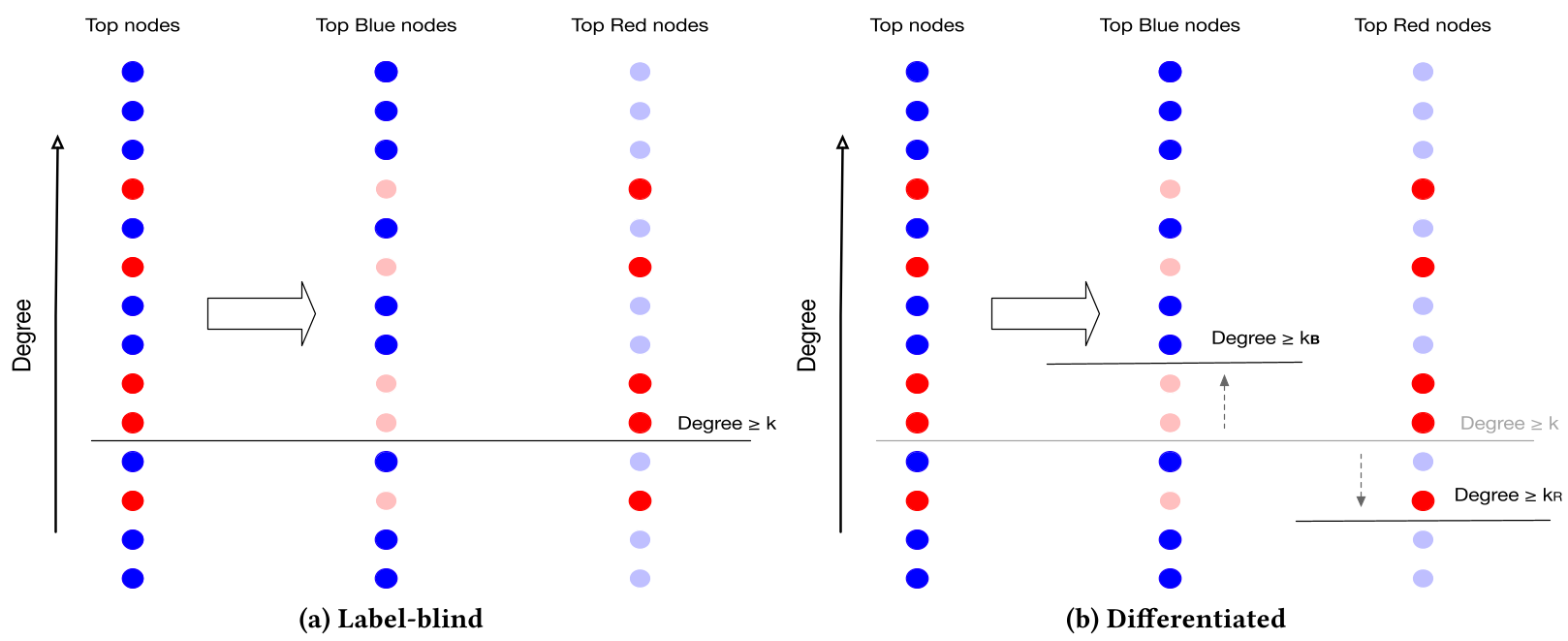 Figure 2: (a) Label-blind seeding vs. (b) Differentiated (aware) seeding. By picking seeds deeper into the minority community's hierarchy, we trigger cascades that would otherwise never happen.
Experimental Evidence
The results from the Instagram simulation are telling. The Greedy algorithm (which is naturally strategic) tends to pick more females as the "conducting probability" () increases, because it realizes that to reach more people, it must jump into the female community.
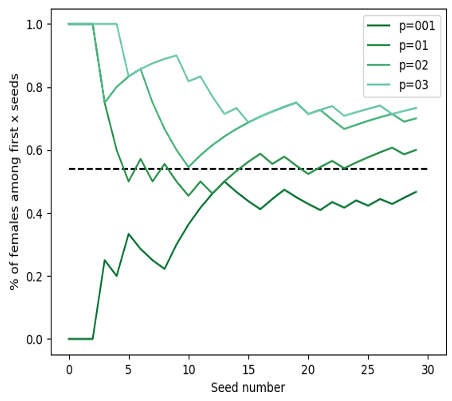 Figure 3: Comparison of Seed Selection and Outreach. The Greedy algorithm (left) adjusts to gender ratios much better than the Degree-blind algorithm (right).
Key Finding: For , the blind degree algorithm failed to reach a proportionate number of women. In contrast, being strategic—specifically being "aware" of the labels—allowed the algorithm to achieve better outreach by diversifying the seed set.
Deep Insight: Efficiency and Fairness are NOT at Odds
The most profound takeaway from this work is the debunking of the "fairness-utility tradeoff." In social networks with strong community structures:
- Diversity is a catalyst for outreach.
- If you only seed the "top" group, your information gets stuck in a structural echo chamber.
- By "affirmatively" selecting seeds from the minority or disadvantaged group, you access untapped parts of the network, increasing total efficiency.
Conclusion
This paper serves as a critical reminder for AI practitioners: Blindness is not Fairness. When designing algorithms for social graphs, ignoring demographic labels doesn't make the algorithm "unbiased"—it makes it a silent partner to existing inequality. Strategic, feature-aware seeding is not just a moral choice; it is a mathematical necessity for optimal performance.
Future Work
While this study focused on the Independent Cascade model, future research needs to investigate Linear Threshold models where "critical mass" is required. In those scenarios, the trade-off between fairness and local density might be more complex.