
Faith to Go or Devil’s Work: Deciphering the Religious Tech Gap
“Faith to Go or Devil’s Work” – Social Media Acceptance in Taboo-Related Usage Contexts
This study investigates the acceptance of religious mobile applications across different faiths. Using a mixed-methods approach (focus groups and N=388 survey), it identifies how Muslims and Christians perceive "digital religion" and determines their specific usage intentions for various app types.
TL;DR
In a world where there is an "app for everything," religion remains a complex frontier for Social Media and mobile technology. This research explores why some believers embrace digital faith while others view it as a distraction. By comparing Muslim and Christian users, the study reveals that Muslims are the early adopters of "digital religion," driven by the functional requirements of their daily rituals, whereas Christians often feel technology dilutes the "spiritual mood" of worship.
Background: The Taboo Frontier
Social media has conquered business, health, and education, but the "Electronic Church" still faces significant cultural resistance. Despite the Vatican launching the "Pope App" and the existence of thousands of biblical tools, the integration of these devices into actual pews remains slow. The authors position this study at the intersection of HCI (Human-Computer Interaction) and theology, seeking to understand if technology is a bridge or a barrier to the divine.
The "Ritual Fit" Motivation
The study highlights a fascinating "Inductive Bias" in how different religions perceive utility.
- Muslim Users: The Islamic faith involves specific daily parameters—prayer times (Salah), dietary restrictions (Halal), and orientation (Qibla). Apps that automate these calculations provide high assistance value.
- Christian Users: Contemporary Christian practice in the study’s German context often centers on "mood" and "atmosphere." For these users, a smartphone represents a secular interruption rather than a spiritual aid.
Methodology: From Dialogue to Data
The researchers moved from qualitative focus groups (identifying requirements like "flawless performance") to a robust quantitative survey of 388 participants. They categorized religious apps into four types:
- Information (Holiday calendars, taboos)
- Participation (Quizzes, discussion forums)
- Assistance (Prayer times, Ezan/Call to prayer)
- Private Interaction (Digital rosaries/Tesbih)
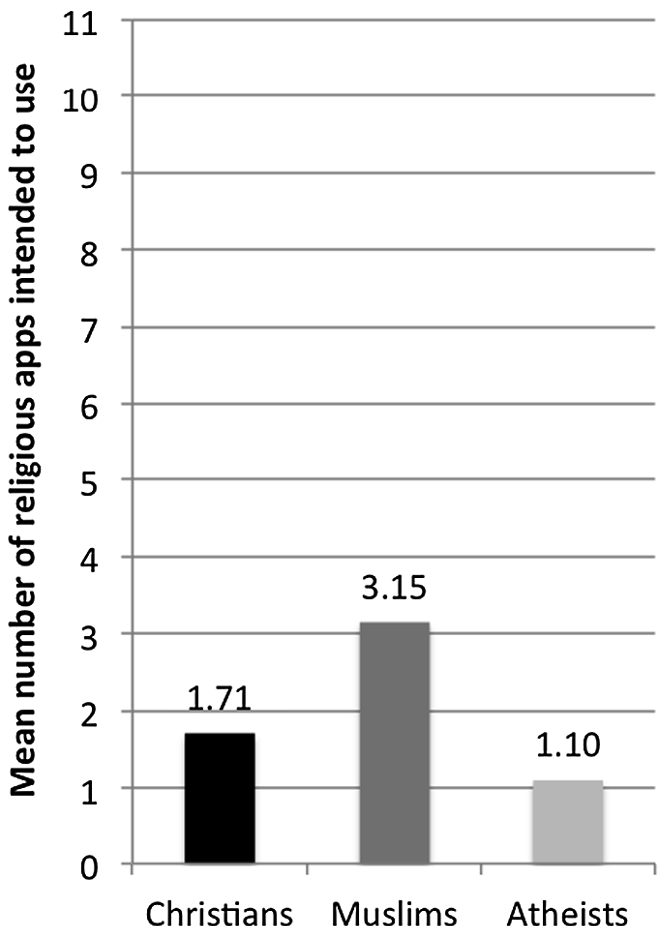 Figure 1: Comparison of intention to use religion-independent apps. Muslims significantly lead in adoption willingness.
Key Findings: Barriers and Drivers
Why Use Them? (The Drivers)
Muslim participants, particularly women, were most open to religious technology. They valued fast access to information and the ability to practice religion in private environments. Technology was seen as a way to make faith "feasible" in a modern, busy world.
Why Avoid Them? (The Barriers)
For Christians, the rejection was often categorical. The most cited reason was that technology "doesn't get you in the right mood" for worship. Conversely, Muslims were skeptical only about the accuracy of the content—they are willing to use the tools, provided the digital Quran or prayer times are 100% correct.
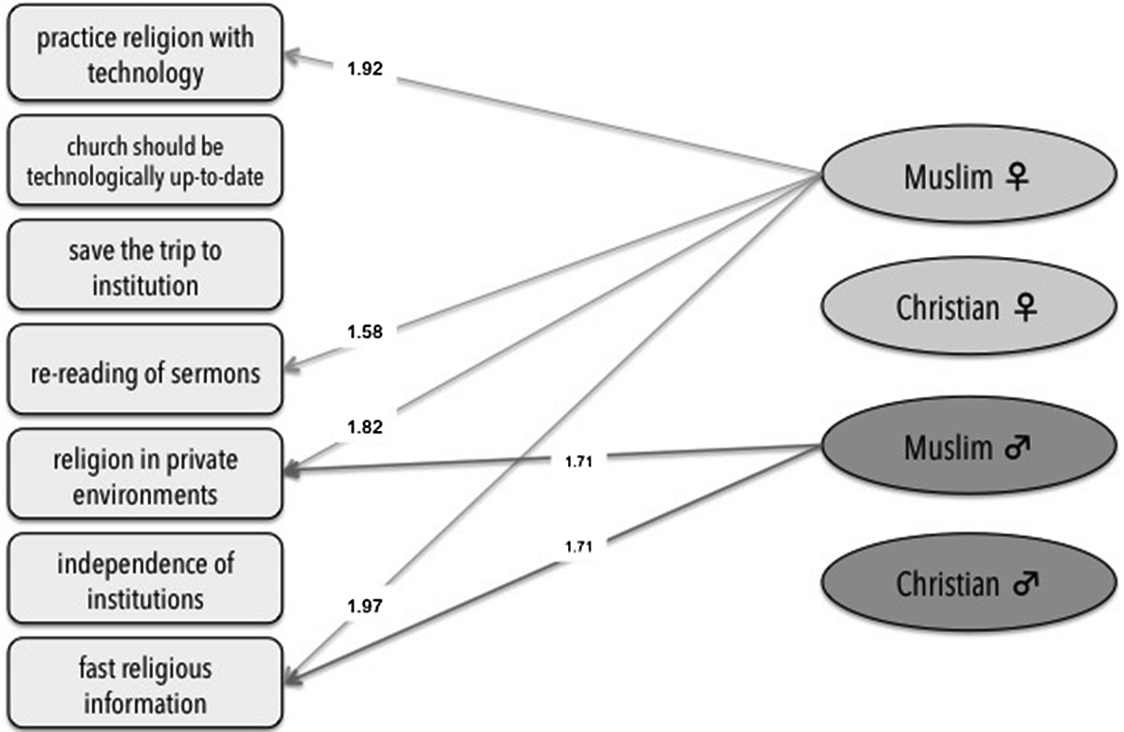 Figure 2: Reasons against application usage. Note the high "mood" barrier for Christians compared to the "information accuracy" concern for Muslims.
Critical Insight: The "App-Affinity" of Faith
The study provides a deep insight into Technology-Faith Alignment. It suggests that religions with "rules-based" everyday structures are naturally more compatible with mobile app logic (which thrives on schedules, locations, and checklists). Religions that rely on "nebulous affect" or specialized holy spaces (the Church sanctuary) find the transition to a 5-inch screen much more disruptive.
Conclusion & Future Outlook
The paper concludes that there is no "one size fits all" for religious apps. Developers must account for the specific "liturgical workflow" of a faith group.
Future Outlook: The next step in this research involves looking at other confessions (Buddhism, etc.) and exploring how religious professionals (priests/imams) view these tools. Will digital media eventually replace the local parish, or will it become the primary tool for recruiting the "digital native" generation? For now, the "Devil's work" is slowly becoming a daily digital companion for millions.
Takeaway for Developers:
If you are building for a religious context, functional assistance wins over social networking. Accuracy and privacy are the non-negotiables that determine whether a user feels they are connecting to the divine or just staring at a screen.