
[ACL 2026] FaithAct: Re-Wiring the Transformer's "Contextual Circuit" for Faithful RAG
FaithAct: Enhancing RAG Faithfulness via Learnable Activation-Guided Sparse Reinforcement Learning
The paper introduces FaithAct, a novel framework designed to improve Retrieval-Augmented Generation (RAG) faithfulness by selectively reinforcing context-encoding channels in Transformer Q/K projections. It utilizes a learnable activation gate and sparse reinforcement learning (RL) to achieve a state-of-the-art faithfulness F1 of 0.856 on Qwen3-8B.
TL;DR
FaithAct is a breakthrough RL framework that solves the "stubborn sloth" problem in RAG—where models ignore correct documents to favor their own memory. By discovering that only 30% of channels in Query/Key projections are responsible for context processing, and using a learnable gate to target those channels during training, FaithAct improves faithfulness F1 to 0.856 (+9.0pp) while simultaneously making the model smarter at general QA (+6.7% accuracy).
The "Stubborn Sloth" Problem: Why LLMs Ignore Facts
Even when a RAG system retrieves the perfect document, LLMs often "hallucinate" answers from their internal training data. This is particularly dangerous in medical or legal fields where names or dates change. The authors argue that this isn't because the model can't read the document, but because the parametric pathway in its brain is louder than the contextual pathway.
Previous attempts to fix this (like CK-PLUG or TCR) were just "band-aids" applied during inference. FaithAct aims for "brain surgery"—permanently re-calibrating the model's internal trust mechanisms.
Methodology: Identifying and Gating the Contextual Circuit
The research team's core insight is grounded in mechanistic interpretability: high-magnitude activations in the Query (Q) and Key (K) layers are the "highways" for contextual information.
1. The FaithAct Architecture
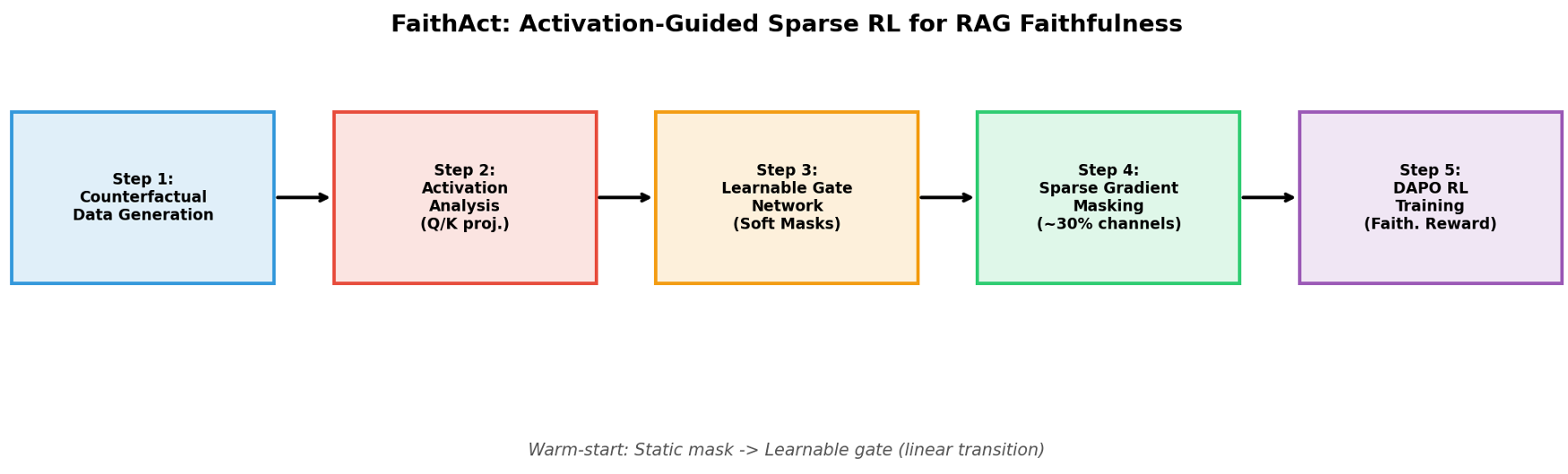
Instead of updating all billions of parameters, FaithAct uses a Learnable Activation Gate. This lightweight network looks at the current input and decides which specific channels in the Q/K projections should be updated.
2. Counterfactual Training
To force the model to choose, they created "Knowledge Conflict" data. If the model knows the Eiffel Tower is in Paris, the training data gives it a document saying it's in Tokyo. The model is rewarded only if it follows the document (Tokyo) and ignores its own memory (Paris).
3. The 30% Rule
Through a two-phase Warm-Start Schedule, the model transitions from a fixed mask to a dynamic, input-dependent one. This prevents the training from becoming unstable in the early stages.
Experimental Proof: The Inverted-U Mastery
The team tested FaithAct on Qwen3-8B. The results were not just a minor bump, but a paradigm shift in performance.
Main Benchmarks
| Method | Faithfulness F1 | Standard QA (EM) |
|---|---|---|
| Base Model | 0.224 | 0.833 |
| Full-Param RL | 0.766 | 0.840 |
| FaithAct-Gate | 0.856 | 0.900 |
As shown in the table, FaithAct-Gate is the only method that significantly improves both faithfulness and standard accuracy. Most RL methods suffer from "catastrophic forgetting," but FaithAct actually makes the model more robust.
The Mechanics of Sparsity
The researchers discovered a fascinating Inverted-U relationship between how many parameters you update and how well the model performs.
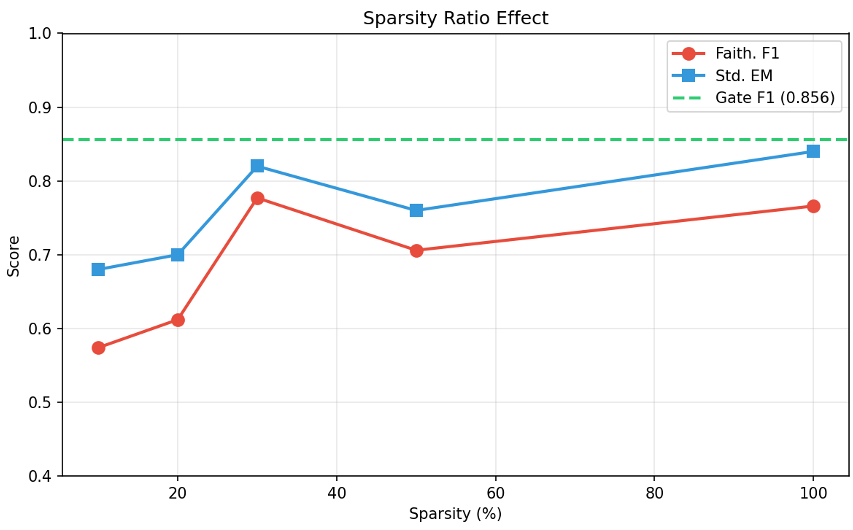
Updating only 10% of channels isn't enough to learn; updating 100% (full-parameter) introduces too much "noise" from parametric memory. The "sweet spot" is 30%. This suggests that exactly one-third of the Q/K projection space is functionally specialized for context.
Deep Insight: Q vs. K Asymmetry
One of the most profound technical findings is the difference between Queries and Keys:
- Queries (Q): Extremely stable (91.5% similarity across samples). They encode "what to look for."
- Keys (K): Highly variable. They encode "what is available."
This is why FaithAct uses separate gates for Q and K. The model needs a stable search strategy (Q) but must adapt to the specific document layout (K).
Conclusion & Future Impact
FaithAct proves that we don't need massive compute to fix RAG unfaithfulness. By understanding the inner workings of the Transformer—specifically the sparse, high-magnitude channels—we can train models to be significantly more faithful in just 200 steps on a few GPUs.
The takeaway for the industry is clear: Don't just train harder; train sparser. Targeting the "functional circuits" of the model is the future of efficient and reliable AI.
Limitations to Consider
While FaithAct is efficient, it has currently only been validated on the Qwen architecture. Future work will need to verify if the "30% rule" holds for Llama-3 or Mistral, and how it handles multi-hop reasoning tasks where conflicts are more subtle than entity substitution.