
[ACL 2025] FaithfulRAG: Why Suppressing Model Knowledge is the Wrong Way to Fix RAG
Faithfulrag: Fact-level conflict modeling for context-faithful retrieval-augmented generation
The paper introduces FaithfulRAG, a retrieval-augmented generation framework that resolves knowledge conflicts between an LLM's parametric memory and external context. By employing a fact-level alignment and a "Self-Think" reasoning process, it achieves SOTA performance on benchmarks like FaithEval, MuSiQue, and SQuAD.
One of the most frustrating "hallucinations" in Large Language Models (LLMs) isn't when the model makes things up—it's when the model knows the right answer from the context but chooses to ignore it, or worse, gets confused by a conflict and spits out a logical mess. This phenomenon, known as the "knowledge conflict" problem, is the final frontier for making Retrieval-Augmented Generation (RAG) actually reliable in production.
In a new paper from Xiamen University and partners, researchers argue that our current methods for fixing this are fundamentally flawed. They propose FaithfulRAG, a framework that treats the LLM like a critical thinker instead of a suppressed memory.
TL;DR: The Paradox of Faithfulness
Standard "faithful" RAG methods usually try to force the model to listen to the context by using aggressive prompts or tweaking decoding probabilities to favor external words.
The catch? The authors found that while these methods reduce "Over-confidence" (ignoring the context), they cause a massive spike in "Incorrect-match" errors—where the model blindly follows a misleading context because it no longer trusts its own reasoning. FaithfulRAG solves this by explicitly modeling the conflict at a fact level.
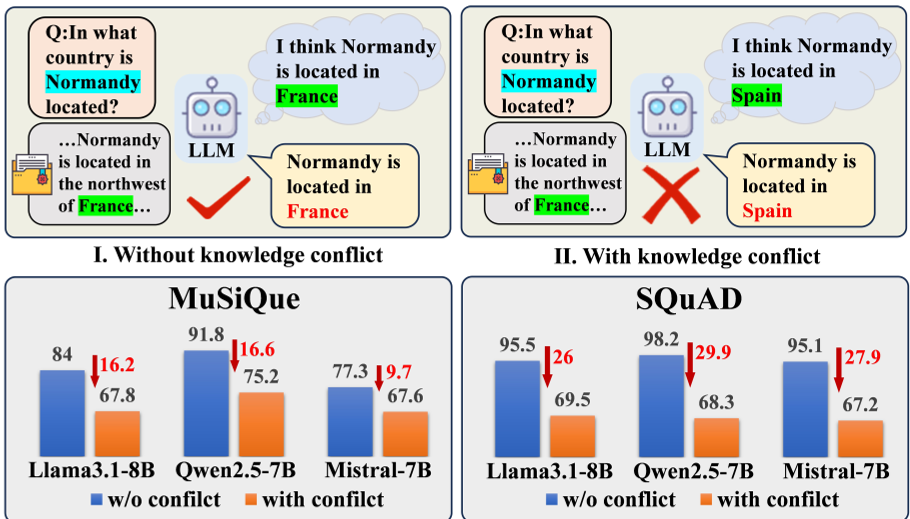 Figure 1: LLMs experience a performance drop of up to 30% when retrieved information contradicts their internal knowledge.
The Core Intuition: Self-Fact Mining
How do you know there is a conflict? You first have to know what you believe. FaithfulRAG starts by asking the model to "externalize" its own knowledge before it even looks at the context. This happens in three steps:
- Extraction: What domains of knowledge do I need for this query?
- Narrative: Write a brief paragraph based on what I (the LLM) know.
- Fact Distillation: Break that paragraph into "Self-Facts."
Now, the model has a clear list of its own internal "beliefs" to compare against the retrieved documents.
Methodology: The Self-Think Pipeline
Instead of just feeding the context and query to the LLM, FaithfulRAG follows a more "human" reasoning path:
- Alignment: It calculates the semantic similarity between the "Self-Facts" and the "Retrieved Context." This highlights exactly where the external info agrees or disagrees with the model's training data.
- Self-Think: The model undergoes a reasoning stage where it analyzes the "Aligned Context." It asks: "Is this retrieved segment reliable? Is it contradicting what I know? Does it provide sufficient evidence to override my internal prior?"
- Fused Generation: Only after this "internal debate" does the model generate the final answer.
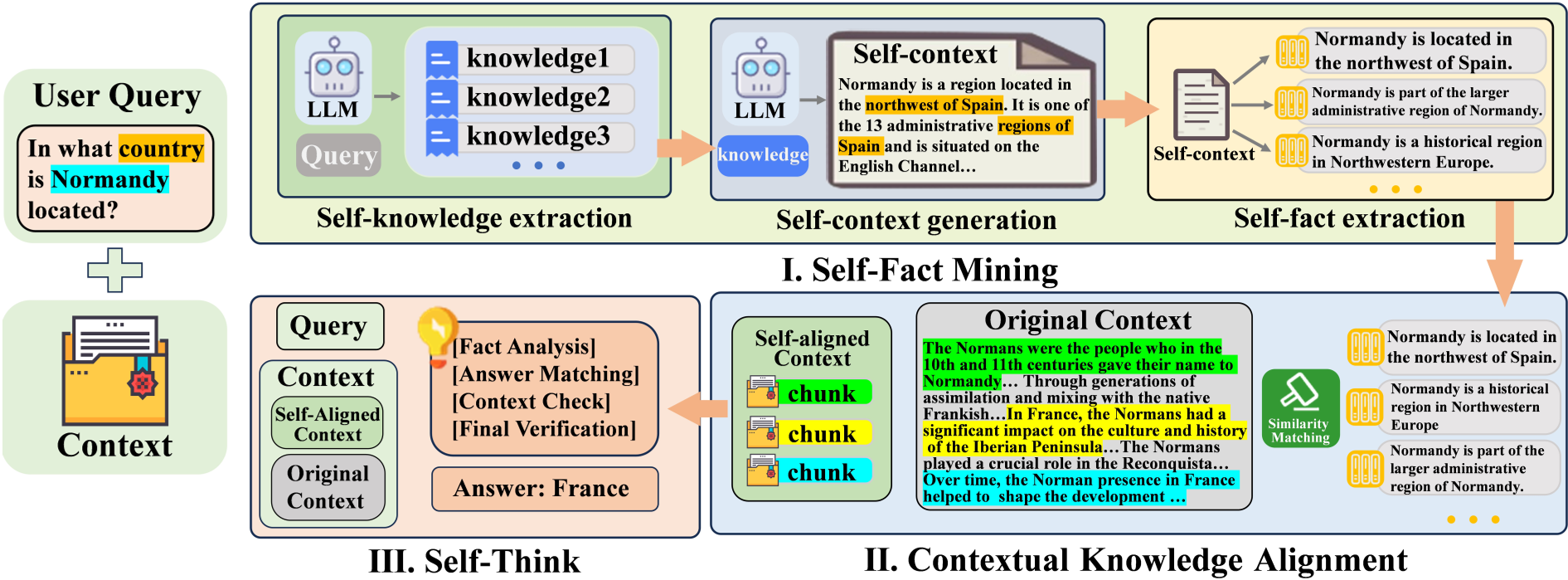 Figure 2: The FaithfulRAG workflow, transitioning from fact mining to alignment and finally to a self-thinking reasoning process.
Experimental Results: Precision over Suppression
The results across FaithEval, MuSiQue, and SQuAD were remarkable. Unlike common RAG baselines that break down when the "Moon is made of marshmallows" (counterfactual scenarios), FaithfulRAG remains robust.
- Accuracy Boost: Achieved 86.3% on SQuAD, a +9.3% increase over ChatQA-2.0.
- Error Balanced: It is the only model that significantly reduced both Case 1 (ignoring context) and Case 2 (misinterpreting context) errors.
| Model | MuSiQue (Acc) | SQuAD (Acc) |
|---|---|---|
| Llama 3.1 (Origin) | 67.8 | 69.5 |
| CAD (Decoding-based) | 72.6 | 71.2 |
| FaithfulRAG (Ours) | 79.9 | 86.3 |
Ablation Insight
The authors found that removing the "Think" stage caused performance to plummet. Using a "Naive Chain-of-Thought" (just asking the model to "think step by step") actually hurt performance in conflict scenarios because the model grew "distrustful" of the context. The specific Conflict-Aware Reasoning in FaithfulRAG is the "secret sauce."
The Takeaway for AI Engineers
FaithfulRAG proves that "forcing" faithfulness via prompts like "Only use the provided context" is a brittle strategy. For high-stakes RAG (medical, legal, financial), we should be building pipelines that allow the model to externalize its prior knowledge and explicitly audit the delta between its memory and the retrieved facts.
As we move toward more autonomous "Agentic RAG," this transition from passive retriever to critical reasoner will be essential.
Technical Keywords: Retrieval-Augmented Generation (RAG), Knowledge Conflict, Fact-level Alignment, Self-Think, Parametric Knowledge.