
Spotting Fake News: A Social Argumentation Framework for Scrutinizing Alternative Facts
Spotting Fake News: A Social Argumentation Framework for Scrutinizing Alternative Facts
This paper introduces a social argumentation framework designed to verify "alternative facts" and combat fake news. It utilizes a graph-theoretic approach to model arguments as networks of claims, evidence, and sources, leveraging crowdsourced participation mediated by expert moderators.
TL;DR
Instead of relying solely on automated "black-box" AI to flag hoaxes, this research proposes a social argumentation framework that uses graph theory and crowdsourcing to verify the validity of claims. By modeling arguments as networks of evidence and sources, and involving a community of experts and users, the system fosters critical thinking while systematically debunking "alternative facts."
Problem & Motivation: The Limits of Automated Detection
The digital landscape is currently flooded with "alternative facts" that spread rapidly through social networks. Conventional computational approaches usually fall into three camps:
- Blacklist tools: Flagging known hoaxes.
- NLP Classifiers: Detecting linguistic patterns associated with fake news.
- Propagation Tracking: Monitoring how misinformation goes viral.
The Gap: None of these methods address the semantic verification of the content itself. They tell you that something is likely fake, but they don't help people understand why using evidence-based reasoning. The author argues that we need a system that mimics human critical thinking—identifying conclusions, premises, and the quality of evidence—to truly inoculate society against propaganda.
Methodology: The Power of Graph Theory
The core of this work is the translation of human debate into a formal Graph-Theoretic Framework.
1. The Argument Anatomy
The system breaks down an argument into three atomic components:
- Claims: Inferences or conclusions.
- Evidence (Premises): Specific data points that support or refute a claim.
- Sources: The origins of information (e.g., web documents, government sites), enriched with metadata for provenance.
2. The Mathematical Model
The argument is represented as a graph :
- Vertices (): Contain the semantic content and attribute dimensions like "authority" and "trust."
- Edges (): Represent the relationship between nodes, identifying them as "pro" or "con" with associated weights.
- Stances: A "Stance" is effectively a sub-graph or a specific path traversal through the larger argument tree, representing a particular viewpoint backed by specific evidence.
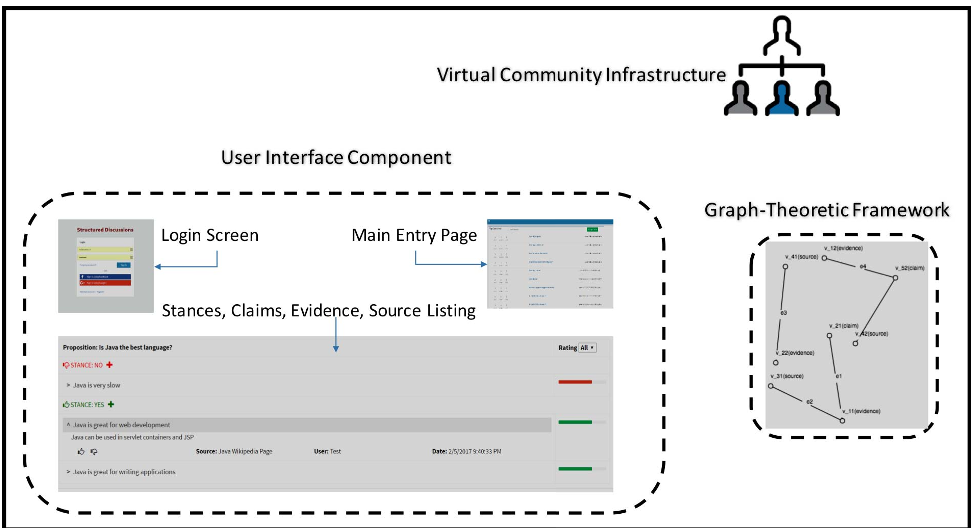 Fig 1: The architecture bridging the user interface, the graph-theoretic engine, and the virtual community.
Experiments & Results: Crowdsourcing Truth
The author implemented this as a web-based application (C#, ASP.NET, SQL) that enables a virtual community to interact.
Virtual Community Roles
To ensure quality, the system defines a five-pronged constituency:
- Questioners: Users seeking information.
- Contributors/Responders: Users providing evidence nodes.
- Experts: Verified individuals providing high-authority nodes.
- Moderators: Overseeing the flow and ensuring quality assurance.
Case Study: "Alternative Facts"
The system was tested on the very term "alternative facts" (coined in 2017). By mapping out the claims made by public figures versus legal definitions, the graph visualized the divergence in meaning and the lack of evidentiary support for claims regarding inauguration attendance numbers.
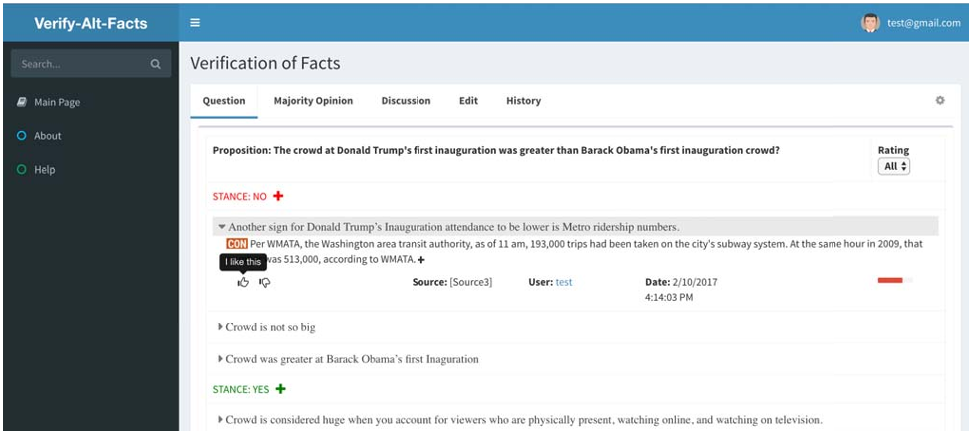 Fig 2: The interface allows users to see conflicting stances side-by-side, each supported by specific source ratings.
Critical Analysis & Conclusion
Takeaway
The real value of this framework is its transparency. Rather than being told what to believe by an algorithm, users can see the "provenance" of a claim—where it came from, who supports it, and what counter-evidence exists. This turns fact-checking into a collaborative learning process.
Limitations
- Scalability: Crowdsourced argumentation is slower than automated NLP.
- Moderation Burden: The system relies heavily on "expert moderators," who may become a bottleneck or introduce their own biases.
- Incentives: How do you keep high-quality experts engaged in a social network?
Future Outlook
As we move into an era of AI-generated misinformation, hybrid systems that combine this structured argumentation with automated reasoning will be essential. This framework provides the "scaffolding" that could allow human experts and AI agents to work together to map out the truth in real-time.