
Decoding the Gaze: What Eye-Tracking Reveals About Our Fake News Habits
Fake News Reading on Social Media: An Eye-tracking Study
This paper presents the first eye-tracking study investigating how users consume and evaluate fake news within a social media feed environment. By analyzing the gaze data of 44 participants, the authors establish a behavioral baseline for misinformation interaction and release a public dataset for the research community.
TL;DR
Why do we fall for fake news? This eye-tracking study of 44 social media users reveals a critical behavioral gap: successful "fact-checkers" ignore the flashy headlines in the feed and dive into the full text, while susceptible users get "trapped" by superficial feed elements. The researchers have provided a blueprint for understanding the human side of misinformation, moving beyond simple algorithms to behavioral psychology.
Background: The Human Bottleneck
Despite the rise of sophisticated AI detectors, fake news continues to spread. Most research focuses on what constitutes fake news, but few look at how we actually consume it. We know that "echo chambers" exist, but we don't know the exact second a user decides to trust a lie. This study fills that "blank spot" using eye-tracking to monitor every fixation and saccade during news consumption.
The "Two-Pass" Methodology
The researchers created a controlled, Facebook-like environment and divided the user experience into two distinct psychological states:
- The Consumption Phase: Casual "checking out" of the feed.
- The Evaluation Phase: Explicitly judging if a story is "Certainly True" or "Certainly False."
By capturing gaze data in both states, they could see how our "filters" change when we are actively looking for the truth versus when we are just killing time.
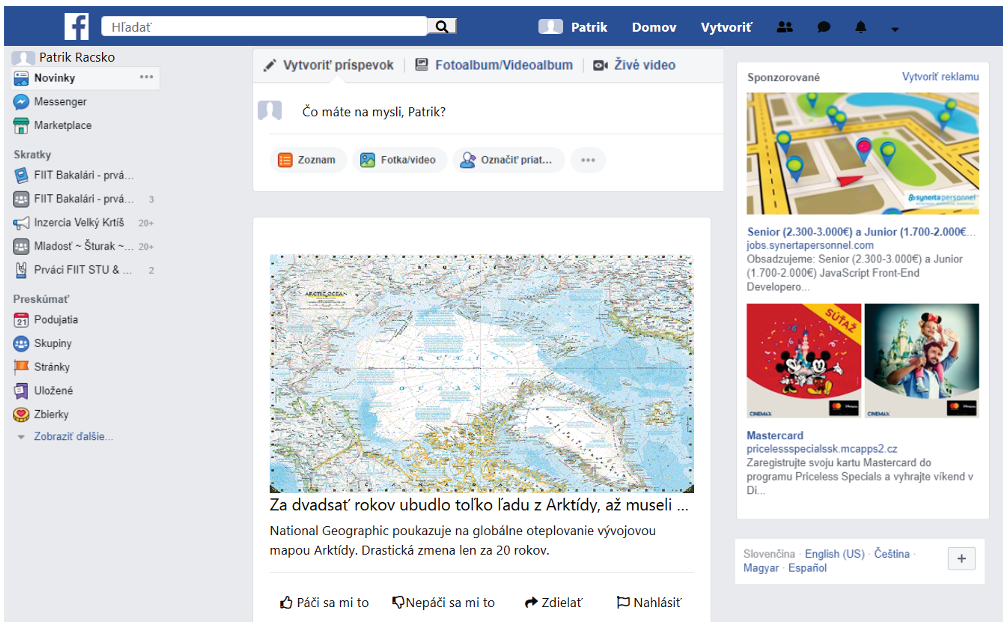 Figure 1: The experimental interface mimicking a social media feed with Area of Interest (AOI) definitions.
Key Insights: The Anatomy of a Successful Fact-Checker
The study’s most striking finding lies in the difference between "successful" and "unsuccessful" participants.
- The Exposure Trap: Less successful users relied heavily on the information presented in the social media feed (the image, the title, the snippet). They spent significantly more time (2.9s per post) lingering on these superficial elements.
- The Deep Dive: Successful participants were faster to dismiss the feed. They spent only 2s on the heading before deciding to either ignore the post or click through to the full article.
- Interest vs. Duty: In casual mode, we only read what we like. However, when asked to verify facts, users "switched on" their critical thinking and read deeply even in topics they previously claimed to be uninterested in.
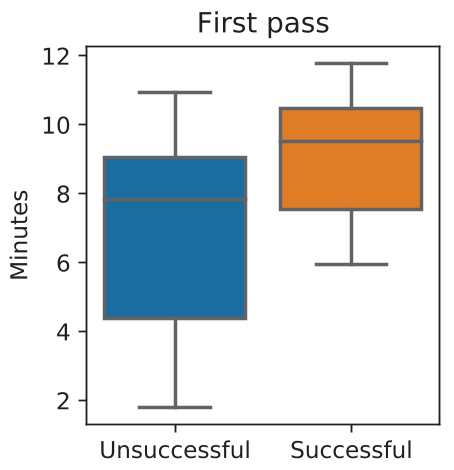 Figure 2: Gaze duration comparison showing that unsuccessful participants (Group B) spent more time stuck on feed-level information.
Why Does This Matter?
The results suggest that feed design is the enemy of truth. Social media feeds are optimized for "dwell time"—exactly what this study shows leads to poorer veracity judgments.
If we want to fight misinformation, we shouldn't just flag "fake" posts; we need to change how users interact with them. Encouraging users to "read the full story" isn't just a polite suggestion—it is the primary behavioral trait of people who aren't easily fooled.
Critical Analysis & Future Work
While the study is a breakthrough in behavioral data, it has its limits. The participants were all high school students, a group naturally more susceptible to digital influence but potentially more tech-savvy than older generations.
The next frontier? Expert verification. By eye-tracking professional fact-checkers and journalists, we can create a "gold standard" of reading behavior that can be used to train AI to detect deceitful content the same way a human expert does.
Takeaway: Stop reading just the headlines. Your eyes—and your ability to spot a lie—depend on the "Deep Dive."