
Beyond the Message: Detecting Fake News via Inductive Trust Mapping
Detecting Fake News Spreaders in Social Networks using Inductive Representation Learning
The paper introduces a Graph Neural Network (GNN) framework for detecting fake news spreaders by combining the Community Health Assessment (CHA) model with inductive representation learning (GraphSAGE). It specifically targets nodes within densely connected communities—categorized as neighbor, boundary, and core nodes—to predict their likelihood of "infection" by false information, achieving over 90% accuracy on real-world Twitter data.
TL;DR
Researchers from the University of Minnesota have shifted the focus of fake news detection from what is being said to who is likely to spread it. By applying an inductive Graph Neural Network (GNN) framework to social network topologies, they can predict potential spreaders with over 90% accuracy. The core discovery? Trust—specifically "Interpersonal Trust"—is a far more reliable indicator of fake news dissemination than the news content itself.
Context: Why Content-Based Detection is Failing
Traditional fake news filters act like spell-checkers: they analyze text for linguistic patterns or factual inconsistencies. However, misinformation is evolving to be "plausibly true." When content is difficult to debunk at a glance, users default to a social heuristic: Trust. If you trust the sender, you are exponentially more likely to retweet without verification.
This paper treats fake news as a "social infection" within a community. To stop the spread, we shouldn't just look at the virus (the content), but rather the "health" and connectivity of the population (the network).
Methodology: The Community Health Assessment (CHA) Model
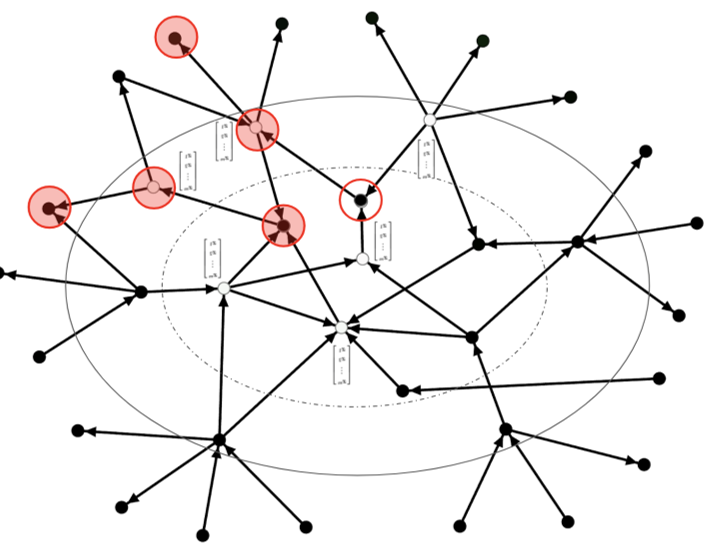
The authors utilize a "Community Health Assessment" model to categorize nodes based on their position relative to a community structure:
- Neighbor Nodes (): External nodes connected to the community.
- Boundary Nodes (): The entry points; community members connected to neighbors.
- Core Nodes (): Internal members connected only to other insiders.
Trust as a Weighted Edge
The model calculates two primary metrics for every user:
- Trustingness (): The propensity of a user to believe others.
- Trustworthiness (): The propensity of others to believe that user.
By combining these, they derive a Believability () score for every edge. This effectively transforms a flat social graph into a "Trust Map," where edges represent the ease with which information (or "infection") can flow.
The Inductive Advantage
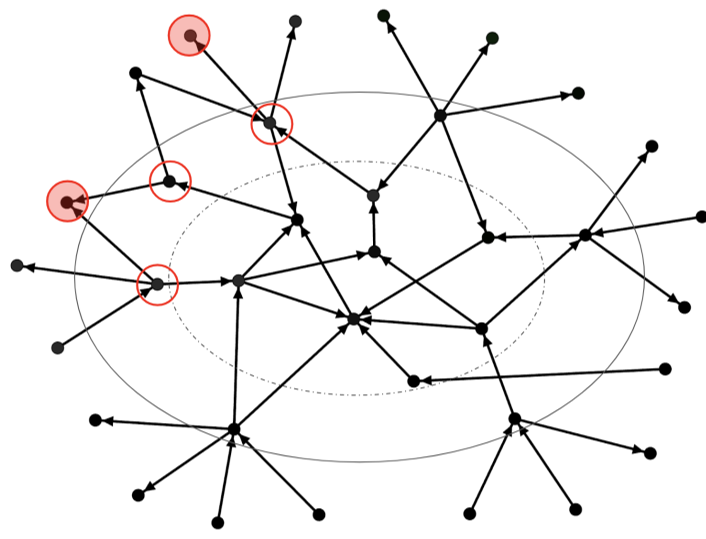
Standard GNNs are often transductive, meaning they need the entire graph to be static to learn. But social media is chaotic and fast-evolving. The authors employ an Inductive Representation Learning approach (inspired by GraphSAGE).
Instead of learning fixed embeddings for specific users, the model learns an Aggregator Function. This function looks at the "Trust" features of a node's neighbors and calculates a spreader-likelihood score on the fly. This allows the system to evaluate a user it has never seen before, provided it can see who that user follows and interacts with.
Experimental Analysis: Topology vs. Activity
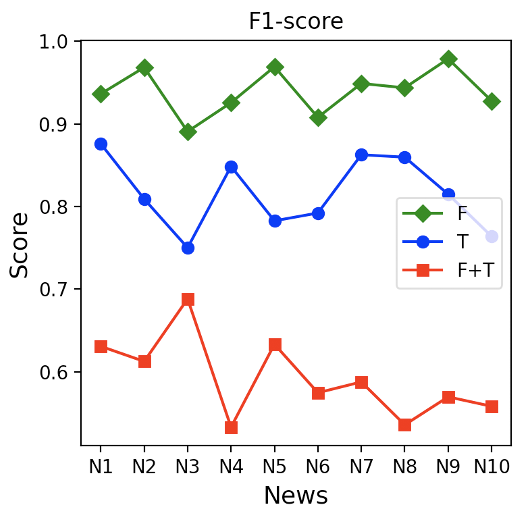
The researchers tested various configurations, comparing Topology-based trust (derived from the follower graph) against Activity-based trust (derived from retweet counts and timelines).
| Model | Accuracy (F) | Precision (F) | F1 Score (F) |
|---|---|---|---|
| GCN (Transductive) | 83.9% | 0.887 | 0.832 |
| (Proposed) | 93.7% | 0.918 | 0.939 |
Key Insights from the Data
- Topology Wins: Social structure (who you follow) provides a much cleaner signal than user activity (what you do). Many users are inactive or have private profiles, making activity data "noisy" and incomplete.
- Fake News vs. True News: The model was significantly more accurate at identifying spreaders of false information than true information. This reveals a fundamental social truth: we share true news because of the content, but we share fake news because of the source.
- Boundary Vulnerability: Identifying spreaders at the "Boundary" of a community is the most effective way to prevent a community-wide "outbreak."
Critical Insight & Future Outlook
This work highlights the "Uber-Spreader" phenomenon—individuals who may not have ill intentions but are highly trusted and non-discerning. By focusing the GNN on these nodes, social platforms can implement more surgical mitigation strategies, such as "quarantining" or shadow-banning specific high-risk connections during a breaking news event, rather than resorting to broad censorship.
Limitations: The model currently struggles with "Core" nodes due to the smaller sample size of internal spreaders. Furthermore, the increasing presence of sophisticated social bots designed to mimic trust dynamics remains a hurdle for future versions of this framework.
Conclusion
By moving the battleground from "Content Verification" to "Node Representation Learning," this paper provides a scalable, real-time solution for fake news mitigation. It proves that in the age of misinformation, your position in the network—and whom you choose to trust—is your most defining feature.