
Fake Reviews Tell No Tales? Dissecting the Shadows of Click Farming in CGSNs
Fake reviews tell no tales? dissecting click farming in content-generated social networks
This paper presents a robust three-phase methodology to detect "click farming" in Content-Generated Social Networks (CGSNs) like Dianping and TripAdvisor. The authors leverage a novel collusion-based social graph and community detection (Louvain method) followed by supervised classification to identify clusters of malicious accounts, achieving up to 96.74% precision.
TL;DR
In the digital reputation economy, "Click Farming" has become a sophisticated weapon used to manipulate store rankings. This research by Shanghai Jiao Tong University and NYU Shanghai introduces a novel detection framework that moves beyond individual account analysis. By constructing collusion networks and using community detection, the authors identified thousands of fake review clusters with over 94% precision across global platforms like Dianping and TripAdvisor.
The Shift from Social Bots to Collusion Groups
In traditional social networks like Facebook or Twitter, bots are often identified by their "attack edges"—the way they follow or message real users. However, in Content-Generated Social Networks (CGSNs) like Yelp or TripAdvisor, users rarely follow each other. Instead, they interact with entities (stores, restaurants).
The current challenge is that click farmers no longer work in isolation. They act as "collusion groups," synchronizing their activities to boost a specific target. Previous metrics like Jaccard similarity often fail to capture this because they don't account for the temporal "burstiness" and the specific polarities (1-star vs 5-star) essential to click farming.
Methodology: Mapping the Collusion Graph
The authors' approach is structured into three surgical phases:
- Defining the Collusion Relation: Instead of standard similarity, the authors propose Algorithm 1, which flags two users as "similar" only if they post reviews for the same store, with the same extreme rating, within a strict time window ().
- Community Detection: Using the Louvain Method, the system clusters these relations to find "dense pockets" of users who frequently act in lockstep.
- Supervised Classification: Not all clusters are malicious (e.g., a group of local foodies might visit the same popular spots). The authors use a Support Vector Machine (SVM) equipped with 8 features, including entropy of reviews and global clustering coefficients, to filter out real-world communities.
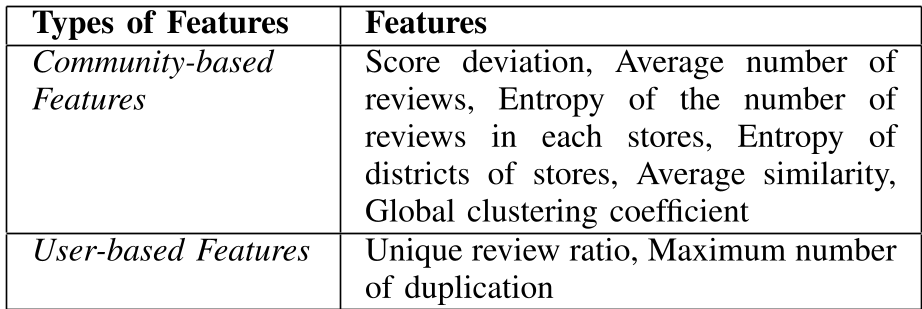 Table 1: Features used to distinguish malicious communities from real users.
Key Insights: The Anatomy of a Click Farmer
1. The Expert Illusion
One might assume click farmers use "Elite" or high-level accounts to appear credible. The data suggests otherwise. On both Dianping and TripAdvisor, click farmers predominantly hold low-level accounts (0-1 stars). Why? Because the cost of registering new accounts is lower than the cost of maintaining "expert" status, and sheer volume often outweighs individual account authority in many ranking algorithms.
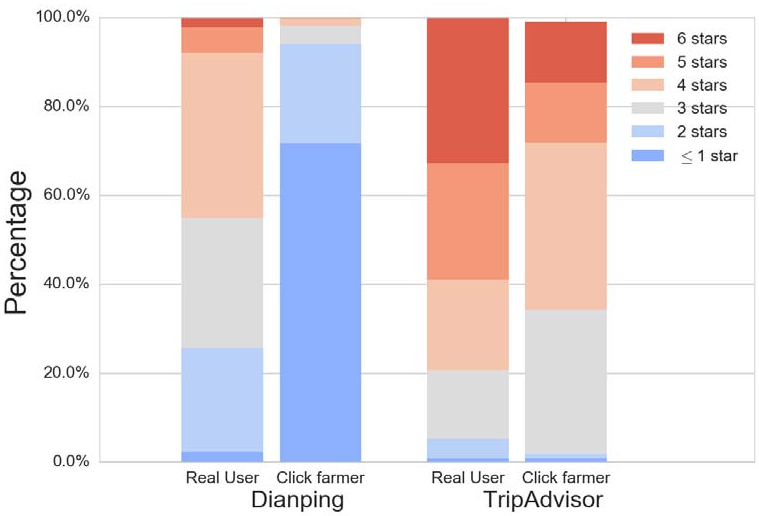 Fig 1: Click farmers (blue) are significantly more likely to be low-ranked "rookie" accounts compared to the normal distribution of real users.
2. High Ranks, High Risk
The most striking revelation is the correlation between store ranking and fake review density. The research found that highly-ranked stores tend to have a greater portion of fake reviews. However, for the "Top 200" ultra-elite stores, the percentage dips—likely because a massive volume of genuine organic reviews eventually dilutes the "fake" signals.
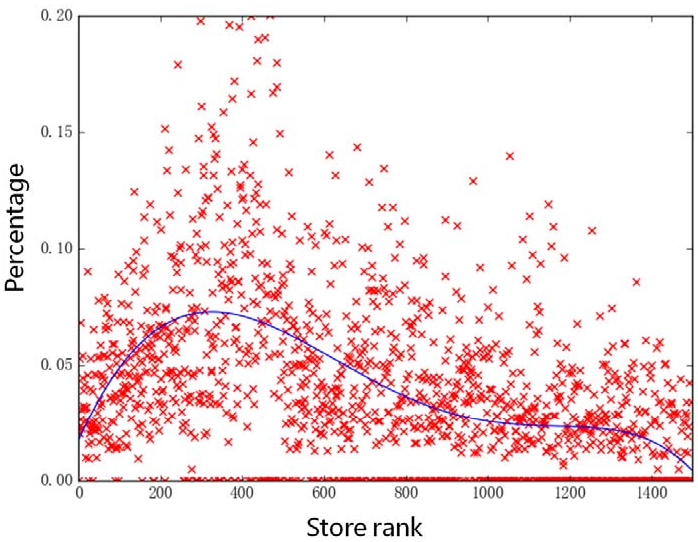 Fig 4: The red dots represent stores; notice the climb in the portion of fake reviews as store rank increases.
Critical Analysis & Future Outlook
This work demonstrates that topology matters more than individual behavior. By looking at how users "cluster" in their actions over time, the authors provide a scalable way to clean up review platforms.
Limitations:
- Adaptive Attackers: As detection methods focus on "lockstep behavior," sophisticated click farmers may begin to inject artificial delays or "noise reviews" to lower their similarity scores.
- Platform Differences: The lower precision on TripAdvisor suggests that smaller datasets or different platform mechanics (like easier level-ups) might require recalibrated features.
Takeaway: For platform architects, the "social" in CGSNs is a double-edged sword. While it builds trust, it also provides the structural framework for collusion. The future of fraud detection lies in real-time community monitoring rather than static account blacklisting.