
Fakesbook: Visualizing the Invisible Risks of Social Media
Fakesbook: A social networking platform for teaching security and privacy concepts to secondary school students
The paper introduces Fakesbook, a simulated social networking platform and curriculum tailored for secondary school students. It leverages interactive graph visualizations using D3.js to demonstrate the real-time spread of data based on privacy settings and "friend" connections.
TL;DR
Researchers from Cal Poly developed "Fakesbook," a sandbox social network that reveals how data flows through digital connections. By visualizing a student's "friend graph" and allowing them to try and "hack" their peers' information, the tool successfully increased privacy awareness among 86% of secondary school participants.
Context: The Privacy Literacy Gap
As social media consumption becomes nearly universal among teenagers, a dangerous gap has widened between their usage frequency and their understanding of data security. Traditional cybersecurity education often relies on dry lectures or complex technical tools that don't resonate with middle or high school students. Fakesbook aims to bridge this gap by letting students see "behind the curtain" of how data access is programmatically controlled.
Problem & Motivation: Why Kids Don't Care (Yet)
Most students view privacy settings as a checklist rather than a dynamic defense mechanism. Prior works in cybersecurity education often focused on information-dense visualizations (like cryptography or network security) that are too complex for non-experts. The authors' insight was that visibility is the precursor to agency: if a student can see their data flowing to a stranger through a "friend-of-a-friend" link, they are far more likely to change their behavior.
Methodology: The Core Mechanism
Fakesbook isn't just a clone of a social media site; it is a live laboratory. The system architecture utilizes a Python/Flask backend and an SQLite database, but the "magic" happens in the frontend.
1. Graph Visualization (The "Aha!" Moment)
Using D3.js, the platform renders every student in the classroom as a node. When a student adds a friend, an edge is drawn. The architecture ensures that changing a privacy setting (from "Friends" to "Everyone") provides immediate, color-coded visual feedback on the graph.
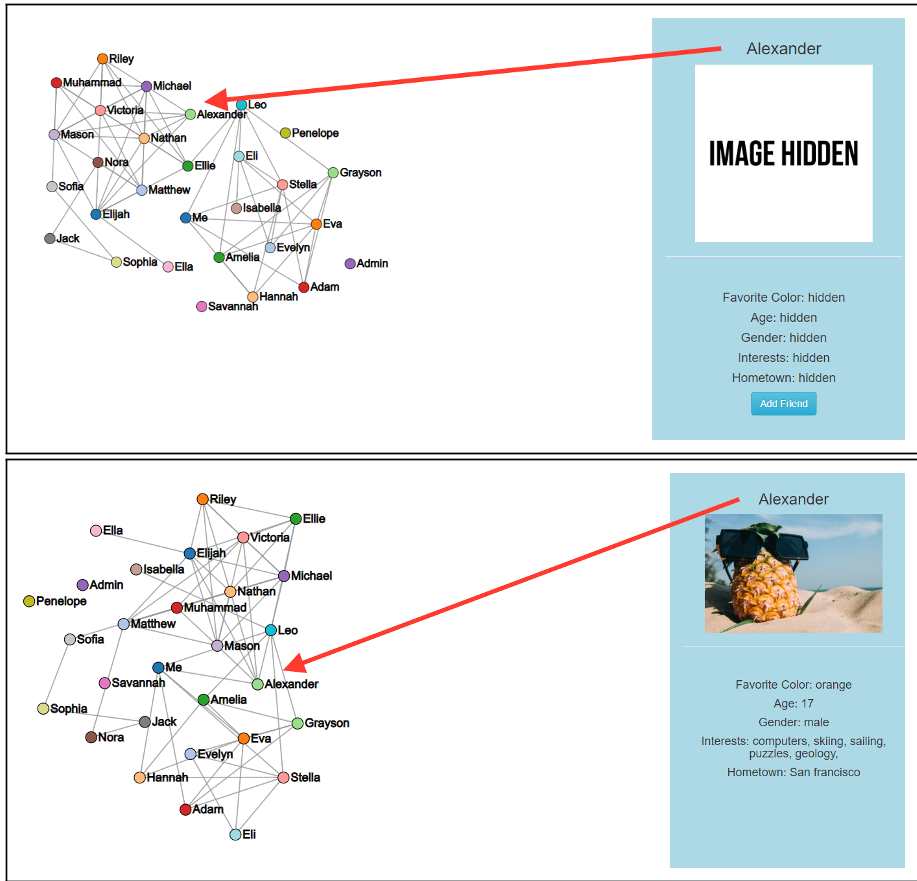 Figure 1: Visualizing how "friending" unlocks data access. Top: Unknown user profile. Bottom: Profile after establishing a connection.
2. Adversarial Analysis
The curriculum goes beyond clicking buttons. After building a "guided" social network, students are tasked with adversarial mining. They are challenged to act as "marketers" or "identity thieves" to find out things like hometowns or interests of students in other groups. This shift in perspective—from victim to predator—solidifies their understanding of how easily data can be exploited.
 Figure 2: The Fakesbook privacy settings panel where users adjust visibility thresholds.
Experiments & Results: Evidence of Impact
The platform was deployed at the EPIC (Engineering Possibilities in College) camps. The results were quantifiable:
- Increased Importance: Before the lab, the average importance of online privacy was rated at 4.22/5. After the lab, it jumped to 4.57/5.
- Visual Efficacy: 86% of students credited the graph visualization with helping them think deeply about computer security.
- Engagement: Roughly 80% of voluntary comments were overwhelmingly positive, with many students citing the "adversarial mining" as their favorite part of the experience.
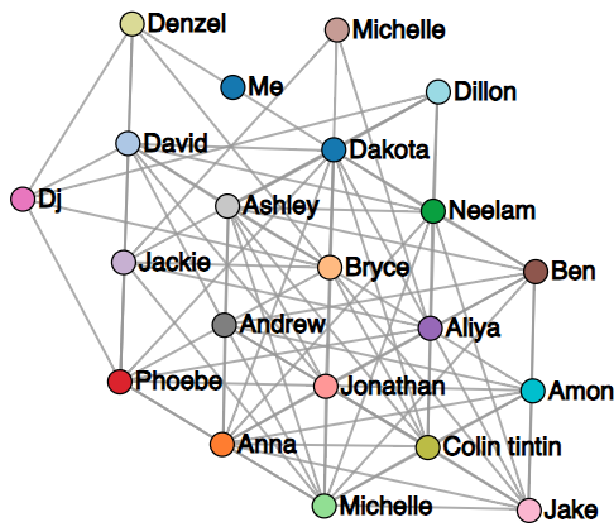 Figure 3: An organically generated Fakesbook graph showing the messy reality of social connectivity.
Critical Analysis & Conclusion
Takeaway
Fakesbook proves that graph theory isn't just for math class; it is a vital tool for digital literacy. By visualizing the "hidden" edges of social networks, students gain an intuitive grasp of how data propagates.
Limitations & Future Work
The current version relies heavily on instructor guidance to prevent "limitless friending" (where everyone adds everyone), which can make the visualization a confusing "hairball" of nodes. Future updates plan to include embedded assessments—where the software asks students to predict the impact of a setting change—allowing for more self-guided exploration.
Ultimately, Fakesbook serves as a blueprint for how we can teach modern privacy: not through fear, but through the empowerment of understanding the underlying system.