
FallDS-IoT: Bridging the Gap Between Wearable Sensors and Elderly Safety
FallDS-IoT: A Fall Detection System for Elderly Healthcare Based on IoT Data Analytics
The paper introduces FallDS-IoT, a wearable fall detection system for elderly healthcare that utilizes MPU6050 (Accelerometer and Gyroscope) sensors integrated with Arduino and Python. By applying machine learning to a custom dataset of 20,000 instances, it achieves a high-precision classification of daily activities, reaching a SOTA-level accuracy of 98.75% using the K-Nearest Neighbors (K-NN) algorithm.
TL;DR
Falls represent a critical risk to the elderly, often occurring when no help is immediately available. FallDS-IoT is a specialized wearable framework that uses dual-sensor data (Accelerometer + Gyroscope) and the K-Nearest Neighbors (K-NN) algorithm to detect falls with an impressive 98.75% accuracy. Unlike manual emergency buttons, this system automatically triggers an SMS alert to family members or hospitals the moment a fall is detected.
The "Golden Hour" Problem in Geriatric Care
In elderly healthcare, the time elapsed between a fall and the arrival of medical assistance—often called the "golden hour"—is the most significant predictor of recovery. Prior works have relied on smartphones or stationary cameras, but these have inherent flaws:
- User Friction: Elderly users often forget to carry phones or find touchscreens inaccessible during a crisis.
- Privacy Concerns: Camera-based systems are intrusive in bedrooms or bathrooms where falls frequently occur.
- Computational Cost: Many SOTA models are too heavy for low-power IoT devices.
The authors' intuition was to build a low-cost, privacy-preserving wearable that treats motion data as a pure classification problem, focusing on the physical signatures of a fall versus "normal" activities like sitting or sleeping.
Methodology: From Raw Motion to Intelligent Classification
The system architecture follows a classic IoT-to-Analytics pipeline: Data Gathering → Preprocessing → Training → Classification → Alerting.
1. Hardware & Data Fusion
The core hardware is the MPU6050, which houses both a 3-axis accelerometer and a gyroscope. To ensure the system is "orientation agnostic" (meaning it works no matter how the sensor is tilted on the body), the authors calculate the magnitude for both acceleration () and gyroscope () using the Euclidean norm:
2. Architecture & Workflow
The data is stored in MongoDB as JSON documents before being processed in Python. The system differentiates between four distinct states: Sleeping, Sitting, Walking, and Falling.
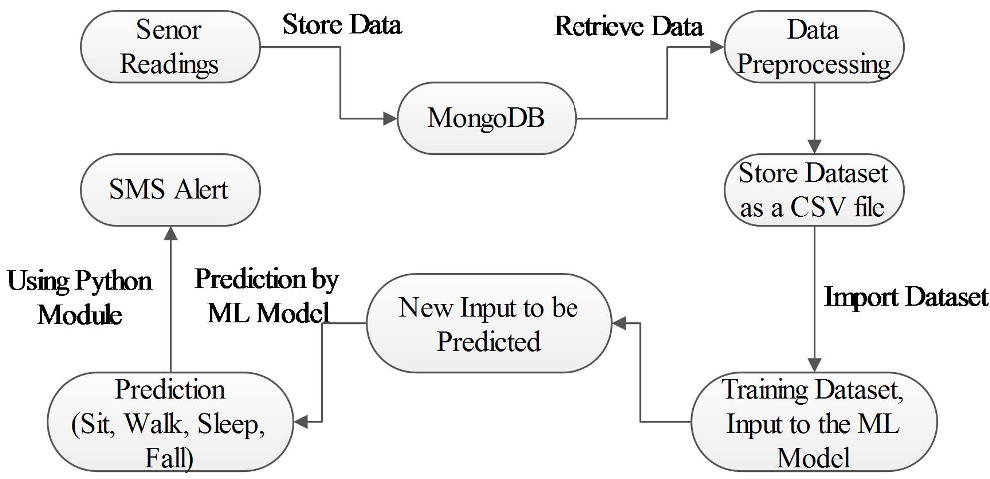 Fig 1. The FallDS-IoT pipeline from sensor collection to Python-based alerting.
Why K-NN Wins
The paper compares two major supervised learning algorithms: K-Nearest Neighbors (K-NN) and Decision Trees.
While Decision Trees are excellent for rule-based logic, they often struggle with the noisy, overlapping boundaries found in high-frequency sensor data. K-NN, a "lazy learner," excels here by mapping the unknown observation to the closest cluster of known behaviors in the feature space.
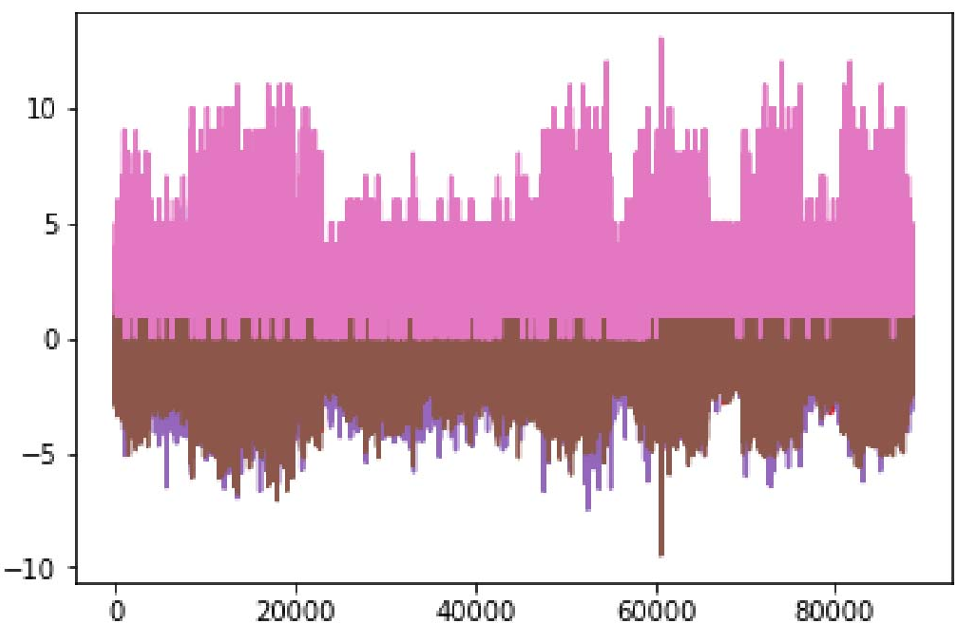 Fig 2. The raw 3-axis readings from the Accelerometer and Gyroscope during activity transitions.
Experimental Performance
Using a dataset of 20,000 instances, the results were definitive:
- K-NN: 98.75% Accuracy
- Decision Tree: 90.59% Accuracy
As shown in the table below, K-NN maintained near-perfect Precision and Recall across all classes. Notably, it successfully distinguished "Fall" events (Labels 4 & 5) from "Walking" (Label 2) with almost no confusion, which is the primary challenge in wearable fall detection.
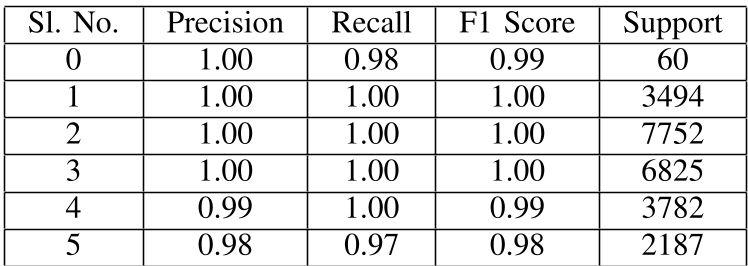 Table 1. K-NN Classification Report showing consistent high performance across all activity labels.
Critical Insight & Conclusion
The success of FallDS-IoT demonstrates that for specific, localized IoT tasks, complex neural networks are not always the answer. By focusing on high-quality data collection and feature engineering (magnitude calculation), the authors achieved SOTA results with a computationally lightweight K-NN model.
Future Work: The authors aim to expand the dataset to include more complex "fall-like" maneuvers (e.g., sitting down quickly) to further reduce false alarms and explore edge-side deployment where the classification happens directly on the microcontroller.