
Propagation Matters: Decoding False Rumors on Sina Weibo via Graph Kernels
False rumors detection on Sina Weibo by propagation structures
This paper introduces a graph-kernel-based hybrid SVM classifier for detecting false rumors on Sina Weibo. By modeling message propagation as labeled trees and utilizing a modified random walk graph kernel, the method achieves a state-of-the-art accuracy of 91.3%.
Executive Summary
TL;DR: Researchers from Shanghai Jiao Tong University have developed a sophisticated "Hybrid SVM" classifier that identifies false rumors on Sina Weibo with 91.3% accuracy. Unlike previous methods that only look at a message's text, this approach treats the propagation structure—the "who" and "how" of reposting—as a primary high-order feature.
Background Positioning: This work represents a significant leap from simple feature engineering to structural pattern recognition. It moves the field of rumor detection from basic NLP toward a holistic analysis of social network dynamics, setting a benchmark for early-stage intervention (detecting rumors within 24 hours).
The Core Deficit of Content-Based Detection
Detecting a rumor is notoriously difficult because false rumors often mimic the "authority" of true news. A rumor about a toxic beetle and a factual warning about the same beetle might use identical keywords: venom, doctor, skin, danger.
Traditional flat-feature models (Natural Language Processing) struggle here. The authors argue that the difference lies in the response:
- False Rumors: Often initiated by normal users, then "hyped" by multiple opinion leaders to create forced virality.
- Normal News: Typically originates from an opinion leader (e.g., official news account) and spreads organically to normal users.
Methodology: The Labeled Propagation Tree
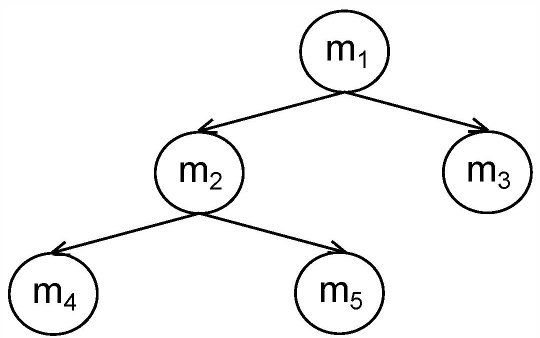
The researchers model each message thread as a Propagation Tree. To make this mathematically tractable for an SVM, they introduced two clever innovations:
1. Structural Enrichment & Simplification
Nodes are labeled as p (opinion leaders) or n (normal users). Edges are labeled with a triple representing (Approval, Doubt, Sentiment). To prevent the graph from becoming computationally explosive (popular posts have thousands of reposts), they "lump" adjacent normal users into super-nodes.
2. The Random Walk Graph Kernel
Instead of just counting reposts, the authors use a Random Walk Graph Kernel. The intuition is: If we take a random walk through the propagation paths of Tree A and Tree B, how similar are the sequences of users and sentiments we encounter?
By calculating the similarity of these walks, the model captures "high-order" patterns—like the specific way a rumor "explodes" through a cluster of suspicious accounts—that a human or a simple word-counter would miss.
Experimental Results: Winning the Race Against Time
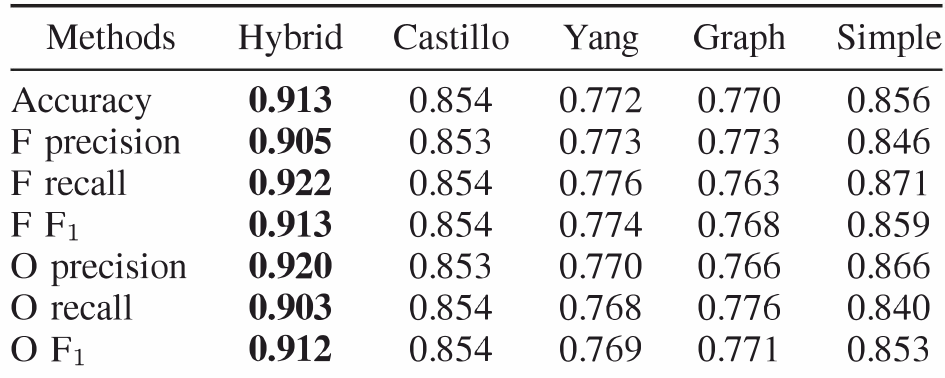
The authors tested their hybrid model against a massive dataset of 2,601 false rumors and 2,536 normal messages from Sina Weibo.
Performance Comparison
The Hybrid model (Graph Kernel + RBF) significantly outperformed the baselines established by Castillo (Twitter) and Yang (Weibo).
The "Early Detection" Holy Grail
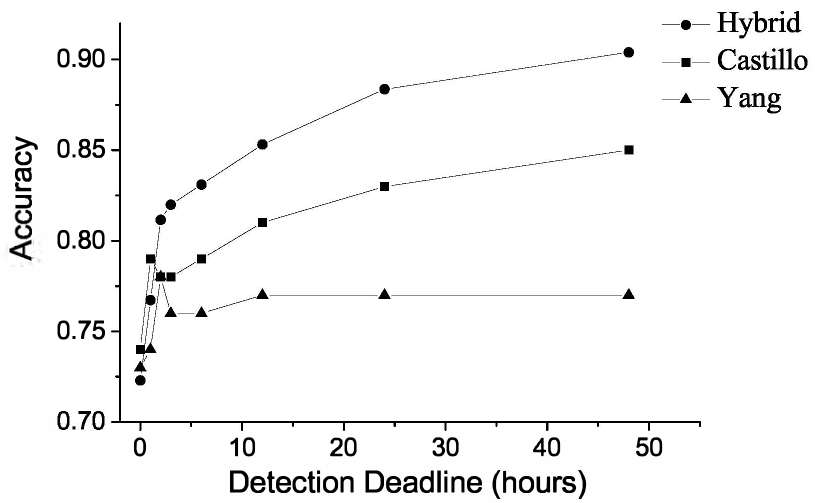
The most impressive feat is Early Detection. A rumor detection system is useless if it only works after the damage is done (e.g., after 10,000 reposts). This model achieves 88% accuracy within just 24 hours of the initial post.
Critical Insights & Takeaways
The success of this paper hinges on the observation that rumors have a distinct "social fingerprint." Even if the text is perfectly crafted to sound like news, the collective reaction of the network—expressed through doubt scores and specific propagation topologies—betrays the falsehood.
Limitations:
- Graph Complexity: Even with simplification, graph kernels are computationally more expensive than flat vectors.
- Platform Specificity: While applicable to Twitter, the "Opinion Leader" thresholds might need recalibration for different social ecosystems.
The Future: As we enter an era of AI-generated misinformation, looking at the source and structure (the Immutable Social Context) may be the only way to safeguard the truth.