
Familiar Strangers in the Digital Age: Bridging the Virtual and Physical Worlds
Familiar strangers detection in online social networks
The paper introduces a framework for detecting "Familiar Strangers" (FS)—individuals who share spatial and temporal patterns but lack direct interaction—within Online Social Networks (OSNs). By combining geo-location data and content-based interest similarity, the authors successfully transposed Stanley Milgram's sociological concept into the digital sphere using Twitter data.
TL;DR
This research transposes Stanley Milgram's 1972 sociological concept of the "Familiar Stranger"—people we see every day but never talk to—into the realm of Online Social Networks (OSNs). By analyzing geolocated Twitter data and user interests, the authors provide a mathematical framework to identify potential social ties that exist in physical space but remain unrecognized in the digital world.
Background Positioning: This paper is a foundational bridge-building effort, moving from traditional physical-only sociology to "cyber-physical" social network analysis using open-source mobile data.
Problem & Motivation
In the physical world, we are surrounded by Familiar Strangers: the person at your usual bus stop or the regular at your local coffee shop. These individuals are not "friends," yet they are not "total strangers" either. Milgram noted they represent a unique social buffer.
The challenge in the digital era is that while we are more connected than ever, our "virtual" social graphs (Layer II) often fail to reflect our "physical" proximity (Layer I). Prior attempts to bridge this gap required participants to wear Bluetooth beacons or sensors. The authors ask: Can we detect these nuanced social relationships using only the public metadata generated by our smartphones?
Methodology: The Multi-Dimensional Model
The authors argue that "Familiarity" is not just being in the same place; it is a combination of Geography, Time, and Identity.
1. The Three-Layer Framework
- Layer I (Spatio-Temporal): Tracking the longitude, latitude, and timestamps of user activities.
- Layer II (Social Graph): Defining "Strangers" as nodes with no mutual "following" or "friendship" links.
- Layer III (Content): Analyzing hashtags and keywords to determine if the users share interests.
2. The Core Innovation: Regularity Over Frequency
Simple frequency (how many times you met) can be misleading. Two people might spend 5 hours together at a one-time conference—this makes them "acquaintances," not "familiar strangers." The authors introduce Definition 7: Compliance Ideal, which measures the regularity of encounters. If the gap between meetings exceeds an "ideal" period (e.g., one day), it penalizes the familiarity score.
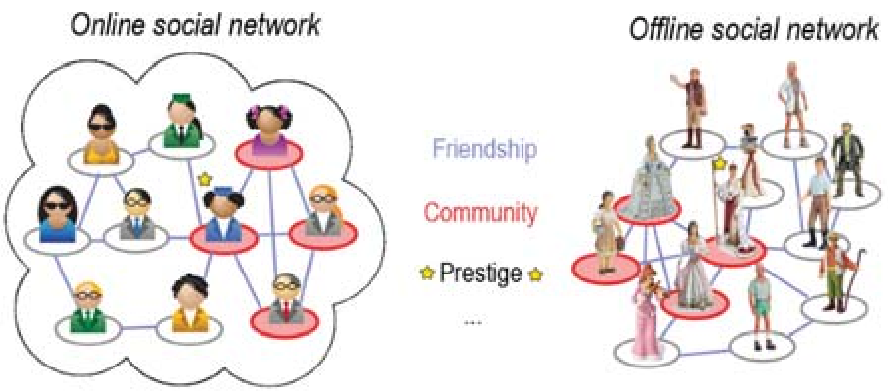 Fig 1. The convergence of Online and Offline social concepts.
Experiments & Results: Twitter in San Francisco
The study analyzed 50,000 users in the San Francisco Bay Area over six months, processing over 1 million geolocated tweets.
Key Findings:
- Filtering Nomadism: The algorithm specifically targets "nomad" users—those who are active, move frequently, and keep their GPS on.
- Similarity Matrix: By plotting users on a familiarity matrix (Figure 7), the authors found that while the majority of users are "true" strangers, a distinct subset of "Familiar Strangers" can be mathematically isolated.
- Spatio-Temporal Constraints: The research shows that shifting the "encounter" radius () from 500m to 1km significantly alters the density of the encounter graph, suggesting that FS detection is highly sensitive to urban density.
 Fig 2. Familiarity matrix where darker pixels indicate higher candidate potential for FS.
Critical Analysis & Conclusion
Takeaway
The paper proves that "Digital Footprints" are high-fidelity enough to reconstruct complex sociological phenomena. This has massive implications for Friend Recommendation Systems—instead of suggesting friends of friends, platforms could suggest the person you've "crossed paths with" 20 times this month.
Limitations
- Data Sparsity: The method relies on users having geolocation turned on, which is a shrinking demographic due to privacy concerns.
- Discrete Sampling: Tweets are "check-ins" at specific moments. They don't capture the continuous path of a user, leading to "missed" encounters.
Future Outlook
As wearable technology and "Cyber-Physical" systems evolve, the distinction between a "Virtual Friend" and a "Physical Neighbor" will continue to blur. This framework provides the mathematical vocabulary to describe that evolution.