
Familiars: Transforming Social Metadata into "Digital Daemons"
Familiars: Representing Facebook Usersʼ Social Behaviour through a Reflective Playful Experience
The paper introduces "Familiars," a social identity presentation game for Facebook that represents users' social behavior through evolving animal avatars. The system utilizes automated Social Network Analysis (SNA) and Facial Expression Recognition (FER) to map user activity to a 3D personality space, achieving a playful yet reflective social experience.
Executive Summary
TL;DR: Familiars is a pioneering social game developed for the Facebook platform that visualizes a user's digital footprint as an evolving animal companion. By analyzing social graph metrics and facial expressions in photos, the system maps behavior to a "social personality" expressed through twelve distinct animal forms.
Background: Published at ACE '09, this work sits at the intersection of Social Computing and Game Design. It moves beyond simple "which character are you" quizzes by using real-time behavioral data to drive a reflective, autonomous identity tool.
The Core Motivation: Moving Beyond Self-Reported Identity
In the early days of social networks, identity was curated manually—users wrote bios or selected moods. The authors identified a gap: while the Facebook API held a treasure trove of social data, there was no "stress-free" way to visualize it. They sought to create a Self-Presentation Tool that was:
- Autonomous: Driven by actual behavior, not just user claims.
- Holistic: Reducing complex metrics (like centrality and reciprocity) into a single, intuitive metaphor.
- Reflective: Allowing users to see how their digital interactions "shape" their perceived persona.
Methodology: The 3D Personality Space
The "magic" of Familiars happens in a 3D coordinate system defined by three axes: Sociability, Attitude, and Activity.
1. The Data Feed
The system harvests data from three primary sources:
- Social Network Analysis (SNA): Using PASION tools to calculate a user's "Centrality" (how influential they are in groups) and "Reciprocity" (how often they interact back).
- Facial Expression Recognition (FER): Automatically scanning a user's tagged photos to determine "Valence" (positive vs. negative temperament).
- Activity Logs: Tracking the frequency of posts, wall entries, and application interactions within a 7-day window.
2. The Metaphorical Mapping
To make this data meaningful, the authors mapped the 3D space to 12 animals. For example:
- Dolphin: High Sociability, High Activity, Positive Attitude.
- Owl: Low Sociability, Low Activity, Neutral/Negative Attitude.
- Wolf: High Activity, Low Sociability (Solitary hunter).
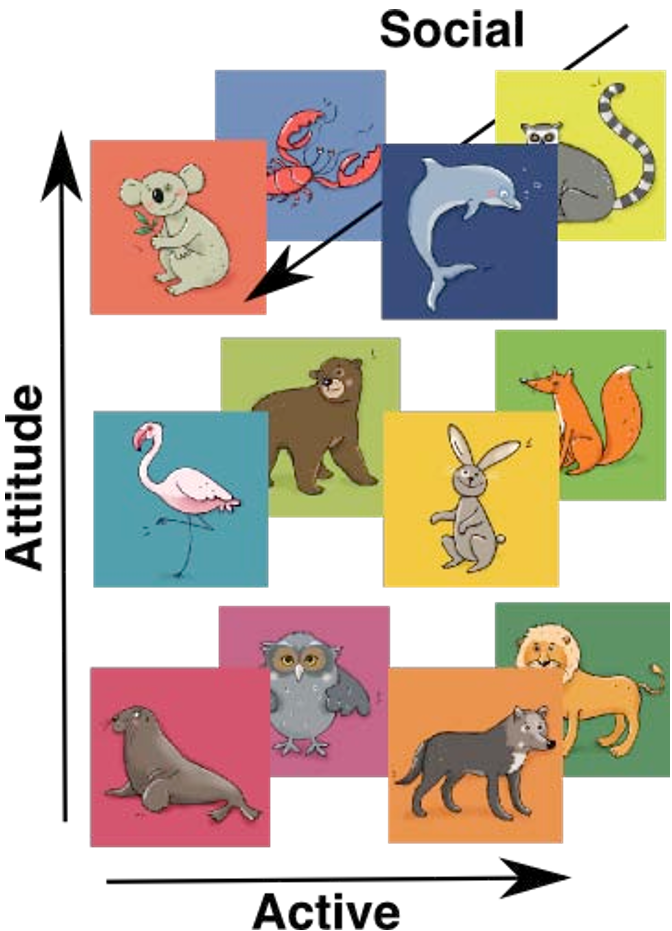 Figure 1: The mapping of 12 animals within the 3D Behavioral Space (Sociability, Activity, and Attitude).
User Validation: Cultural Consensus
A critical aspect of the methodology was a pilot study to ensure that the animals chosen actually represented the intended traits in the eyes of users. Interestingly, the Dolphin was the most preferred "status symbol," whereas the Lobster received zero preference—highlighting that users aren't just looking for accuracy; they are looking for a digital identity they can be proud of.
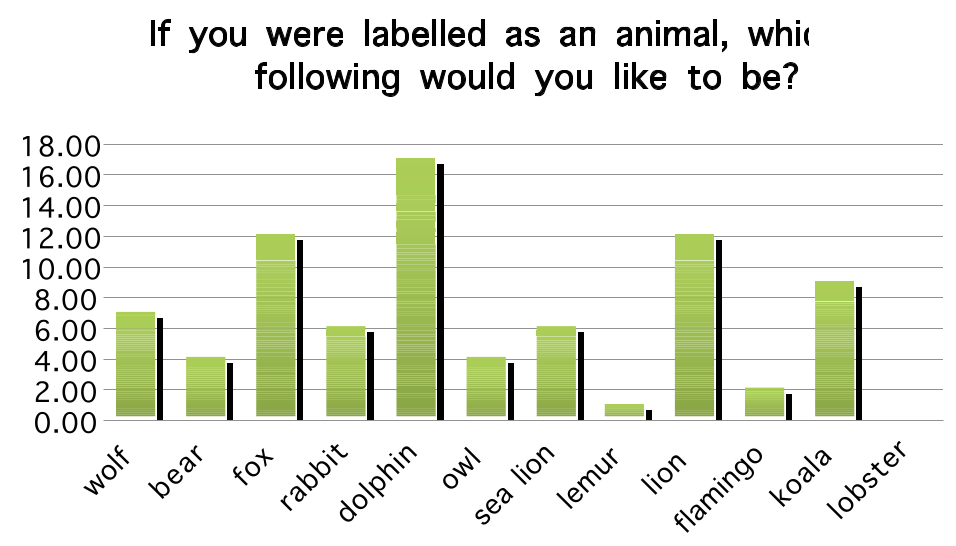 Figure 2: Pilot study results showing user preferences for different animal labels.
Experiments & Results
In a two-month summative evaluation (n=268), the researchers observed a "stepped" growth pattern, characteristic of viral social spread through mutual friend groups.
- Engagement: A small "hardcore" minority of players drove the majority of interactions (voting for friends' animal forms), suggesting that such tools thrive on a "power law" of participation (Figure 3).
- User Sentiment: 70% of participants enjoyed the experience. Despite the invasive nature of scanning photos, 69% felt their privacy was protected, largely because the data was used for a "playful" rather than commercial purpose.
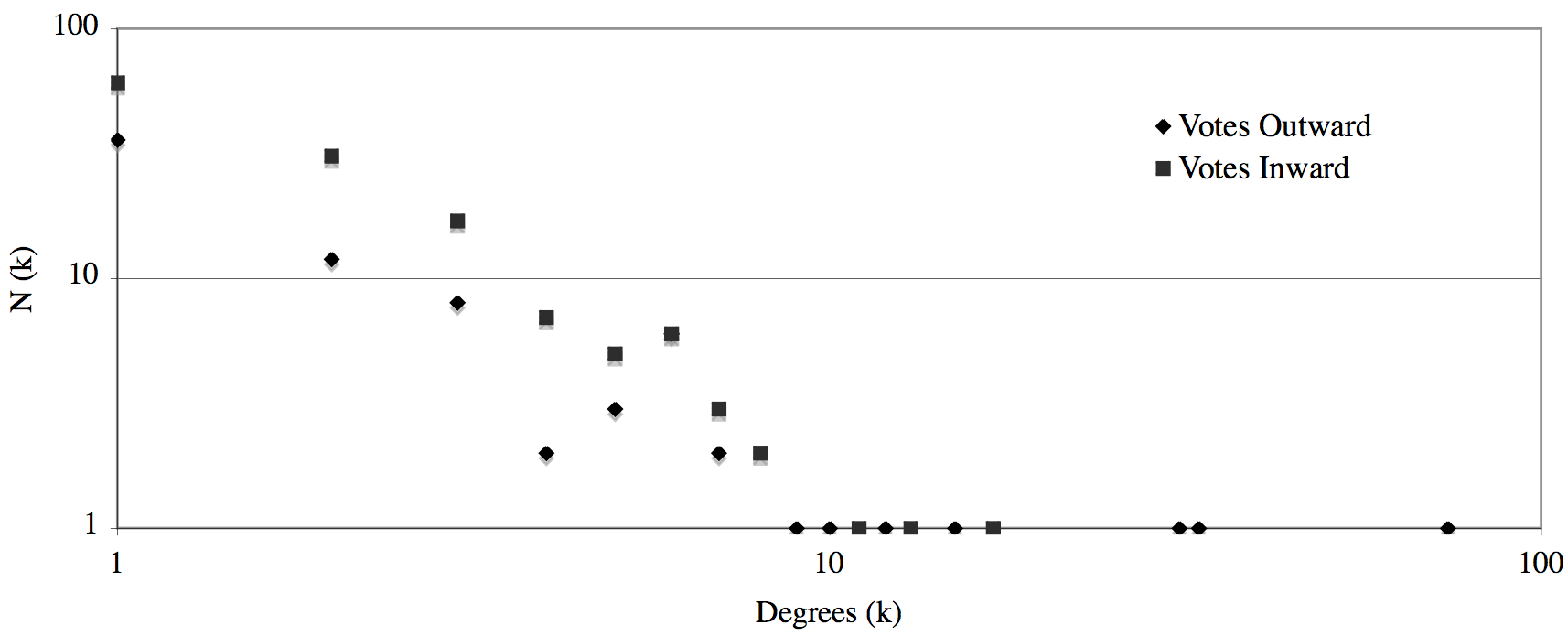 Figure 3: Log-log distribution of user interactions, showing the "hardcore" player base.
Critical Insight: The "Glass Box" Reflection
The genius of Familiars isn't just in the tech—it's in the social feedback loop. Because friends can "vote" to nudge a familiar's form, the game bridges the gap between what the algorithm sees and how friends perceive you.
Limitations & Future Directions
The authors acknowledge the "platform risk"—dependence on Facebook's API means the application is subject to changes in privacy policies and UI constraints. Furthermore, while animals are a great metaphor for social behavior, the system could easily be "re-skinned" for other demographics (e.g., using car brands or film characters).
Conclusion
Familiars successfully demonstrated that social metadata doesn't have to be just for advertisers. By turning SNA and FER data into a "Digital Daemon," the researchers created a meaningful mirror for social life, proving that reflective play is a powerful tool for understanding our digital selves.