
Explicit Graph Embedding: Fusing Structural Power with Statistical Precision
A Family of Novel Graph Kernels for Structural Pattern Recognition
The paper introduces a novel family of graph kernels that bridge structural and statistical pattern recognition by embedding graphs into n-dimensional real vector spaces. The core method utilizes Graph Edit Distance (GED) relative to a set of prototypes to create explicit vector representations, achieving SOTA performance in graph classification across diverse datasets.
TL;DR
This research addresses the fundamental "gap" between symbolic graph representations and statistical classification algorithms. By calculating the Graph Edit Distance (GED) between an input graph and a set of prototypes, the authors transform complex structural data into standard feature vectors. This allows powerful tools like Support Vector Machines (SVM) and Ensemble Methods to be applied to graphs, significantly outperforming traditional graph-based nearest neighbor approaches.
Background: The Structural vs. Statistical Divide
In the world of pattern recognition, we often face a trade-off:
- Feature Vectors: Easy to compute similarities, but "rigid" and unable to capture complex relationships between parts.
- Graphs: Highly flexible and descriptive, but "mathematically barren"—you can’t easily "average" two graphs or find their coordinates in space.
The authors argue that we shouldn't have to choose. By using Graph Kernels, we can map the symbolic richness of graphs into the structured world of Hilbert spaces.
Methodology: Embedding via Dissimilarity
The core innovation is the Explicit Vector Space Embedding. Instead of using an implicit kernel function (the "kernel trick"), the authors define a coordinate system based on actual graphs.
1. Prototype Selection
How do you define the "axes" of a graph space? You pick a set of representative graphs called Prototypes (). The paper explores several strategies:
- Centers: Selecting the "median" graphs of the dataset.
- Spanning: Picking graphs that are as far apart as possible to cover the entire distribution.
- k-Centers: Using clustering to find centers of densely populated regions.
2. The Mapping Function
For any graph , its vector representation is defined by its distance to these prototypes: Where is the Graph Edit Distance—the minimum cost of operations (insert, delete, substitute) to transform one graph into another.
Experimental Proof: Better than the Baseline
The authors tested their approach against a k-Nearest Neighbor (k-NN) classifier operating directly in the graph domain. They utilized four distinct datasets: distorted letters, segmented images, NIST fingerprints, and HIV molecules.
Key Clinical Results:
- Robustness: On the "Letter" dataset with high distortion, the embedding method (combined with plurality voting) achieved 94.3% accuracy, compared to only 90.1% for the standard k-NN.
- Versatility: In molecular classification (AIDS database), the SVM-based embedding reached 98.3%, showing its efficacy in high-stakes biological domains.
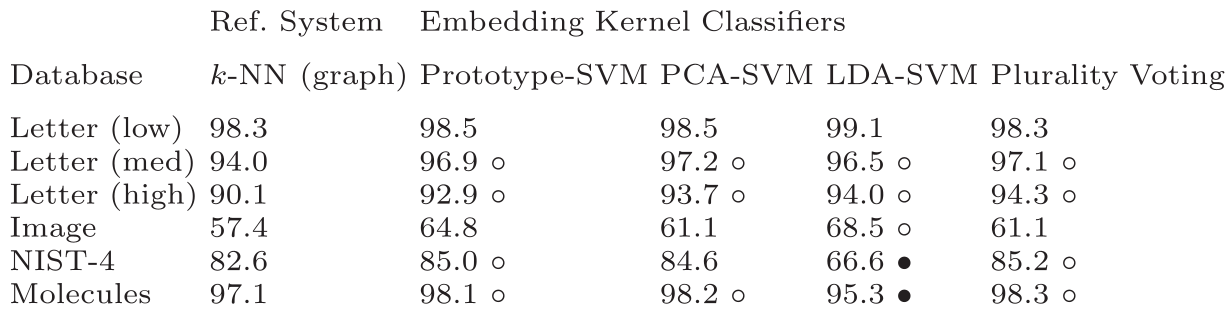 Note: The table shows that "Plurality Voting" and "Prototype-SVM" consistently outperform the reference k-NN system across almost all categories.
Deep Insight: Why Why Does This Work?
The brilliance of this approach lies in its Inductive Bias. By using Graph Edit Distance as the embedding metric, the model incorporates domain knowledge (the cost of changing a node or edge) directly into the feature vector.
Furthermore, because the embedding is explicit, we can perform Dimensionality Reduction (PCA/LDA). This refines the feature space, stripping away noise and focusing on the structural differences that actually matter for classification.
Critical Analysis & Conclusion
Takeaway
The paper successfully demonstrates that structural pattern recognition does not need to reinvent the wheel. By embedding graphs into vector spaces, we can leverage decades of progress in statistical learning.
Limitations
- Computational Complexity: Graph Edit Distance is NP-hard. While the authors mention suboptimal "fast" algorithms, scaling this to graphs with thousands of nodes remains a challenge.
- Prototype Sensitivity: The performance is highly dependent on the choice of prototypes. If the prototypes don't cover the diversity of the test set, the embedding fails.
Future Outlook
This work lays the groundwork for modern Graph Signal Processing and Graph Neural Networks. The idea of defining a graph by its "distance to others" remains a potent concept in unsupervised graph representation learning today.