
CRM: Mastering the Social Battlefield with Fast Competitive Recommendation Algorithms
A Fast Algorithm for Competitive Recommendation Marketing Strategy
This paper introduces the Competitive Recommendation Marketing (CRM) problem, proposing the Competitive Independent Cascade (CIC) and Competitive Linear Threshold (CLT) models to simulate product adoption. By proving the submodular property of influence spread in these models, the authors develop a Fast Heuristic Algorithm that significantly outperforms traditional greedy methods in efficiency.
TL;DR
In the hyper-competitive landscape of social media, marketing is no longer a solo performance—it's a tug-of-war. This paper tackles the Competitive Recommendation Marketing (CRM) problem: how to select a limited number of "seed" users to maximize your product's spread while a competitor is doing the exact same thing. The authors introduce the CIC and CLT models and a Fast Heuristic Algorithm that balances the pursuit of market share with the need for computational speed in massive networks.
The "Winner-Takes-All" Social Paradigm
Traditional influence maximization research often treats the social network as an empty field where one product spreads in a vacuum. However, in reality, your competitors are already there. If a user adopts a competitor's product, they are often "negatively activated" and unlikely to switch to yours.
The authors identify two fatal flaws in previous approaches:
- Lack of Competition: Most models don't account for the "negative influence" of rival products.
- Computational Overhead: Standard greedy algorithms rely on Monte-Carlo (MC) simulations, requiring tens of thousands of passes over the graph, which is prohibitively slow for networks with millions of edges.
Methodology: CIC, CLT, and the Hypergraph Insight
To model this social battlefield, the paper defines:
- CIC (Competitive Independent Cascade): If a node has multiple active neighbors, it calculates the net influence (Positive - Negative). A positive sum leads to product adoption; a negative sum leads to competitor adoption.
- CLT (Competitive Linear Threshold): Nodes have an internal threshold . They only activate if the total weighted influence of their neighbors exceeds (positive) or falls below (negative) that threshold.
The Core Innovation: Fast Heuristic via Hypergraph
Instead of running 10,000 MC simulations for every potential seed choice, the authors propose a Hypergraph H-based approach.
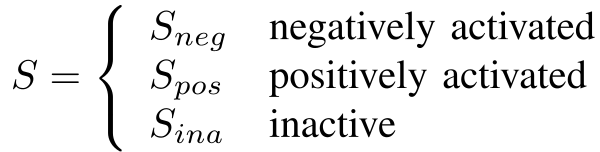 State definition for CIC/CLT models: Positive, Negative, or Inactive.
The Workflow:
- Simulate Reachability: Perform depth-first searches from the competitor's seeds to see which nodes they are likely to "capture."
- Construct Hypergraph: Represent these reachable sets as edges in a hypergraph.
- Frequency Analysis: Pick nodes that appear most frequently in the "threat zones" of the competitor. By occupying these nodes, you effectively "block" the competitor's path while expanding your own reach.
Experimental Battleground
The model was tested on real-world data including Twitter (32k nodes, 763k edges) and Epinions.
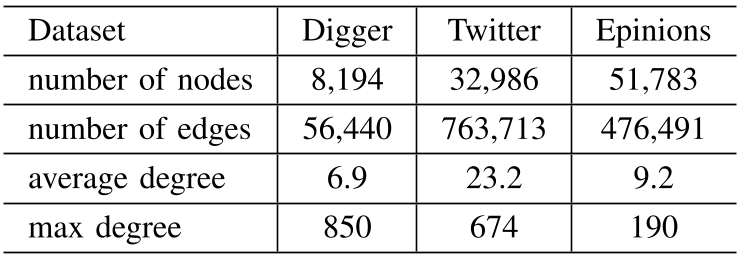 The study utilized diverse social structures to test algorithm robustness.
Key Findings:
- Efficiency: The heuristic algorithm operates at , making it viable for large-scale graphs where the Greedy fails.
- Product Adoption: As the number of our recommended seeds increases, the competitor's adoption rate drops sharply (as seen in Figure 2 of the paper), validating the "blocking" utility of the CRM strategy.
- Submodularity: The authors mathematically proved that the influence spread remains a monotone and submodular function even under competition, which guarantees that simple greedy approaches will yield a solution within at least of the global optimum.
Academic Insight & Future Outlook
The CRM strategy is a significant step toward Game-Theoretic Marketing. By framing influence maximization as a follower's perspective—where one party reacts to a competitor's existing seeds—this work provides a blueprint for "reactive" social media management.
Limitations: The model assumes the competitor's seeds are known. In the real world, brands often have to guess or predict who the competitor is targeting. Future research combining this with source localization (identifying where a rumor started) could create a powerful end-to-end defense system for brand reputation.
Conclusion
This paper effectively bridges the gap between theoretical submodular optimization and the practical chaos of competitive markets. Whether you are launching a new app or managing public opinion, the "Fast Heuristic" approach provides a scalable tool for securing your "territory" in the digital social landscape.