
ItemRank: Leveraging Microeconomic Intuition and Graph Centrality for Retail Profit Mining
Fast Algorithm for Mining Item Profit in Retails Based on Microeconomic View 1
The paper introduces ItemRank, a novel algorithm for optimal item selection in retail based on microeconomic theory. It models customer behavior as a directed graph to rank items by their profitability while explicitly accounting for the cross-selling effect via a PageRank-inspired mechanism.
TL;DR
In the complex world of retail, the most valuable item isn't always the one with the highest price tag—it’s the one that convinces customers to buy more. This paper introduces ItemRank, a PageRank-inspired algorithm that treats retail inventory as a social network of products. By accounting for the cross-selling effect, ItemRank identifies "influencer" products that drive overall store utility, outperforming previous SOTA methods in both profit generation and computational efficiency.
The Problem: The "Lone Wolf" Profit Fallacy
Retailers often fall into the trap of Naïve Profit Ranking: sorting items by their individual margins and discarding the "laggards." However, microeconomic theory suggests that an enterprise should maximize overall utility across all transactions.
The challenge is the Cross-selling Effect. If a customer buys a low-profit printer, they are likely to buy high-profit ink. Removing the printer (the "loss leader") would inadvertently destroy the profit from the ink. Previous attempts to model this, like the HAP (Hub-Authority Profit) algorithm, attempted to use HITS-like structures, but they often struggled with stability and objective weighting between an item’s self-profit and its associative value.
Methodology: ItemRank and the Customer Behavior Model
The authors suggest that if an item is "influenced" by many high-profit items, it inherently possesses high value within the retail ecosystem.
1. The Customer Behavior Model
The authors construct a directed graph :
- Vertices (V): Items in the inventory.
- Edges (E): Directed links representing the cross-selling effect, derived from association rules ().
- Weights: Derived from the confidence of these rules and the item's individual profit.
2. The ItemRank Formula
To solve the ranking problem, the authors adapt the Google PageRank algorithm to include economic variables:
Where:
- : Damping factor (usually 0.2 in this study) to handle "rank sink."
- : The self-profit of the source item.
- : The strength of the association.
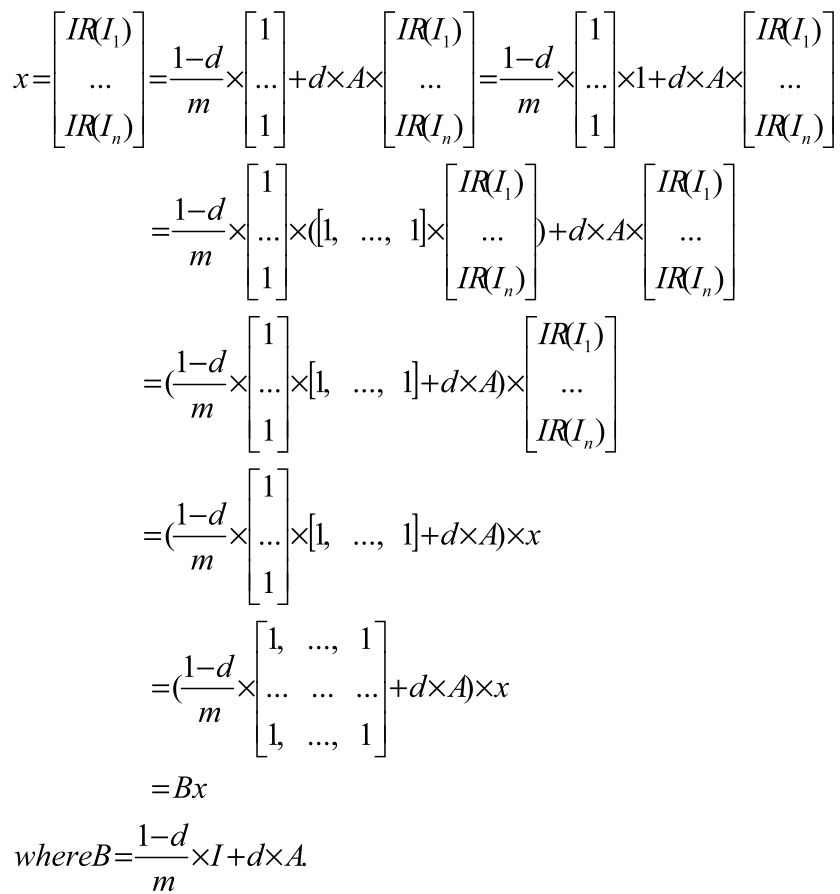 The algorithm computes the principal eigenvector of the modified transition matrix B to find the steady-state rank of every item.
Experimental Insights: Performance vs. Scale
The researchers tested ItemRank against the HAP algorithm and Naïve selection using the IBM synthetic data generator.
Key Findings:
- Superior Profitability: In scenarios with strong cross-selling effects (support threshold at 0.1%), ItemRank consistently secured higher total profits than HAP across all levels of item selection (from 10% to 100% of the catalog).
- Sensitivity to Damping (): The paper finds that a damping factor of around 0.2 is optimal. This suggests that in retail, there's roughly a 20% "probabilistic jump" or external influence factor in consumer behavior.
- Worst-Case Robustness: In datasets specifically designed to make HAP fail, ItemRank maintained high performance, proving its mathematical stability.
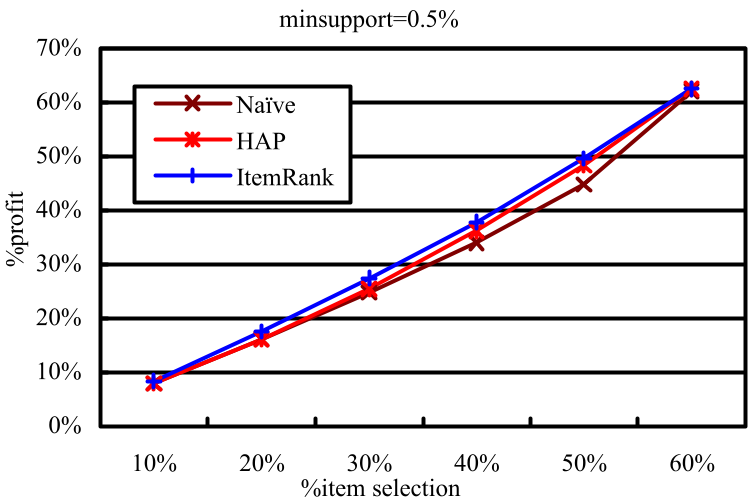 Figure 1: Comparison of Profitability. ItemRank (top line) consistently yields more profit than HAP and Naïve methods.
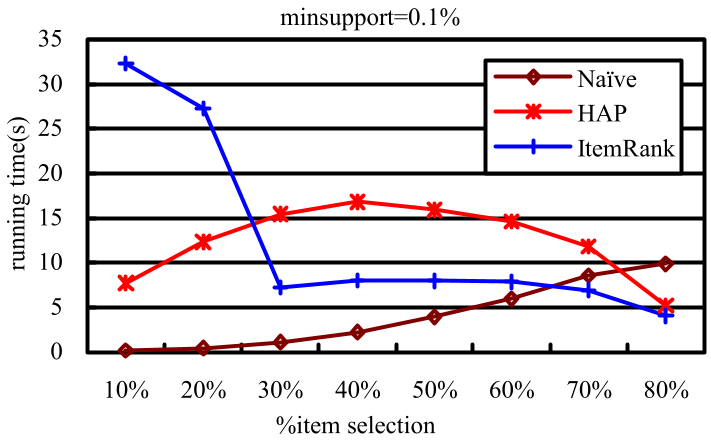 Figure 2: Efficiency analysis. While ItemRank requires iterations, its scaling behavior makes it highly efficient for large-scale retail selections.
Critical Analysis & Conclusion
Takeaway: ItemRank bridges the gap between pure graph theory and microeconomics. By treating items as nodes that "pass wealth" to each other based on co-occurrence, it provides a rigorous framework for inventory management.
Limitations:
- Static Profits: The model assumes item profit is constant, whereas real-world retail involves dynamic pricing and seasonal fluctuations.
- Association Rule Dependency: The quality of rankings depends heavily on the quality of mined association rules.
Future Outlook: As retail moves toward hyper-personalization, integrating ItemRank with real-time streaming data could allow stores to dynamically adjust their "featured products" list to maximize total ecosystem utility rather than just moving single units. This graph-centric view is likely the future of automated category management.