
Fast Algorithms for Time Series: Beyond Simple Trends
Fast algorithms for time series with applications to finance, physics, music, biology, and other suspects
The paper presents a suite of specialized algorithms and a query language (AQuery) designed for high-performance time series analysis. It introduces the StatStream framework for real-time correlation discovery, Shifted Binary Trees for elastic burst detection, and envelope-based filtering for "Query by Humming" systems.
TL;DR
Time series are more than just lines on a graph; they are the pulse of finance, physics, and music. This paper provides a masterclass in accelerating time series analysis. By leveraging dimensionality reduction, novel hierarchical data structures like Shifted Binary Trees, and a specialized query language called AQuery, the authors demonstrate how to move from slow, brute-force calculations to real-time discovery of correlations and anomalies.
The "Real-Time" Wall: Why it's Hard
Most databases are built on the relational model, which treats data as an unordered set. But time series data is intrinsically ordered. When a financial trader wants to find two stocks that stop correlating, or an astrophysicist looks for a gamma-ray burst across different time scales, the math becomes heavy.
- Pairwise Correlation: Monitoring thousands of streams involves comparisons. Doing this for every new tick is impossible for standard systems.
- Burst Detection: Bursts (sudden increases in value) can happen over milliseconds or days. Checking every possible window size independently is computationally exhausting.
Methodology: The Three Pillars of Speed
1. StatStream: Real-time Correlation
Instead of calculating correlations on raw data, the authors use the GEMINI framework logic: map time series to a lower-dimensional space using Fourier or Wavelet transforms.
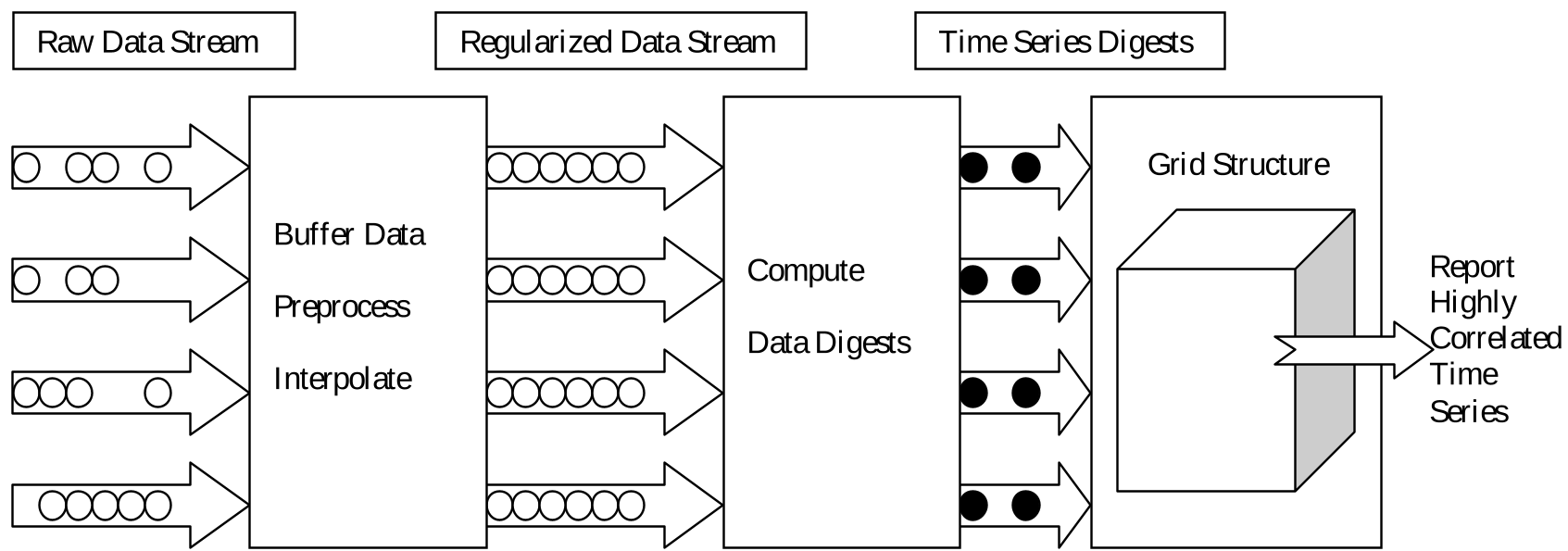
The key insight here is the use of synopses for basic windows. By keeping summary statistics of small time chunks, the system can incrementally update sliding window correlations without re-scanning historical data.
2. Shifted Binary Trees for Burst Detection
How do you find a burst when you don't know its duration? The authors propose the Shifted Binary Tree (SBT). By creating a hierarchy of overlapping windows, they prove that any subsequence of length is contained within a window at a specific level of the tree. This allows the system to monitor a logarithmic number of window sizes to cover all possible bursts, reducing the complexity of multi-window detection significantly.
3. AQuery: Language for the Ordered World
Standard SQL is not "order-aware." To calculate a moving average, you often need complex self-joins. AQuery introduces the ASSUMING ORDER clause, allowing users to write logic that assumes the data is sorted.
sql SELECT max(price - mins(price)) FROM Trades ASSUMING ORDER timeofday WHERE ID = 'MSFT'
This column-oriented approach is naturally faster for time series because it operates on vectors rather than individual rows.
Experimental Performance
The impact of these methods is quantified through real-world scenarios:
- Physics: In Gamma Ray detection, the SBT approach provided a 7x speedup compared to naive monitoring.
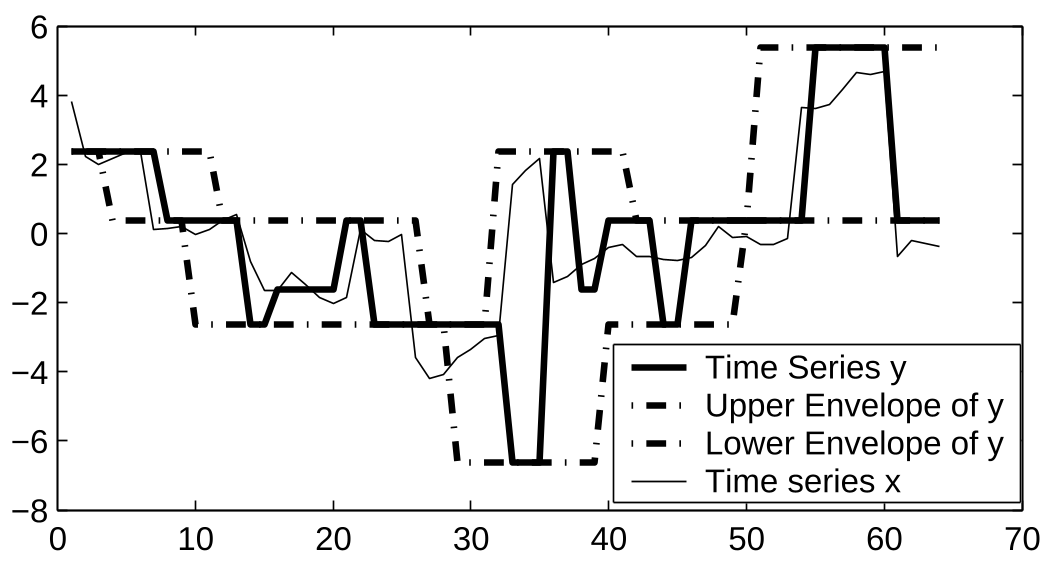
- Music: Their "HumFinder" system utilized an Envelope Filter to prune candidates for Dynamic Time Warping (DTW), allowing accurate song matching even from out-of-tune humming.
Critical Insight & Future Directions
The paper is a seminal look at why "order" matters in data systems. While published in 2004, its principles—dimensional reduction, hierarchical pruning, and column-oriented processing—are the bedrock of modern high-frequency trading (HFT) and observability platforms.
Limitations: The methods rely heavily on the assumption that thresholds for "bursts" or "correlations" are high (rare events). In extremely noisy environments where "alarms" are frequent, the pruning efficiency of Shifted Binary Trees or Envelope Filters may degrade.
Conclusion: As we enter the era of IoT and ubiquitous sensors, these fast algorithms remain a foundational roadmap for anyone looking to extract signal from the noise of the time-ordered world.