
FICET: Balancing Speed and Smoothness in Dynamic Community Tracking
Fast Community Discovery and Its Evolution Tracking in Time-Evolving Social Networks
This paper introduces FICET (Fast Incremental Community Evolution Tracking), a unified framework for discovering communities and tracking their evolution in large-scale dynamic social networks. By utilizing a "core sub-graph" strategy and incremental updates, it achieves State-of-the-Art (SOTA) performance in both clustering quality (NMI/Modularity) and computational efficiency.
TL;DR
Social networks are never static; they are living, evolving entities. Tracking how communities form, merge, and dissolve in real-time is a massive computational challenge. The FICET (Fast Incremental Community Evolution Tracking) framework solves this by focusing on the "skeleton" of the network—the core sub-graph. By processing only the core nodes and incremental changes, it achieves high-quality clustering on massive datasets (like DBLP) where traditional methods crash.
The Problem: The Efficiency-Quality Paradox
Existing research in dynamic community tracking usually falls into two camps:
- Evolutionary Clustering: High quality, but slow. It treats the network as a series of snapshots and tries to keep the results "smooth" over time, often requiring complex optimization (e.g., FacetNet, DSBM).
- Incremental Clustering: Fast, but often "jittery." It processes updates as they come (streaming), but frequently loses the global context, leading to poor modularity.
The authors of FICET identified that most nodes in a network are "followers," while a small subset of "core nodes" defines the community structure.
Methodology: The Core Sub-graph Insight
The FICET framework operates on a brilliant "divide, track, and expand" logic.
1. Identifying the "Skeleton" (Modified PageRank)
Instead of treating all nodes equally, FICET uses a Modified PageRank (MP) algorithm to rank nodes by influence. The top-ranked nodes form the Core Sub-graph. Mathematically, the damping factor is determined automatically based on node weights, removing the need for manual parameter tuning.
2. Discovering & Expanding Communities
- Core Discovery (HC): Applying hierarchical clustering on the much smaller core sub-graph. Since the number of nodes is significantly reduced, this step is lightning-fast.
- Expansion (EC): Ordinary nodes are then "attached" to these core communities based on an "intimacy" metric. This ensures the global structure is maintained without global computation.
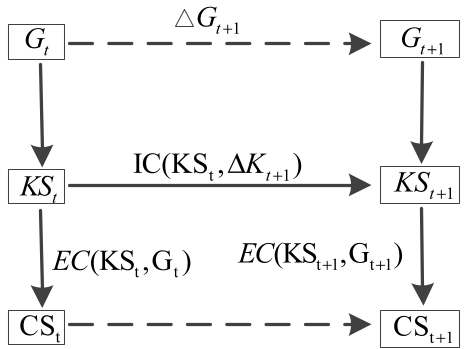 Fig 1: The incremental tracking module demonstrates how core communities are updated between time steps t and t+1.
3. Evolutionary Tracking (The IC Algorithm)
The real magic happens during tracking. Instead of re-clustering everything, the Incremental Clustering (IC) algorithm:
- Deletes obsolete nodes/edges.
- Splits communities if connectivity breaks.
- Adds new nodes/edges based on community intimacy.
- Community Structure Stability (CSM): FICET calculates a stability score. If the network changes too much (crossing a threshold ), it triggers a full re-discovery; otherwise, it keeps updating incrementally.
Experiments: Speed Meets Accuracy
The authors tested FICET against heavyweights like FacetNet and DSBM.
Synthetic Success
On datasets with both fixed and variable numbers of communities (SYN-FIX/VAR), FICET consistently maintained higher NMI (Normalized Mutual Information) and Modularity throughout multiple timestamps. While DSBM's performance collapsed after 5 timestamps, FICET remained stable.
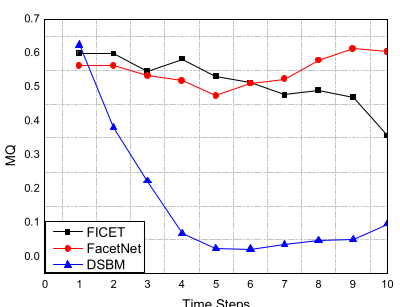 Fig 2: Performance comparison on synthetic networks showing FICET's superior stability in NMI and Modularity.
Real-World Scaling: The DBLP Challenge
The DBLP dataset, containing over 800,000 nodes and 1,000,000 links, proved to be the ultimate test. Both FacetNet and DSBM failed to produce results in standard experimental environments due to memory and time constraints. FICET, however, successfully tracked the 12-year evolution of co-authorship, capturing a local peak in step 6 where a major structural shift triggered a community re-detection.
Critical Analysis & Conclusion
Takeaway: FICET proves that we don't need to look at the whole picture to understand the change. By focusing on core nodes and employing a stability-triggered re-detection mechanism, it achieves what was previously "too expensive" for large graphs.
Limitations: The performance of FICET heavily relies on the quality of the core node identification. In networks where central hierarchy is flat (no clear "cores"), the efficiency gains might diminish. Furthermore, the selection of the threshold and the core-node percentage still requires some domain knowledge.
Future Insight: This framework opens the door for real-time monitoring of social trends and anomaly detection in massive streaming graphs where traditional snapshot-based methods are no longer viable.