
RoleMatch: Breaking Anonymity with Fast Structural Role Matching
Fast De-anonymization of Social Networks with Structural Information
This paper introduces RoleMatch, a seedless and efficient framework for social network de-anonymization using purely structural information. By implementing a novel similarity measure (RoleSim++) and a priority-based matching algorithm (NeighborMatch), it achieves state-of-the-art performance in both global and local de-anonymization tasks.
TL;DR
Researchers have developed RoleMatch, a fast, seedless de-anonymization framework that identifies users across social networks using only graph structure. By introducing RoleSim++ (a directed similarity measure) and NeighborMatch (a structural feedback algorithm), they achieved up to 2x the precision of previous SOTA methods and proved that "local" attacks—where only a small sub-network is known—are far more dangerous than previously thought.
Background & Motivation
When social media companies release "anonymized" datasets for research, they typically remove names and IDs. However, the structure of our relationships is often as unique as a fingerprint. Previous de-anonymization efforts usually required a "seed set" (knowing a few people's identities beforehand) or were too slow to run on real-world graphs.
The authors identify a critical gap: Local De-anonymization. Most attackers don't have the whole network; they only crawl a small portion. Existing tools fail here because the "noise" (nodes that don't overlap) overwhelms the signal.
Methodology: The Core Architecture
RoleMatch operates in two distinct phases: Similarity Computation and Node Matching.
1. RoleSim++: Seeing Both Ways
Traditional similarity measures like SimRank often ignore edge direction or fail to normalize for node degrees, causing small-degree nodes to "disappear" during computation. RoleSim++ solves this by:
- Directed Aggregation: It separately calculates similarity for incoming and outgoing neighbors.
- Normalization: It ensures scores stay within a range, preventing high-degree nodes from dominating the matching process.
- Efficiency (-RoleSim++): By using a dynamic threshold , the algorithm prunes pairs that are unlikely to match, reducing the search space from to a manageable subset.
2. NeighborMatch: The Power of Feedback
Instead of just picking the highest similarity score, NeighborMatch uses the intuition that if my friends match your friends, we probably match too.
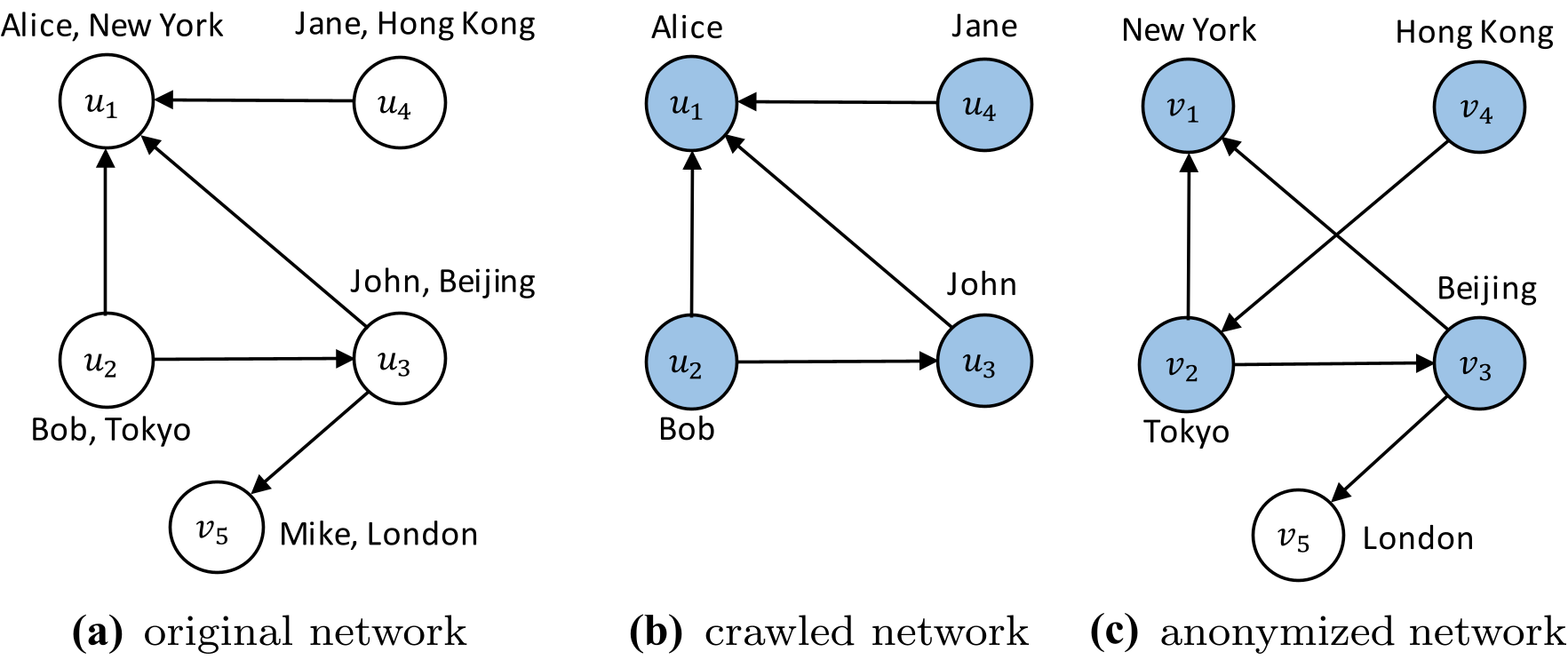 Figure 1: The de-anonymization workflow, matching a crawled network (b) to an anonymized network (c).
Experimental Breakthroughs
The authors tested RoleMatch against datasets like LiveJournal (4.8M nodes) and Twitter.
- Accuracy vs. Noise: In "Local De-anonymization" tests, RoleMatch achieved 80% precision while the previous baseline struggled at under 10%.
- Scalability: While basic similarity measures couldn't finish the Twitter dataset in 24 hours, the -RoleSim++ variant finished in under 30 minutes.
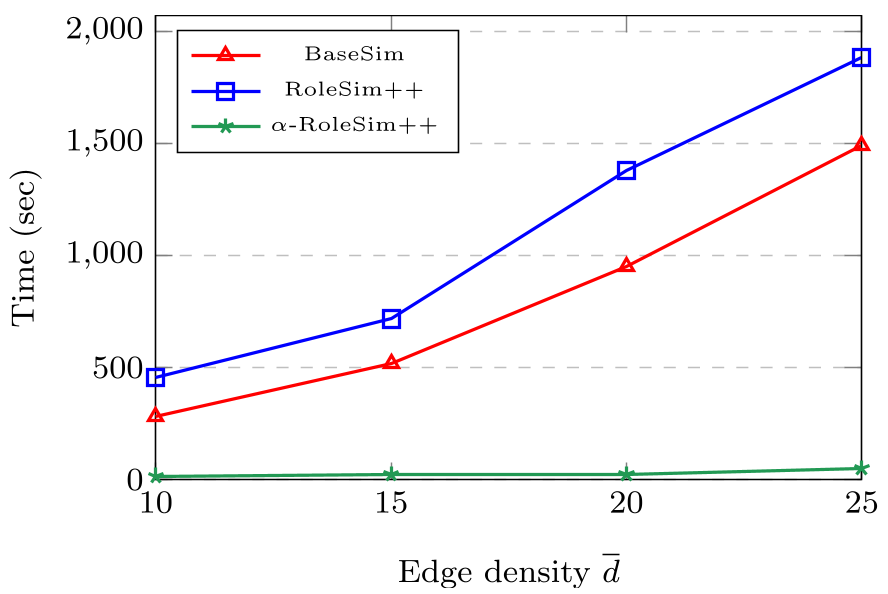 Figure 2: Top-k precision comparison showing RoleSim++ significantly outperforming the BaseSim methodology.
Critical Insight: Why Does It Work?
The secret sauce is the Inductive Bias of RoleSim++. By treating social roles (how many people follow you vs. who you follow) as a recursive mathematical definition, the model captures the "essence" of a node's position in the social hierarchy. This makes it incredibly robust to "edge perturbation" (adding or deleting random friend links), which is the most common way companies try to anonymize data.
Conclusion & Future Work
RoleMatch proves that privacy-preserving data publishing needs to go beyond simple edge-swapping. Structural information is remarkably resilient.
Limitations: While RoleMatch is fast, it still relies on "structural isomorphism" to some degree. If a network changes significantly between the time it was crawled and the time it was published, the precision may drop. Future research may look into Deep Graph Alignment (using GNNs) to handle even noisier topological shifts.
Takeaway for Practitioners: If you are publishing graph data, beware—edge direction and local neighborhood structures are highly identifiable signatures.