
NaFa4KDA: Accelerating Social Network Anonymization for the Big Data Era
A fast graph modification method for social network anonymization
The paper introduces NaFa4KDA, a high-performance graph modification algorithm for k-degree social network anonymization. It leverages a Number Factorization (NaFa) technique for edge removal and the Neighborhood Attraction Firefly Algorithm for edge addition, achieving state-of-the-art results in processing speed for big data.
TL;DR
Anonymizing massive social networks is notoriously slow because modifying a graph to meet privacy standards (like -degree anonymity) involves NP-hard edge selection. NaFa4KDA solves this by utilizing number factorization to delete edges in a single scan and an optimized Firefly Algorithm to add edges strategically. The result? A dramatic reduction in runtime (e.g., from 15 hours down to 2) while actually improving the structural utility of the data.
The Scalability Wall in Privacy
In the context of social media, privacy isn't just about hiding names; it's about hiding the topology. An adversary knowing a victim has exactly 57 friends can find them in a public dataset if only one person has that degree. To prevent this, -degree anonymity ensures every node shares its degree with at least others.
Existing SOTA methods like UMGA (Utility-Maintaining Graph Anonymization) are effective but suffer from a "greedy bottleneck." To remove or add a single edge, they scan the entire candidate list. For a network with millions of edges, this repeated scanning leads to a computational meltdown, making them useless for real-world "Big Data" scenarios.
Methodology: The "Secret Sauce" of NaFa4KDA
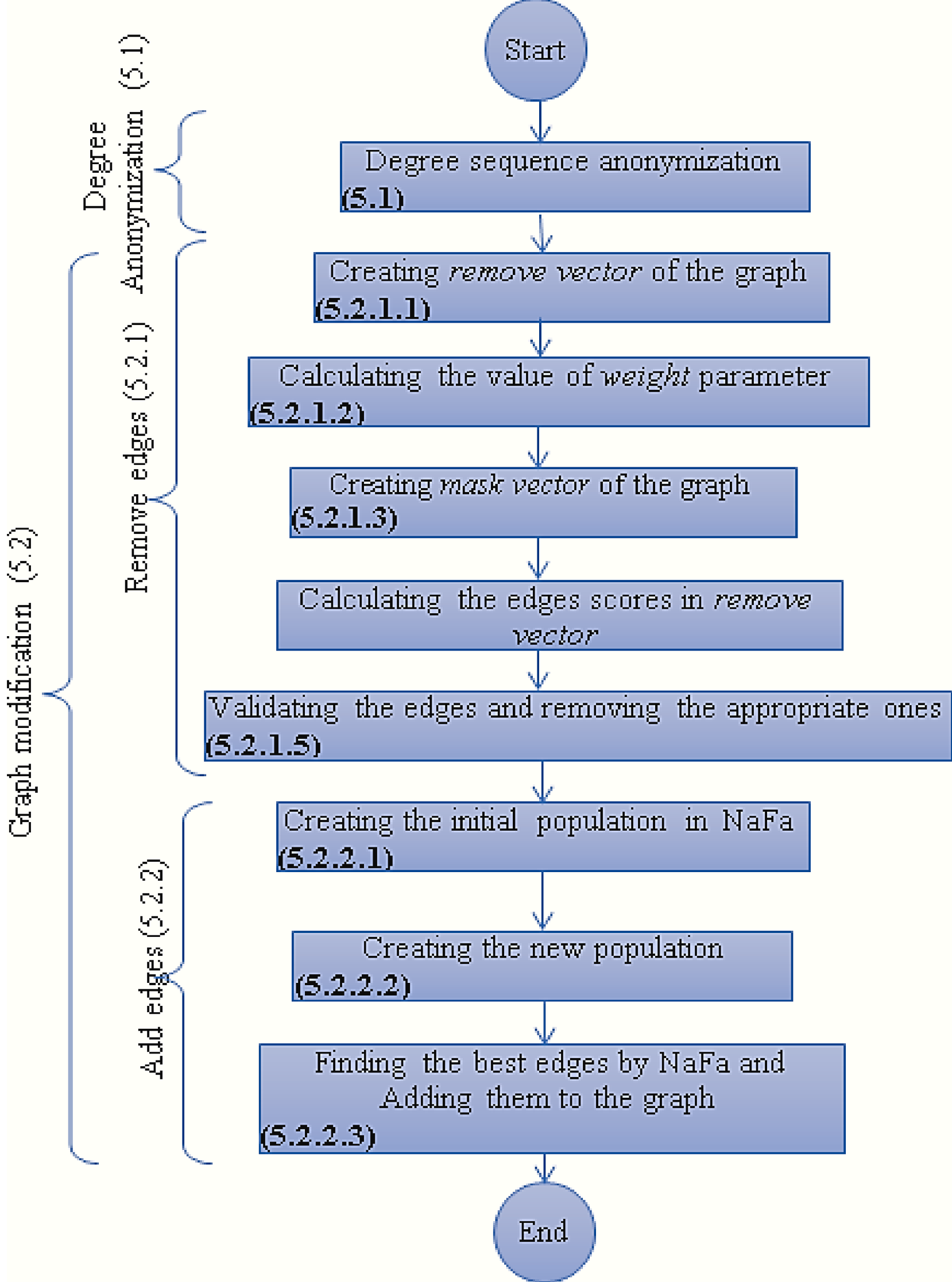
1. Smart Edge Removal via Number Factorization
Instead of re-evaluating the graph every time an edge is removed, the authors treat the degree-reduction requirement as a mathematical product.
- Each "negative" node (node needing a degree decrease) is assigned a unique prime number.
- A Weight parameter is calculated as the product of these primes.
- By scanning a "mask vector" of candidate edges just once, the algorithm uses the remainder theorem (modulus) to decide which edges to cut, ensuring the exact reduction needed for every node is met in time.
2. Edge Addition via NaFa (Swarm Intelligence)
Adding edges is even trickier because you want to "hide" the nodes without destroying the "small-world" properties of the graph (like triangles and community clusters). NaFa4KDA uses the Neighborhood Attraction Firefly Algorithm (NaFa).
- Unlike standard Firefly Algorithms that look at the entire population, NaFa fireflies only move toward brighter neighbors.
- The fitness function prioritizes Neighborhood Centrality (NC) and Participation Level (PL)—basically ensuring new edges don't become unintended "bridges" that radically change the graph's skeleton.
Does it Work? The Experimental Verdict
The authors tested the algorithm on massive datasets including Email-Enron, DBLP, and YouTube.
Speed Performance
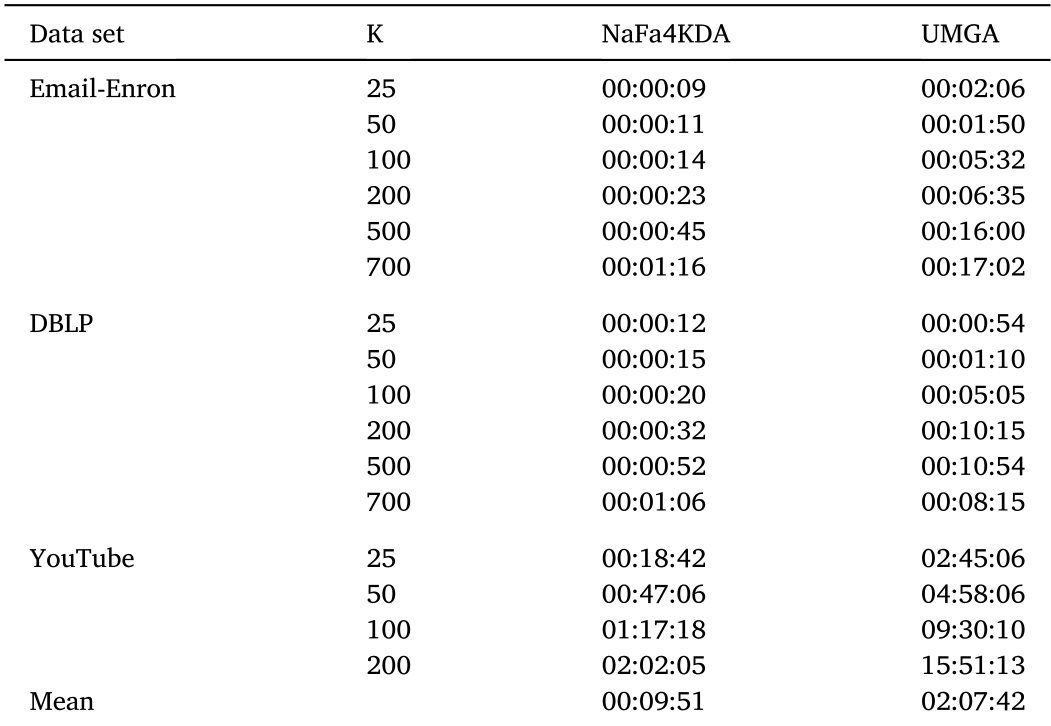
The contrast is stark. On the YouTube dataset (), UMGA took nearly 16 hours. NaFa4KDA completed the task in 2 hours. Across all datasets, the mean runtime was reduced by over 92%.
Utility Retention
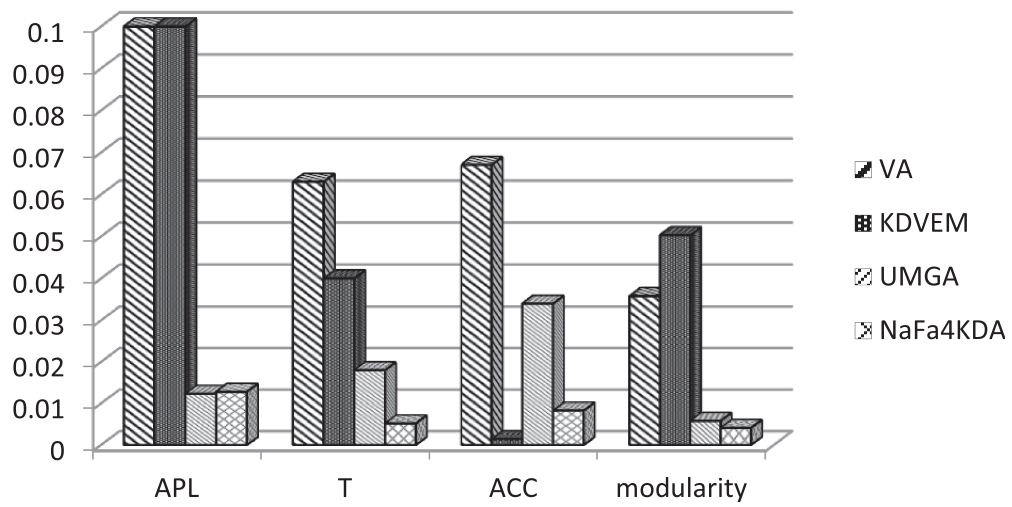
Speed is useless if the data is ruined. NaFa4KDA maintains the Average Path Length (APL) and Clustering Coefficient better than VA or KDVEM. By treating edge addition as a global optimization problem rather than a series of local greedy choices, it preserves the "community structure" (measured via Normalized Mutual Information) much more effectively.
Deep Insight & Conclusion
The true brilliance of this paper lies in its hybrid approach. By recognizing that edge removal can be handled by a deterministic mathematical trick (Factorization) while edge addition requires a flexible heuristic (NaFa), the authors decoupled the complexity of graph modification.
Takeaway: If you are working with large-scale relational data, don't just throw "greedy" algorithms at NP-hard problems. Look for ways to map your structural constraints into mathematical identities—like prime numbers—to achieve the "one-scan" holy grail.
Limitations: Currently, the model is built for static, undirected graphs. Transitioning this to dynamic, streaming social graphs remains the next frontier.