
Fast, Lenient, and Accurate: The Tech Behind LinkedIn’s Instant Search
Fast, lenient and accurate: Building personalized instant search experience at LinkedIn
The paper presents LinkedIn's "Instant Search" system, a large-scale retrieval framework that provides real-time query completions and search results as users type. It leverages an inverted index-based architecture combined with static ranking, personalized query rewriting, and "name clusters" to achieve a 39.53% increase in typeahead CTR.
TL;DR
LinkedIn's instant search isn't just a simple autocomplete; it is a sophisticated real-time retrieval engine handling over 450 million members. By moving away from simple string matching to Entity-Based Segmentation, implementing Name Clusters for fuzzy logic, and biasing retrieval toward the Social Graph, LinkedIn increased their typeahead engagement by nearly 40% while slashing tail latency by 83%.
The Challenge: Navigational vs. Exploratory Intent
Most search systems treat all queries equally. LinkedIn makes a critical distinction:
- Navigational Search: The user is looking for a specific entity (e.g., "Jeff Weiner"). The goal is to provide the result immediately in the suggestions box.
- Exploratory Search: The user is browsing (e.g., "Software Engineer New York"). The goal is to guide them to a structured query page.
The "Instant Search" experience aims to satisfy the navigational intent before the user even finishes typing, which introduces a massive performance-relevance trade-off.
Methodology: The Architecture of Instant Retrieval
1. From Strings to Things (Query Tagging)
Instead of treating a query like a bag of words, LinkedIn uses a sequential prediction model to tag entities (PERSON, COMPANY, SCHOOL, etc.). Example: "Jeff Weiner CEO LinkedIn" is parsed into a Person, a Canonical Title, and a Canonical Company ID. This allows the engine to skip the "keywords" and search the "entities" directly.
2. Tuning the Inverted Index for Speed
To handle 450M members, LinkedIn uses Static Rank—a query-independent score based on profile views and celebrity status—to order their posting lists. This allows for Early Termination: the engine stops looking after checking the first documents because the most relevant "top" hits are likely already found.
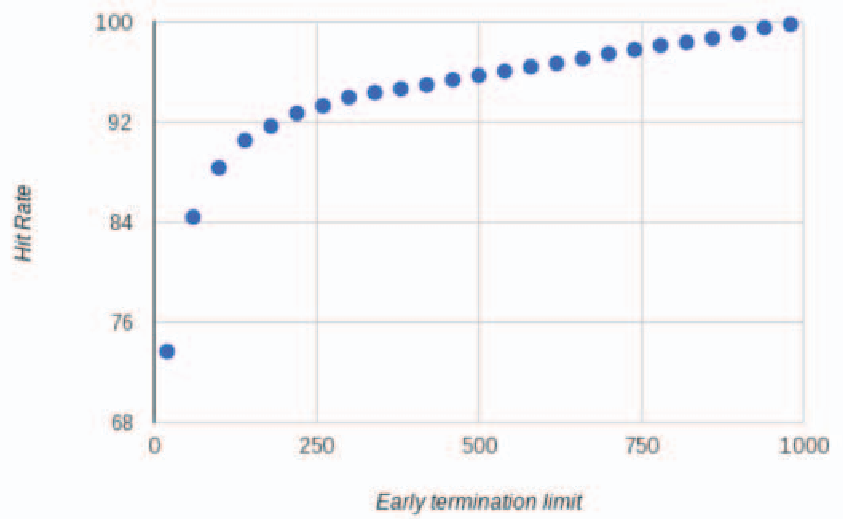 As shown in Figure 2, a limit of just 1,000 documents (numToScore) achieves nearly 100% recall compared to searching the entire index.
3. The "Name Cluster" Solution for Leniency
Standard edit-distance (Levenshtein) is terrible for names. "Agarwal" has dozens of valid spellings. LinkedIn’s approach:
- Coarse Clustering: Using Double Metaphone to group names that sound similar (Recall-focused).
- Fine-Grained Clustering: Using Jaro-Winkler distance and User Reformulation data (if people type "Jeff" and then backspace to type "Geoff", they are likely the same) to refine the groups (Precision-focused).
4. Overcoming Network Bias Problems
One of the core innovations is how they handle the social graph. If you search "Mark," you probably want the Mark you know, not a global celebrity. Standard search operators like MUST or SHOULD fail under early termination—they either return zero results or overwhelm the local matches with global ones.
LinkedIn introduced a Special Operator:
+TEXT ?NETWORK[100] numToScore=500
This tells the engine: "Get me 500 people named Mark, but make sure at least 100 are in the searcher's 1st or 2nd-degree network."
Experiments and Results
The transition to a Learning to Rank (LTR) model using Logistic Regression allowed the team to weight features like "first name match in 1st degree network" higher than "last name match."
- Latency: Early termination reduced p99 latency by 83%.
- Accuracy: LTR provided a 5.6% boost in Click-Through Rate (CTR).
- Business Impact: The cumulative effect of these optimizations was a 39.53% increase in searches served via typeahead.
Critical Insight & Perspective
The genius of this work lies in the "Best Effort" retrieval. In high-concurrency systems, you cannot afford to be perfect; you must be fast. By baking the social graph directly into the indexing phase and using "Name Clusters" to pre-calculate errors, LinkedIn transformed a computationally expensive problem into a simple lookup.
However, the reliance on click logs for personalization (Position Bias) remains a challenge. As search becomes more "instant," the line between suggesting a query and suggesting an answer blurs, making the "Entity-Aware" component the future of professional search.
Future Outlook
While this paper focuses on text, the next frontier for LinkedIn is likely Multimodal Instant Search, where intent is derived not just from typed characters, but from the user's recent browsing context and live "intent" signals, potentially using Vector Databases (ANN) to supplement the traditional inverted index.