
Neuro-Fuzzy Networks: A Faster Path to Finding Similar Friends in Social Networks
A fast way for finding similar friends in social networks by using neuro-fuzzy networks
This paper introduces a Neuro-Fuzzy Network (NFN) approach to accelerate similar-friend discovery in social networks by approximating "skyline regions." By integrating fuzzy logic with neural learning, the method identifies relevant user clusters more precisely than traditional multi-criteria algorithms.
TL;DR
Finding truly "similar" friends in a social network is harder than it looks because human preferences are multi-dimensional and often vague. This paper proposes a Neuro-Fuzzy Network (NFN) to approximate "Skyline Regions"—a method that sifts through complex user data to find the best matches. By adding fuzzy logic to neural training, the authors significantly cut down on "noise" (dissimilar users) and speed up the recommendation process.
The Problem: The "Similarity" Paradox
In a world of big data, why do recommendation systems still get it wrong?
- The Dimensionality Trap: Methods like K-means often force a user into a single category. If you like Chinese food but hate Western food, a simple K-means filter might miss your connection with someone who shares your Chinese food passion but has different Western food tastes.
- The Skyline Bottleneck: "Skyline Queries" were designed to solve this by looking at all dimensions independently. However, calculating a true Skyline for millions of users is computationally expensive.
- The Precision Gap: Previous attempts to use Neural Networks to "guess" the skyline region were too blunt—they often included "intermediate" users who weren't actually similar to the target, wasting processing power.
Methodology: The Neuro-Fuzzy Synergy
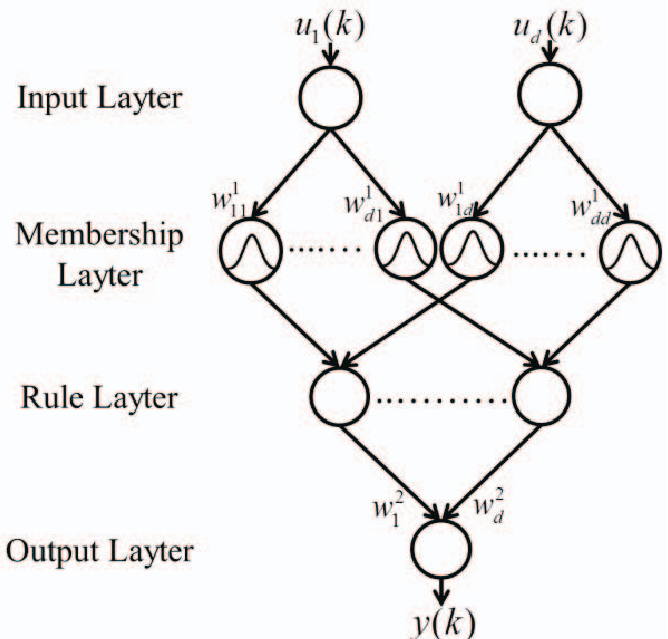
The authors argue that similarity isn't binary—it's fuzzy. They propose a four-layer Neuro-Fuzzy Network (NFN) to define the boundaries of potential friends.
1. Structure of the NFN
The model consists of:
- Input Layer: Accepts data dimensions (e.g., age, food preferences).
- Membership Layer: Uses Gaussian Functions to convert raw numbers into fuzzy values.
- Rule Layer: Applies "AND" logic to combine these fuzzy inputs.
- Output Layer: Produces a value between -1 and 1, indicating how likely a user belongs in the "Similar" skyline.
2. Why "Fuzzy" Matters
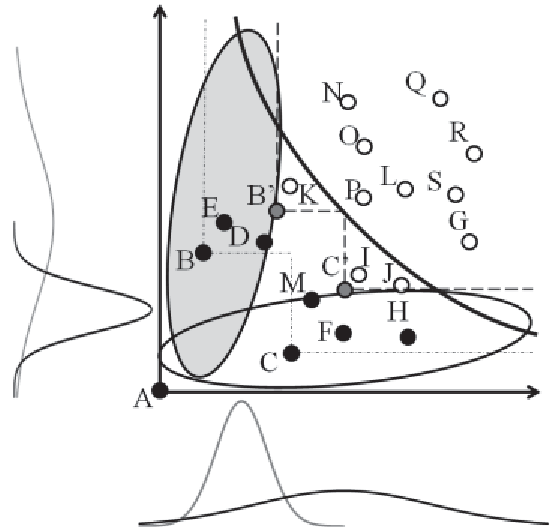
By using Gaussian functions, the model creates "ovals" of influence rather than rigid boxes. This allows the system to adjust the "fuzziness" of the boundary. In the figure below, you can see how the NFN (Figure 2) creates a tighter, more relevant region compared to standard neural approaches that capture irrelevant users (like points I, J, K).
Experiments & Results
The researchers tested their NFN against the then-SOTA neural-based skyline algorithm (Hou et al.) across different data distributions:
- Independent Datasets: Where dimensions have no correlation.
- Anti-correlated Datasets: The "hardest" scenario for skyline algorithms where users who excel in one dimension perform poorly in another.
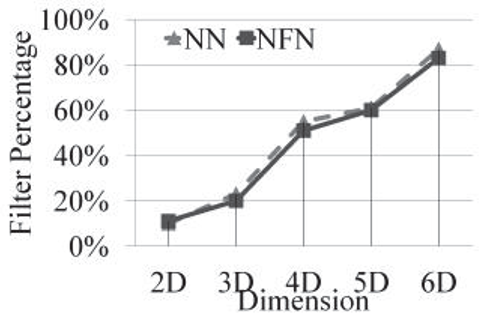
Key Finding: The NFN consistently outperformed the baseline. By narrowing the search area to only include high-probability "similar" users, they achieved higher precision without the overhead of comparing every point in the network.
Critical Insight & Future Outlook
This work highlights a critical trend in AI: Deep Learning is powerful, but Logic makes it efficient. By embedding fuzzy rules into a neural structure, we gain interpretability and precision that "black box" neural networks often lack in niche spatial queries.
Limitations: The authors admit that finding the absolute "optimal" parameters for the NFN is still a challenge. Future Work: The next step involves using Genetic Algorithms to auto-tune the NFN, potentially making the system even more autonomous and accurate for real-time social applications.
Conclusion
If you're building a system that needs to understand "similarity" in a multi-faceted way, the NFN-based Skyline approach provides a compelling blueprint for balancing speed and accuracy in the high-dimensional space of social networks.