
FASTER: Value-Guided Sampling for Fast Diffusion RL
FASTER: Value-Guided Sampling for Fast RL
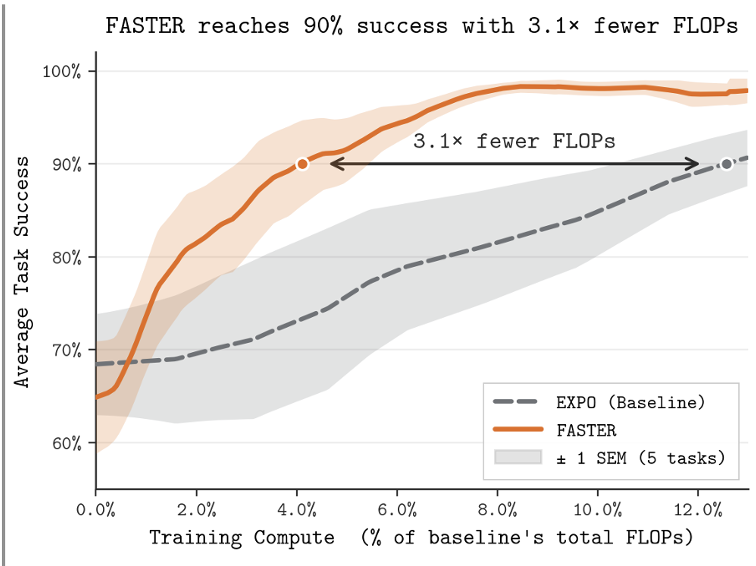
FASTER is a novel framework designed to accelerate test-time scaling for diffusion-based Reinforcement Learning (RL) policies. By modeling the denoising process as a filtering Markov Decision Process (MDP), it selects the most promising noise seeds early, achieving the performance of "Best-of-N" sampling while reducing computational overhead by up to 8x in large-scale Vision-Language-Action (VLA) models.
TL;DR
Diffusion-based Reinforcement Learning (RL) has set new benchmarks in robotics, but its "Best-of-N" sampling strategy—often necessary for performance—is a computational nightmare. FASTER (Value-Guided Sampling for Fast RL) fixes this by learning to predict the quality of an action from its initial noise seed. By filtering candidates before denoising begins, it achieves the performance of massive sample sets with the cost of a single rollout.
Background: The Cost of Excellence
In modern robotics, expressive policies (like Diffusion or Flow Matching) are the gold standard. To ensure safety and success, researchers often use "test-time scaling": sampling different potential actions, denoising all of them, and then using a critic (value function) to pick the best one.
While this "Best-of-N" approach works, it is catastrophically slow. If you have a 3-billion-parameter VLA model and you want to sample 8 actions, your latency multiplies by 8. In a high-speed manipulation task, this latency is the difference between a successful grasp and a collision.
Methodology: Denoising as an MDP
The core insight of FASTER is that the "goodness" of a sample is often visible early in the denoising chain. The authors frame the denoising process as a Filtering Markov Decision Process (MDP).
The Filtering MDP Architecture
Instead of waiting until the end of the 10-50 denoising steps to evaluate an action , FASTER evaluates the initial noise .
- State: Includes the environment state and the current set of noise/intermediate candidates.
- Action: A binary decision—keep or discard a candidate.
- Reward: The value of the final denoised action, .
In practice, the authors found that filtering at Step 0 (the noise level) is surprisingly effective. They train a "Noise Critic" to regress toward the value of the ultimate action that the noise would produce.
Algorithm Efficiency
By shifting the selection to the noise level, the computational complexity changes dramatically:
- Standard Best-of-N:
- FASTER:
Since (evaluating a small MLP) is much cheaper than (denoising a large Transformer), and we only denoise one candidate for steps, the savings are massive.
Experimental Battleground
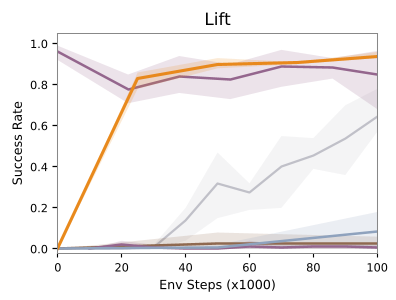
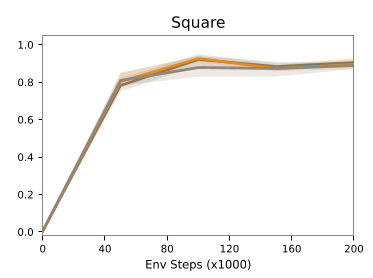
FASTER was tested against state-of-the-art RL baselines like EXPO, IDQL, and RLPD on challenging manipulation tasks (Robomimic and LIBERO).
1. Performance Parity with Best-of-N
One might fear that choosing a candidate based only on "noise" is inaccurate. However, results shown in Figure 3 demonstrate that FASTER-EXPO maintains nearly identical success rates compared to the full Best-of-N EXPO while being significantly faster.
2. Scaling to VLAs (3.3B Parameters)
The most impressive result comes from applying FASTER to a pretrained Vision-Language-Action model.
- Update Time: Dropped from 11.6s to 2.5s per step.
- Inference FLOPs: Reduced by 8x.
- Latency: 1.7x speedup for real-time control.
Deep Insight: Why Not Just Distill?
A common alternative to speed up diffusion is Distillation (training a single-step policy to mimic the best-of-N result). The authors show that FASTER significantly outperforms distillation (Figure 11). This is because distillation creates a moving target as the Q-function updates during RL, leading to instability. FASTER, by contrast, solves a simpler "filtering" problem, which is much more stable during online learning.
Critical Analysis & Conclusion
FASTER is a "plug-and-play" module for any generative RL algorithm. It cleverly exploits the Crystal Ball Hypothesis (the idea that the final structure of a generated sample is encoded in the initial noise).
Limitations:
- It requires the policy to be noise-based (diffusion/flow).
- While it improves computational efficiency, it doesn't inherently improve the sample efficiency—it still needs the same amount of environment data as the base algorithm.
Future Outlook: This work paves the way for deploying massive 10B+ parameter Foundation Models in robotics without the lag that usually plagues multi-sample verification. It suggests that the future of "Model-Based" or "Generative" robotics lies in smarter, earlier filtering rather than just raw hardware scaling.