
fastText for Russian Emotions: Tackling the Chaos of Internet Discourse
fastText-based methods for Emotion Identification in Russian Internet Discourse
The paper presents a framework for automatic emotion identification in Russian informal Internet discourse (Telegram, VK). By leveraging fastText embeddings and deep learning architectures, the authors achieve a state-of-the-art F1-score of 0.81 using a Logistic Regression classifier built on top of subword-informed word vectors.
TL;DR
Researchers from the Higher School of Economics have set a new benchmark for emotion detection in Russian social media. By moving beyond traditional word-level analysis to subword-level fastText embeddings, they achieved an F1-score of 0.81, significantly outperforming deep learning models like CNNs and LSTMs. The study reveals that in the world of Telegram and VK, "how" we say things (functional words) matters just as much as "what" we say.
Contextual Positioning
This work represents a critical transition in Russian NLP from traditional feature engineering to representation learning. It specifically addresses the "Internet Discourse" – a unique hybrid of written and oral speech characterized by intentional linguistic "games" and misspellings that usually break standard NLP pipelines.
The Problem: Why Russian Social Media is an NLP Nightmare
Most emotion detection models are optimized for English, a language with relatively simple morphology. Russian, however, is highly inflected. When you add "Internet Discourse" to the mix, you get:
- Intentional Alterations: Users change spelling to add expressiveness.
- Asynchronous Nature: Lack of tone and face-to-face cues forces users to rely on specific lexical choices.
- Data Sparsity: Short messages often lack the context required for massive neural networks to converge effectively.
Methodology: Subwords over Deep Layers
The authors hypothesized that fastText would be the silver bullet for this task. Unlike Word2Vec, which treats words as atomic units, fastText breaks words down into character n-grams.
- Why it works: If a model sees a misspelled version of "happiness," it can still recognize the root n-grams.
- The Experiment: The team tested 8 different models, comparing standalone fastText classifiers against architectures like CNN (local patterns) and LSTM/GRU (long-range dependencies).
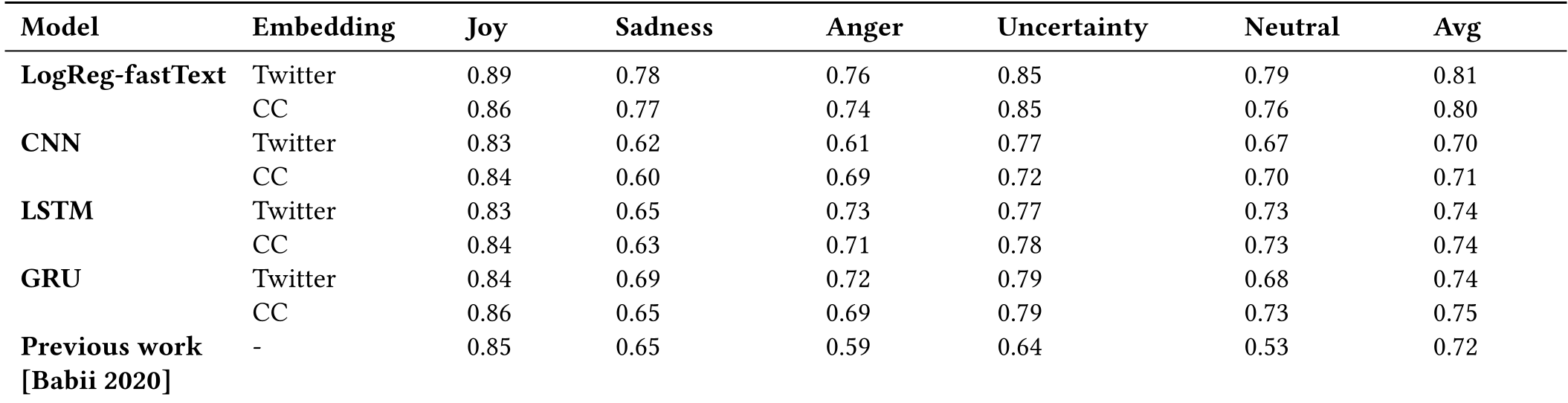 Table: LogReg-fastText consistently outperformed complex NN architectures across most emotion labels.
Key Insights from Experimental Results
1. The Superiority of "Simple" Classifiers
Surprisingly, the Logistic Regression + fastText combination outperformed LSTMs and GRUs. This suggests that for short informal messages, the quality of the word representation (the embeddings) is more critical than the depth of the neural network architecture.
2. The "Functional Word" Revelation
In many NLP tasks, "stop words" (and, but, or) are discarded. This study found that removing functional words caused a 10% drop in F1-score. In emotional Russian discourse, these words provide the structural framework that signals sentiment.
3. Emotion-Specific Sensitivity
The models found Joy significantly easier to detect than Sadness or Anger.
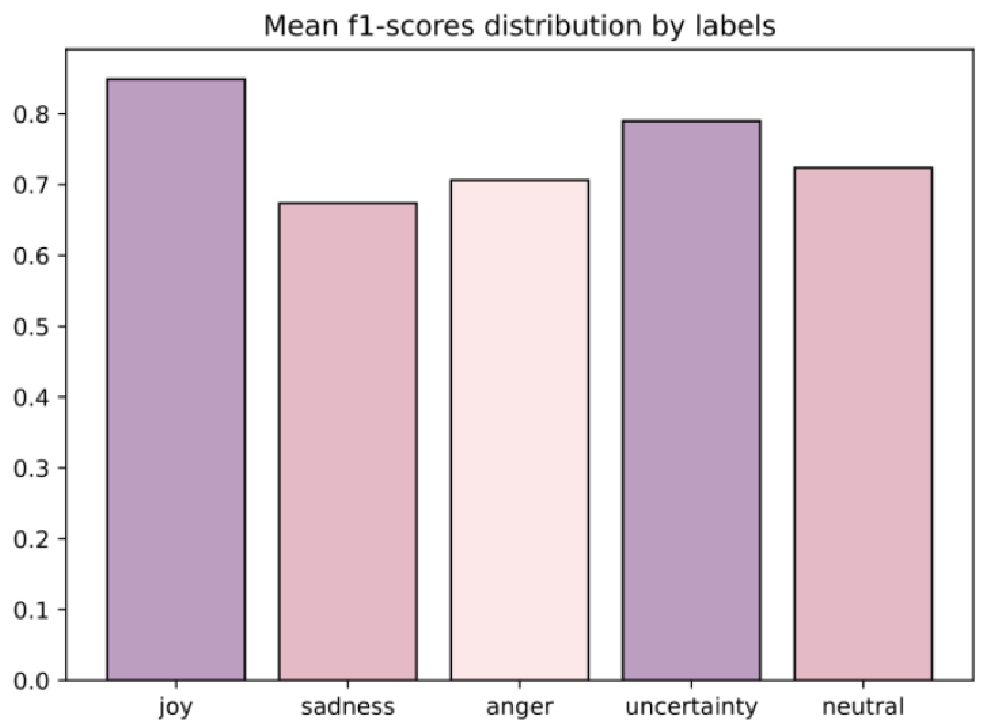 Figure: The "Joy" category acts almost like a binary sentiment task, making it the most recognizable class.
Critical Analysis & Future Outlook
While the F1-score of 0.81 is impressive, the study notes a high confusion rate between "Neutral," "Anger," and "Sadness." This suggests that negative emotions in Russian Internet discourse may share overlapping linguistic features that even subword embeddings can't fully disentangle.
Future Directions: The authors point toward Transformer-based architectures (BERT) and broader emotion classifications (like Plutchik’s 8 emotions) as the next frontier. Using these tools to build empathetic chatbots or suicide prevention programs could move this research from pure academics to life-saving technology.
Conclusion
This research proves that for noisy, morphologically complex languages, inductive biases toward subword structures (like those in fastText) are essential. It challenges the "remove stop words" dogma and provides a robust blueprint for analyzing the emotional pulse of the modern Web.