
Fauxvea: Democratizing Eye-Tracking via Crowdsourced Cursor Interactions
Fauxvea: Crowdsourcing Gaze Location Estimates for Visualization Analysis Tasks
Fauxvea is a crowdsourcing method for estimating gaze locations in static visualizations using a Web-based "Restricted Focus Viewer" (RFV) interface. By requiring users to deblur regions with cursor interactions, it captures fixation data that closely approximates traditional eye-tracking hardware results across various chart types and analysis tasks.
TL;DR
Can we know where users are looking without a $30,000 eye-tracker? Fauxvea proves we can. By using a "blur-and-reveal" interface on Amazon Mechanical Turk, researchers can now estimate gaze fixations with professional-grade accuracy using nothing but standard mouse clicks. This work bridges the gap between expensive lab studies and scalable web-based user research.
The Hardware Bottleneck in Visualization Research
In the field of Information Visualization (Infovis), knowing where a user’s attention goes is the "Holy Grail." It tells us if a legend is being ignored, if a trend is being misread, or if a chart is too cluttered. Traditionally, this required Eye-Tracking (ET) hardware.
However, ET has three major friction points:
- Cost: High-end trackers are expensive.
- Geography: Participants must physically come to a lab.
- Scale: Recruiting 100 people for a lab study is a logistical nightmare.
While "moving window" techniques (like MOUSELAB) have existed since the 80s, they were often too clunky for the nuanced layouts of modern data visualization. Fauxvea enters the scene as a refined, web-optimized implementation of the Restricted Focus Viewer (RFV) principle.
Methodology: The "Blur-and-Click" Insight
The core philosophy of Fauxvea is simple: If the whole screen is blurred, the user must tell the computer what they want to see.
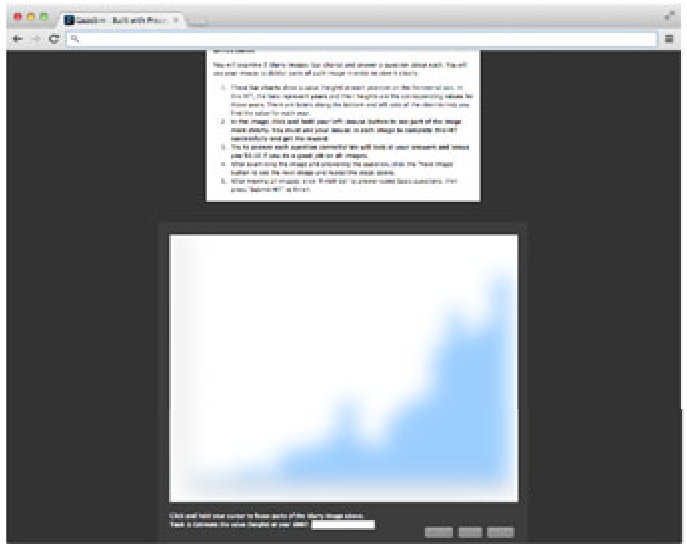
How it works:
- Gaussian Pre-processing: The visualization is blurred to a level where the task (e.g., "What is the value in 2008?") is impossible to solve.
- The Focus Window: When a user clicks and holds, a circular region (mimicking the human fovea's 1-2 degree arc) is rendered sharp.
- Explicit Fixations: Unlike "hover" tracking, Fauxvea requires a press-and-hold. This creates a clean "Start Time" and "End Time" for each fixation, allowing for the calculation of duration and transition sequences.
Proving the Parity: Experiment Results
The researchers didn't just build a tool; they ran a rigorous three-stage validation to prove that "Mouse Gaze" equals "Eye Gaze."
1. Qualitative & Quantitative Alignment
In a head-to-head battle between 18 lab-based participants (using SMI Eye-Trackers) and 100 Turkers, the heatmaps were strikingly similar. Whether analyzing bar charts or scatter plots, the "hot spots" fell on exactly the same semantic elements (axes, outliers, labels).
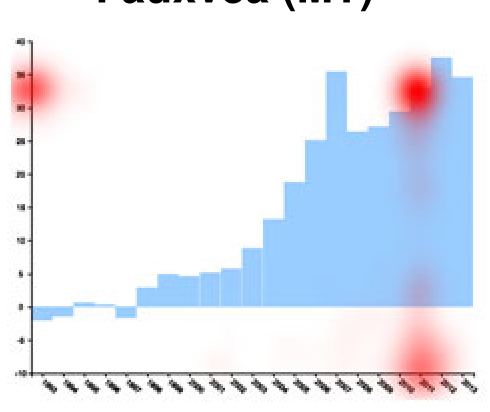 Above: Comparison between real eye-tracking (left) and Fauxvea estimates (right). Notice the high spatial correlation on task-relevant chart areas.
2. The Replication Test
The ultimate test of a proxy method is whether it can replicate published scientific findings. The authors chose a classic study on Tree Layouts (Burch et al.). Fauxvea successfully replicated complex exploration behaviors, such as the frequency with which users jump between the root node and specific leaf nodes.
Deep Insight: Beyond Saliency
One of the paper's most critical contributions is the comparison against Computational Saliency Models. Algorithms can predict what is "visually loud" (bright colors, high contrast), but they cannot predict "task intent."
Fauxvea outperforms these models because it captures Human Intent. As shown in the results, even if a part of a chart is visually salient, users only "deblur" it if it helps them solve the assigned task. This makes Fauxvea a superior tool for UX and UI designers compared to automated AI heatmaps.
Limitations & The Path Forward
While revolutionary, the authors note a crucial distinction:
- Saccades vs. Clicks: Moving a cursor is "heavier" than moving an eye. This leads to slightly longer "fixation" durations in Fauxvea.
- Covert Attention: The system cannot capture "looking out of the corner of your eye."
Conclusion
Fauxvea marks a shift in visualization pedagogy. It transforms the browser from a simple display into a sophisticated sensor. For researchers, this means the ability to run "eye-tracking" studies with hundreds of participants overnight for a fraction of the cost, moving the field of visualization design toward a more data-driven, evidence-based future.
Key Takeaway: Don't buy a tracker; build a better interface. Fauxvea demonstrates that intentional interaction is an excellent proxy for visual attention.