
Favors from Facebook Friends: Unpacking the Hidden Dimensions of Social Capital
Favors from Facebook Friends: Unpacking Dimensions of Social Capital
This research investigates the conversion of social capital into tangible favors on Facebook using an experimental approach (N=98). The authors deconstruct Williams’ Internet Social Capital Scales (ISCS) into granular sub-dimensions to identify which specific facets of social relationships actually drive network responsiveness, moving beyond binary bridging/bonding categories.
TL;DR
Does having thousands of Facebook friends actually help when you need a favor? This study moves beyond the vague concepts of "bridging" and "bonding" to show that only specific sub-facets—like the perception of Individual Benefit—actually predict whether your friends will step up. By combining a lab experiment with rigorous factor analysis, the researchers reveal that your history of asking for help and the specific way you word your request matter far more than your total friend count.
The Granularity Gap: Why "Social Capital" is Too Vague
For years, HCI researchers have used social capital to explain the benefits of social media. The standard model uses two buckets:
- Bonding: Deep, emotional support from close ties.
- Bridging: Broad, informational access from weak ties.
The problem? As the authors point out, these broad buckets are "missing more fine-grained nuances." If you ask for a favor, is it because you feel "connected to the bigger picture" (Bridging) or because you have someone you "trust to help solve problems" (Bonding)? By treating these as monolithic scales, researchers often fail to see which mechanism is actually doing the heavy lifting.
Methodology: From Perceptions to Action
The researchers conducted a two-phase study:
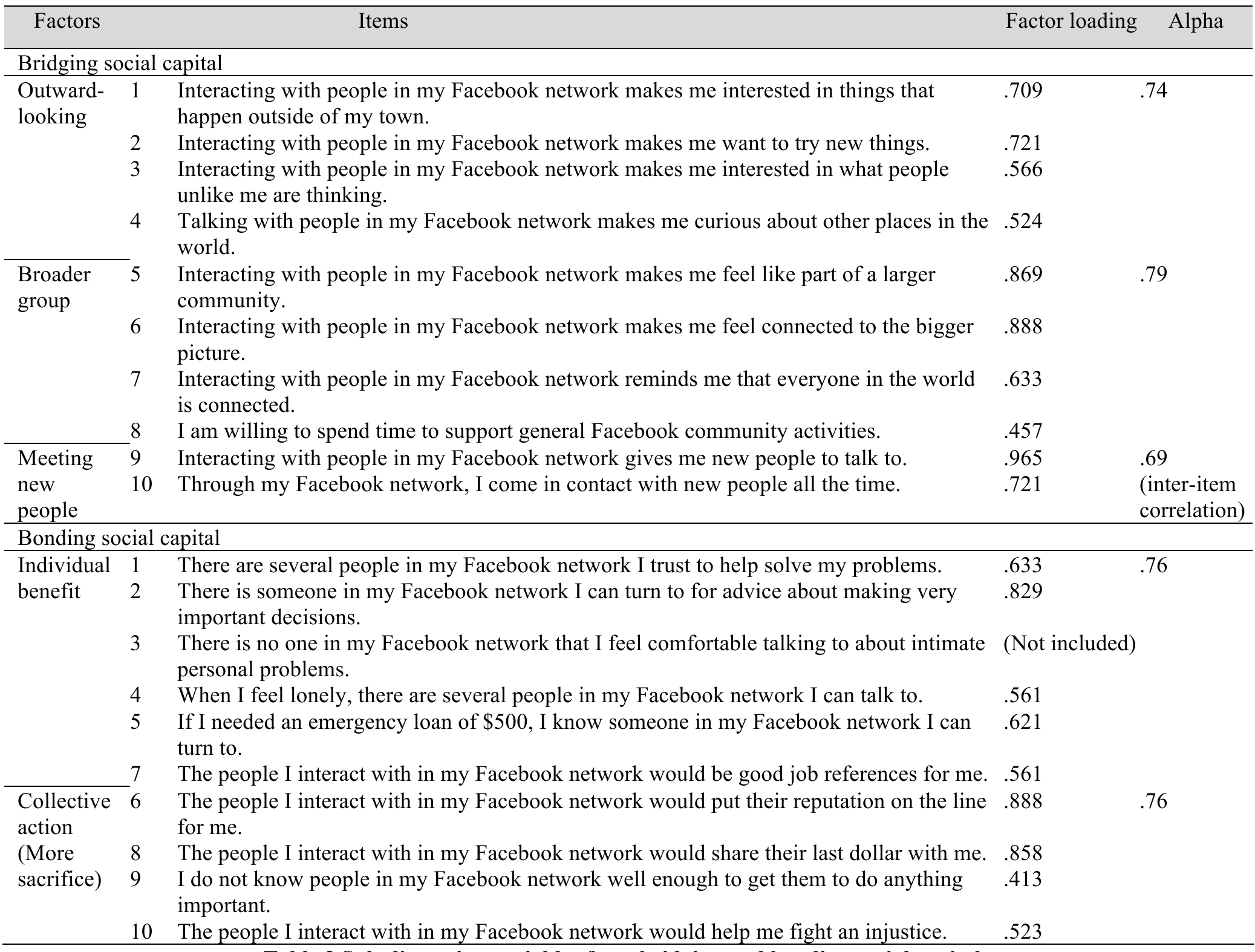
- Deconstruction: They took the 20-item Internet Social Capital Scales (ISCS) and used Confirmatory Factor Analysis (CFA) to verify sub-dimensions.
- The Favor Experiment: 98 participants were asked to post a real request on their Facebook walls: "Please fill out this survey for me." Friends who responded were essentially providing a "micro-favor" that required time and effort.
The Refined Framework
Through their analysis, the authors identified several distinct sub-factors:
- Bridging Sub-factors: Outward-looking, Broader group, Meeting new people.
- Bonding Sub-factors: Individual benefit (advice/emergency help), Collective action (sacrifice/reputation).
Key Findings: What Actually Triggers a Response?
1. Perceived Individual Benefit is King
The most striking finding was that the standard Bridging and Bonding scores were not significant predictors of getting favors. However, when looking at sub-dimensions, Individual Benefit was a powerful positive predictor. If you believe your network contains people you can turn to for advice or emergency loans, you are significantly more likely to receive responses to a favor request.
2. The "New People" Penalty
Interestingly, the sub-dimension "Meeting New People" had a marginal negative effect. The authors suggest that users who view Facebook primarily as a place to meet strangers might not be building the "reciprocal interactions" necessary to sustain a favor-based economy.
3. Rhetoric Matters
How you ask is just as important as who you know. The study identified six rhetorical strategies. Using a higher variety of these strategies led to more responses.
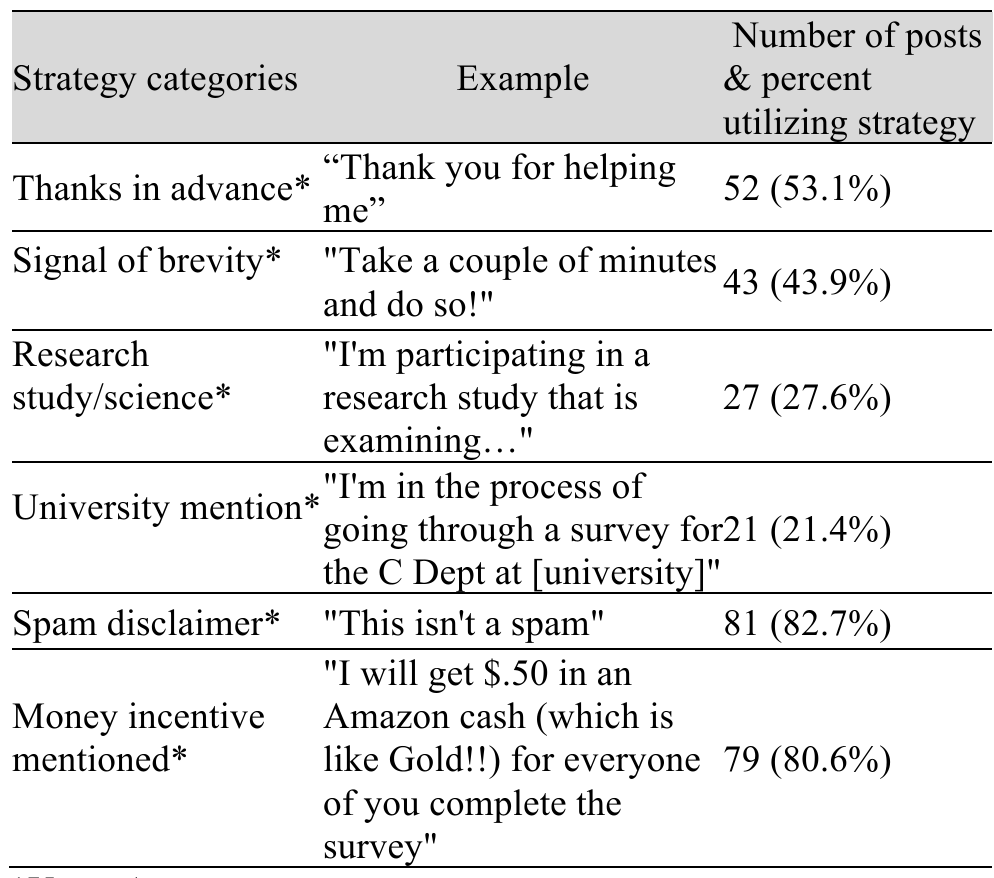
- The Power of Affiliation: Explicitly mentioning the "University" was one of the most effective strategies. By highlighting a shared sub-cluster, the requester reduces the "decisional cost" for the friend to help.
- Incentives vs. Participation: Mentioning an incentive (like the $0.50 Amazon credit) was effective at getting at least one person to respond, but it didn't necessarily drive a high volume of responses.
Critical Insight: The Visibility Paradox
The study also found that the Frequency of asking for help was a strong predictor of success. This might be due to two factors:
- Skill: Frequent askers get better at framing requests.
- Algorithmic Visibility: Facebook’s EdgeRank algorithm prioritizes active users. If you engage with your network frequently, your "favor request" is more likely to actually appear in your friends' feeds.
Conclusion and Future Outlook
This paper serves as a wake-up call for social capital researchers: aggregated scales are not enough. To understand how digital platforms facilitate resource exchange, we must look at the specific sub-dimensions of those relationships.
For designers, the takeaway is clear: don't just build for "connecting people." Build for "Relational Investment." Tools that make favors visible, emphasize shared affiliations, and lower the friction of "social grooming" will ultimately create more robust, helpful networks.
Limitations to consider: The study was conducted in 2013; today's algorithmic landscape and the shift toward private messaging (WhatsApp/Messenger) rather than public wall posts might change these dynamics, but the underlying psychological dimensions of social capital remain relevant.