
FB2vec: Decoding the Triadic Logic of Social Forwarding Behaviors
FB2vec: A Novel Representation Learning Model for Forwarding Behaviors on Online Social Networks
This paper introduces FB2vec, a novel representation learning framework designed to model information dissemination in social networks by embedding forwarding behaviors. Unlike traditional node-centric embeddings, it represents the triadic relationship between generators, forwarders, and receivers, achieving SOTA performance in behavior prediction and user similarity tasks on WeChat and Weibo datasets.
TL;DR
FB2vec is a specialized representation learning model that moves beyond simple "friendship" links to model the triadic process of information dissemination. By leveraging a multi-modal autoencoder and a utility-based intensity function, it maps Generators, Forwarders, and Receivers into a unified latent space, significantly outperforming traditional embeddings in predicting user behavior and detecting similarities.
Background: Beyond the Sparsity of Friendships
Most social network analysis relies on "who is friends with whom." However, friendship networks are notoriously sparse. Two users might share identical interests but never connect. In contrast, forwarding behaviors (retweets, shares) are much denser and reflect actual information flow.
The authors identify a critical gap: existing models treat links as binary or pairwise, but a forwarding event is a triadic relationship:
- Generator (): The original source of content.
- Forwarder (): The intermediary who spreads it.
- Receiver (): The final consumer who is influenced.
Methodology: The FB2vec Framework
FB2vec treats user representation as a multi-faceted embedding problem. It uses a Multi-modal Autoencoder to fuse two streams of data: Topological Structure (via DeepWalk) and Profile Features (demographics or categorical data).
1. The Information Intensity Function
The most innovative part of FB2vec is its borrowing from economics. To decide if a receiver will engage with content from generator via forwarder , the model defines an Information Intensity Function based on a utility function:
Here, represents the trade-off between Content Influence (the generator) and Social Influence (the forwarder). This allows the model to learn whether a specific user forwards an article because they like the topic or because they trust the person who shared it.
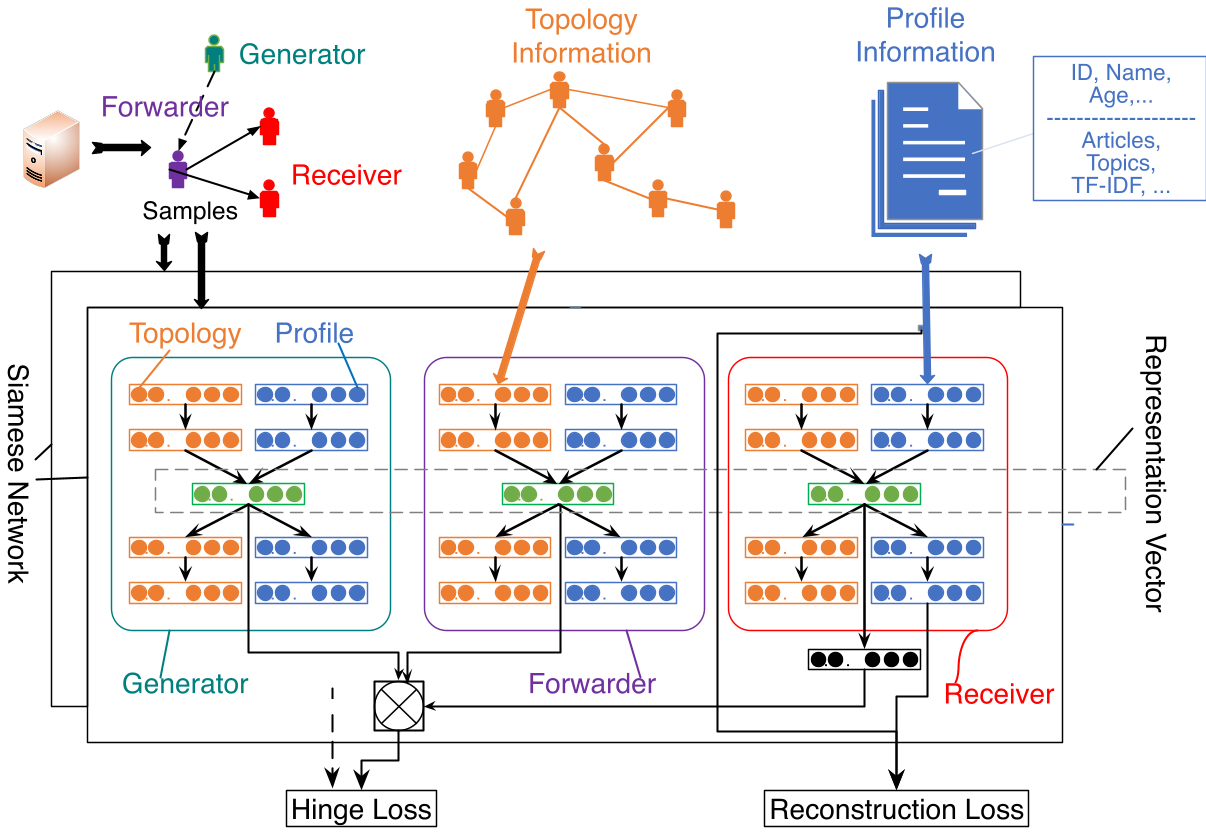 Figure 1: The FB2vec framework showing the dual-branch autoencoder and the Siamese network structure for intensity training.
2. Learning through Comparison (Siamese Network)
Because "forwarding intensity" isn't a simple linear value, the authors use a Siamese Network with a Large Margin Strategy. Instead of teaching the model "this user forwarded 10 times," they teach it "User A is more likely to forward this than User B" using pairwise sampling.
Experimental Analysis
The model was tested on two massive real-world datasets: WeChat Articles and Sina Weibo.
Behavior Prediction Results
FB2vec consistently beat state-of-the-art models like SDNE and DANE. In the WeChat dataset, the precision reached 0.940, compared to 0.791 for DeepWalk.
| Model | WeChat F1 | Weibo F1 |
|---|---|---|
| DeepWalk | 0.781 | 0.562 |
| SDNE | 0.869 | 0.611 |
| FB2vec | 0.944 | 0.676 |
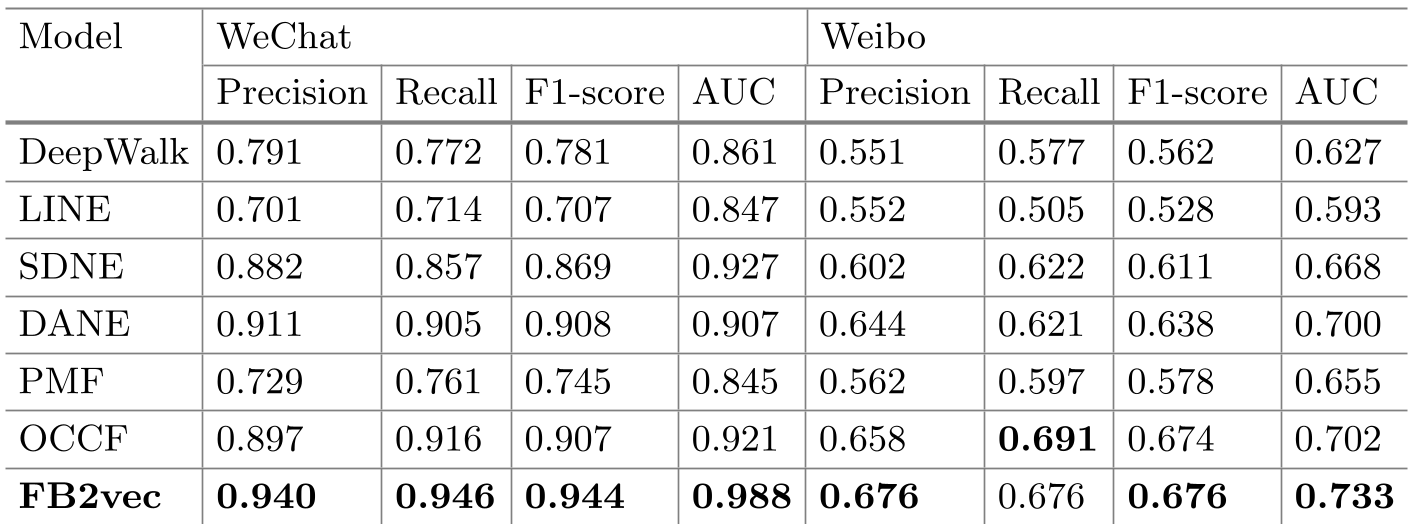 Table 1: Performance comparison across diverse metrics. FB2vec shows superior robustness.
Visualizing "Social Interest"
The parameter study reveals fascinating sociological insights. By analyzing the values, the model showed that for WeChat Official Accounts:
- Military Accounts primarily attract older male users.
- Entertainment Accounts skew heavily towards younger female audiences.
- News Accounts have a more uniform, cross-demographic appeal.
Critical Analysis & Conclusion
Takeaway
FB2vec successfully demonstrates that behavioral triples contain significantly more information than structural edges. By decomposing "influence" into content and social components, the model provides a interpretable way to understand why information spreads.
Limitations & Future Work
- Dynamic Modeling: Currently, the model is static. Social networks evolve rapidly; integrating temporal dynamics (how interests change over time) is a logical next step.
- Computational Complexity: While more accurate, the triadic sampling (Algorithm 1) is more computationally expensive than traditional random walks.
- Cross-Platform Application: The framework is set up to be general, making it a prime candidate for multi-platform user alignment (e.g., matching a user's behavior on Twitter vs. LinkedIn).
In summary, FB2vec provides a sophisticated, mathematically grounded bridge between economic utility theory and deep network embeddings.