
The Digital Battlefield of Recruitment: Analyzing FBI Branding Amidst Political Noise
17174_Assessing e-Recruiting on Social Media FBI Case Study.
This study presents a computational analysis of the FBI's Twitter (X) recruitment campaign, examining the interplay between official messaging and public engagement. By utilizing topic modeling and temporal spike analysis, the research identifies how institutional branding competes with external socio-political events in the digital sphere.
Executive Summary
TL;DR: This research investigates the effectiveness of the FBI’s Twitter recruitment strategy, revealing that while the agency focuses heavily on diversity and career development, the narrative is frequently hijacked by external political events. The study identifies a "dependency" on non-government retweets for reach, making the brand vulnerable to the prevailing political climate.
Context: In the landscape of digital sociology and computational communication, this work serves as a critical case study on how "Institutional Branding" interacts with "Real-world Volatility." It moves beyond simple sentiment analysis to show the structural limitations of social media as a recruitment tool for high-stakes governmental roles.
Problem & Motivation
Modern recruitment is no longer just about job postings; it is about identity. The FBI aims to project an image of professionalism and diversity to attract a new generation of Special Agents. However, the agency does not operate in a vacuum.
The core challenge identified by the authors is the Interference Effect: How can a recruitment message about "Diversity in the FBI" compete with a breaking news story about a raid on a high-profile political figure? Existing literature often treats recruitment campaigns as isolated variables, but this paper argues that the public’s "search intent" and engagement are fundamentally reactive to the broader socio-political ecosystem.
Methodology: Decoding the Narrative
The researchers didn't just count likes; they categorized the "Nature of Converse" using Structural Topic Modeling (STM).
1. Topic Distribution
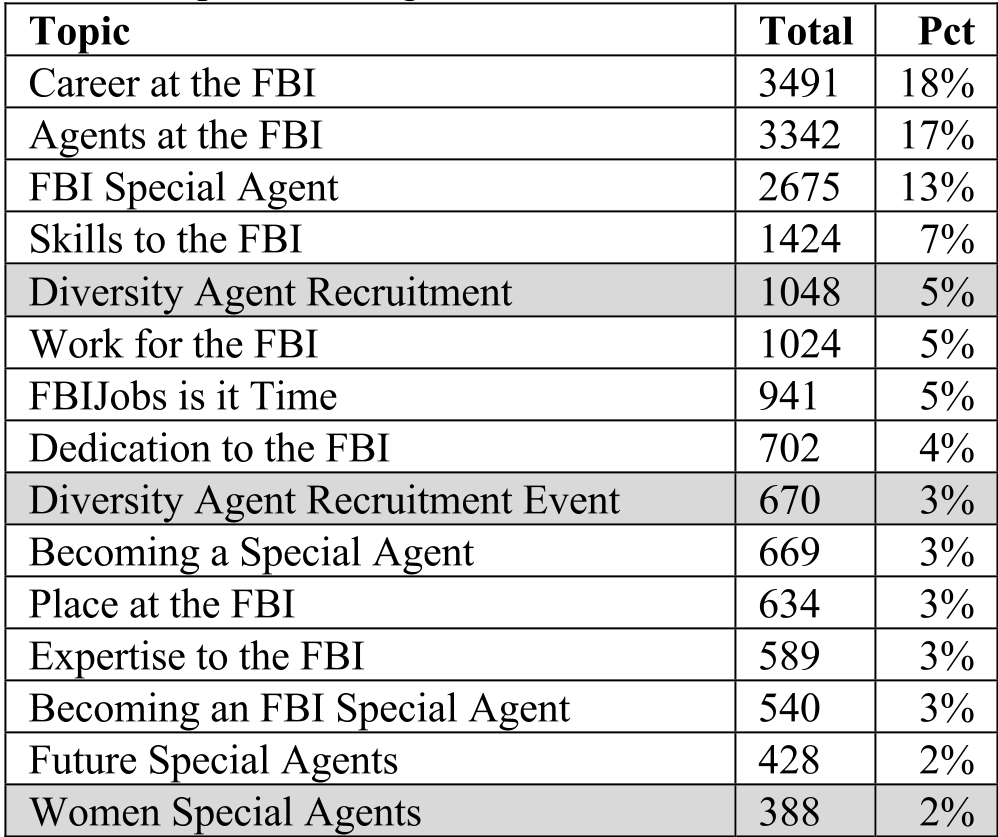
By analyzing thousands of tweets, the study broke down the FBI's digital footprint into distinct buckets. As seen in the table below, recruitment for Special Agents and Diversity programs constitutes a significant portion of the intentional messaging.
2. Temporal Spike Analysis
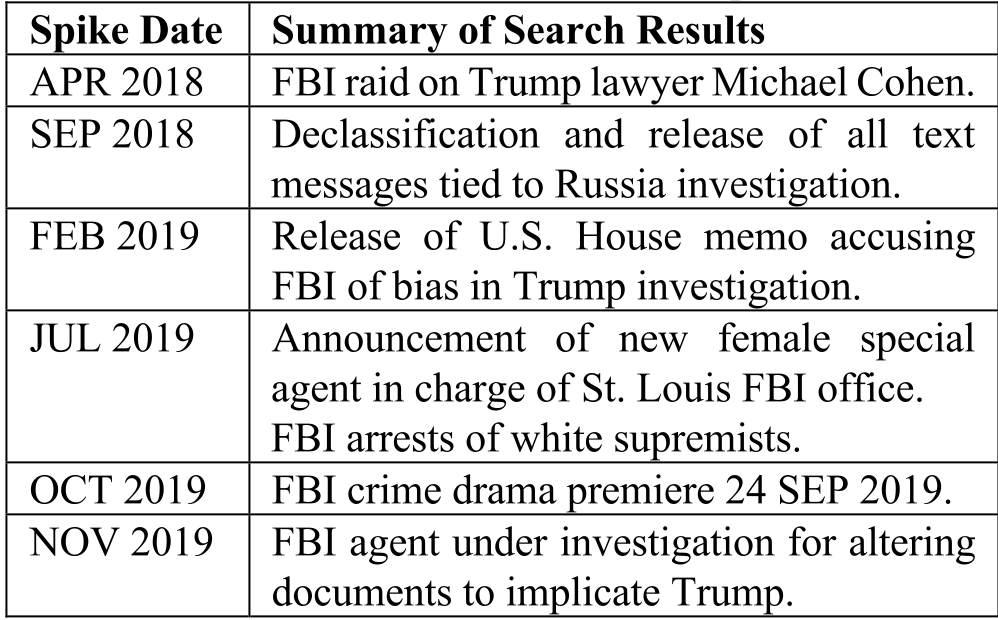
The authors mapped the volume of tweets over time against a timeline of major news events. This allowed them to see if a spike in "FBI" mentions was due to a successful career campaign or a controversial legal investigation.
Key Findings: The Retweet Paradox
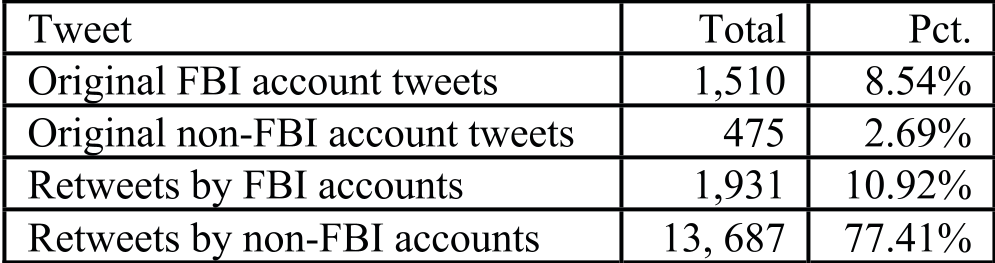
One of the most striking insights is the distribution of content. Only 8.54% of the tweets in the dataset were original content from official FBI accounts. A staggering 77.41% were retweets by non-FBI accounts.
- Insight: The FBI’s message is highly "leveraged." It relies on private citizens and news organizations to amplify its presence. This creates a double-edged sword: high reach, but zero control over the surrounding context or sentiment.
The data shows that major spikes in activity (e.g., April 2018 or February 2019) were not caused by recruitment drives, but by events like the Michael Cohen raid or declassification of text messages. This suggests that the "Recruitment Brand" is constantly being re-contextualized by "Agency News."
Critical Analysis & Conclusion
Takeaway
The FBI’s digital recruitment success is tethered to its public reputation. The study proves that for government agencies, social media engagement is 80% reactive and 20% proactive. If the proactive branding (Recruitment) lacks the momentum of the reactive news (Investigations), the recruitment message is effectively drowned out.
Limitations
The study primarily focuses on volume and topic categorization. Future research should delve deeper into the conversion funnel: do these Twitter engagements actually translate into job applications, or are they merely digital "noise" that reaches people who have no intention of applying?
Future Outlook
As agencies move toward more decentralized or "human" branding (using individual agents as influencers), the problem of political interference may intensify. The future of government recruitment lies in building "Resilient Brands" that can maintain a steady signal even during periods of high political turbulence.