
FCM: Precision Task Assignment in Crowd-Sensing via Ontology and Decision Trees
FCM: A Fine-Grained Crowdsourcing Model Based on Ontology in Crowd-Sensing
The paper proposes the Fine-grained Crowdsourcing Model (FCM), an ontology-based framework for Mobile Crowd Sensing (MCS) that matches service requests with providers. It utilizes an ontology triple structure and a hybrid approach involving similarity analysis and decision trees to achieve high-precision recommendations.
TL;DR
The Fine-grained Crowdsourcing Model (FCM) is a sophisticated framework designed to solve the "matching problem" in Mobile Crowd Sensing. By moving beyond simple keyword matching, FCM uses Ontology triples to model user behavior and Decision Trees to predict service quality, significantly outperforming traditional genetic algorithms (CoDiGA) in recommendation accuracy.
Background & Motivation: The Granularity Gap
In the era of ubiquitous computing, mobile devices act as sensors, but the challenge lies in Information Asymmetry. Requesters don't know which providers are reliable, and providers often receive tasks mismatched to their context. Prior researchers often treated sensing tasks as monolithic entities, failing to account for the "Fine-grained" nuances—such as varying success rates over different service types or the evolving nature of user behavior.
Methodology: The Three Pillars of FCM
1. The Ontology Triple: Standardizing Heterogeneity
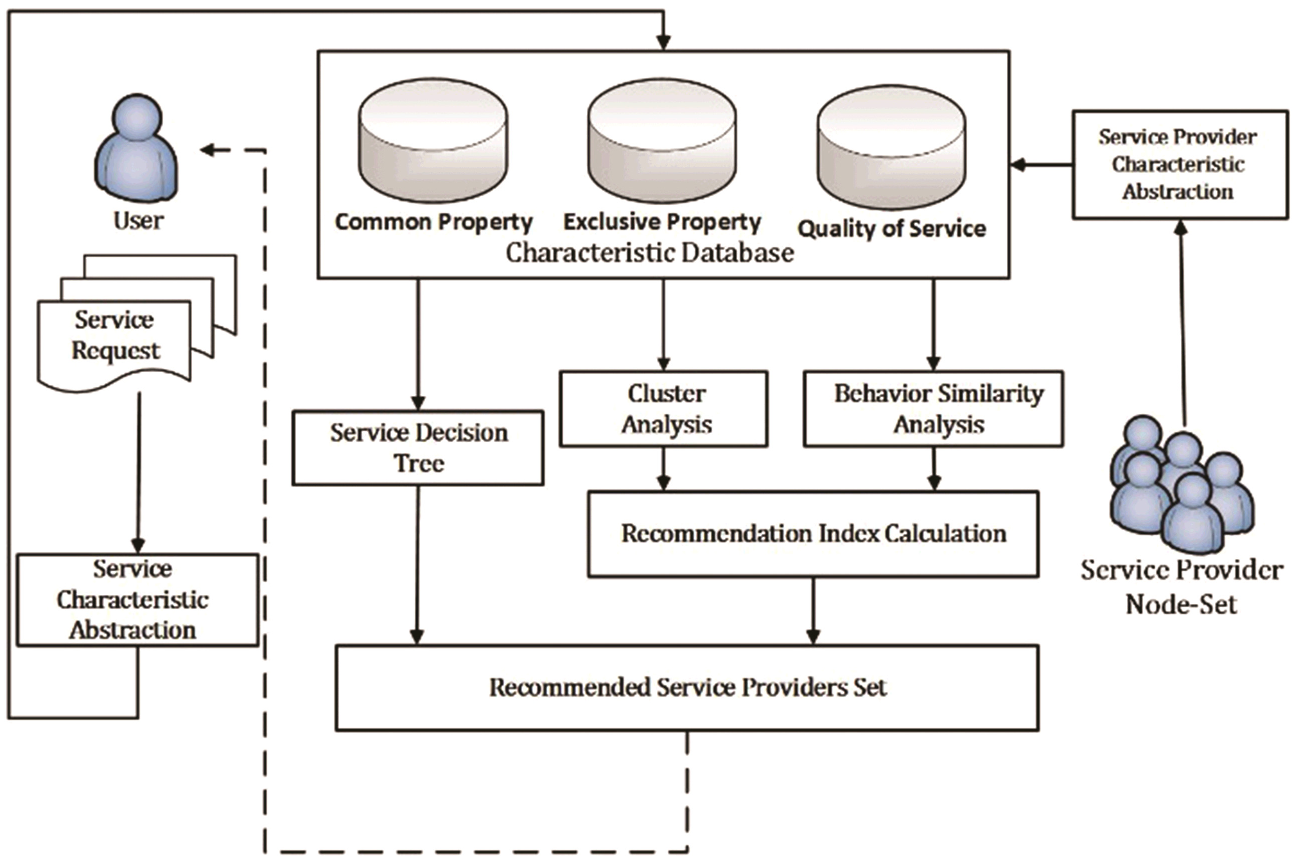
To bridge the gap between different service entities, FCM defines every user via a triple: <CP, EP, QoS>.
- Common Property (CP): Basic identification.
- Exclusive Property (EP): Spatio-temporal context (Location, Availability, Type).
- QoS Property: The "Truth" layer containing historical Valuation and Success Rate matrices.
2. Computing the Recommendation Index
The model calculates a score for each provider based on two dimensions of similarity:
- User Behavior Similarity: Uses the Pearson Correlation Coefficient to find "Look-alike" users who share similar valuation patterns.
- Type Similarity: Leveraging Information Theory, it calculates how close two service types are based on their depth in a Concept Hierarchy Tree.
3. Service Decision Tree
When a complex decision involving multiple constraints (Distance, Availability, Success Rate) is required, FCM builds a decision tree. Using the Information Entropy principle, it recursively splits the data to find the provider with the highest probability of a positive outcome.
Experimental Validation
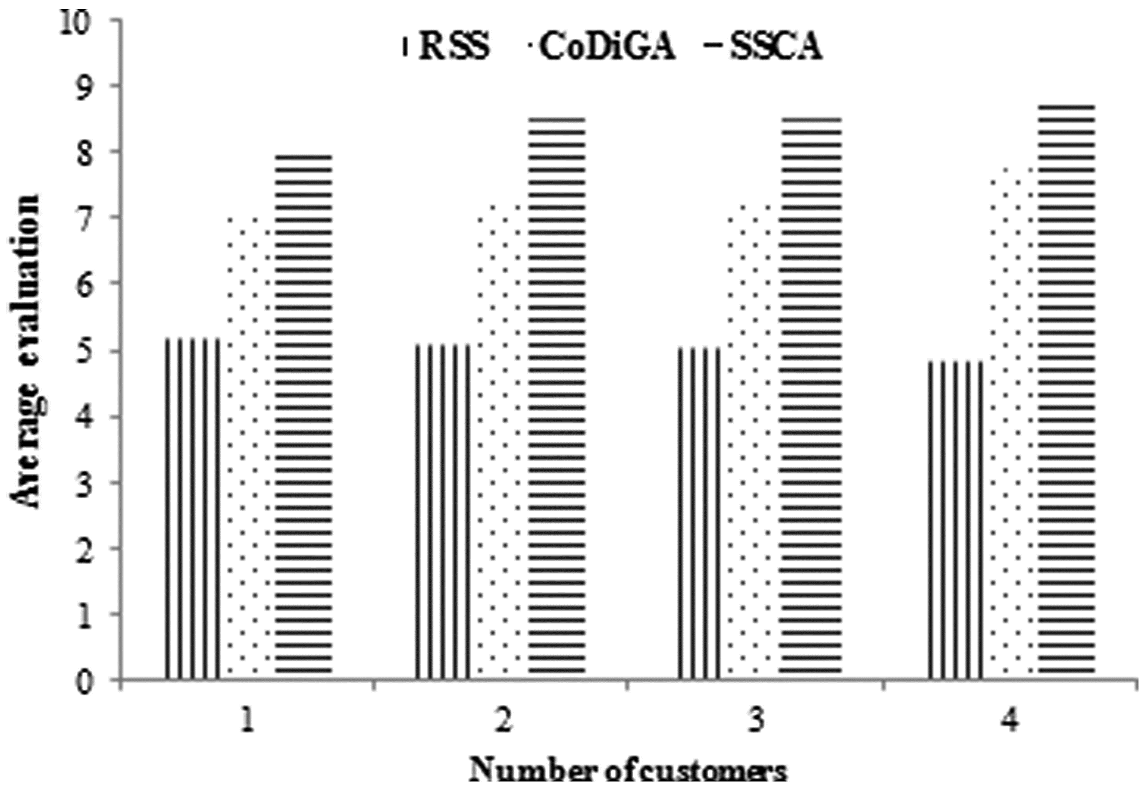
Using a real-world dataset from Dianping.com (5,000 customers), the authors compared FCM against Random Selection (RSS) and the CoDiGA genetic algorithm.
Key Findings:
- Superior Satisfaction: As shown in the performance curves, FCM maintains an average evaluation score significantly higher than CoDiGA, even as the number of service providers scales.
- Scalability: The clustering component of the algorithm allows FCM to maintain low latency even in large-scale environments.
- Index vs. Tree: A fascinating insight from the study is that the Recommendation Index is best for finding a single top provider, while the Decision Tree is more robust when a large set of candidates is needed.
Deep Insight & Conclusion
The true value of FCM lies in its Inductive Bias: it assumes that past performance in semantically similar categories is the best predictor of future success. By formalizing this intuition through Ontology, it creates a flexible "Language" for crowd-sensing.
Limitations: The model heavily relies on historical valuation data. In a "Cold Start" scenario where no prior valuations exist, the Recommendation Index would struggle. Future work should look into integrating Zero-shot Learning or transfer learning to handle new users with no history.
Final Takeaway: For developers of MCS platforms, the transition from simple filtering to ontology-driven decision-making is no longer optional—it is the prerequisite for high customer satisfaction in heterogeneous networks.