
FD-LLM: Bridging the Gap Between Industrial Sensors and Semantic Reasoning
FD-LLM: Large language model for fault diagnosis of complex equipment
The paper introduces FD-LLM, a Multimodal Large Language Model framework designed for complex equipment fault diagnosis. By integrating time-series engineering data with text through modal alignment and a novel fuzzy semantic embedding, it achieves SOTA results, including 94.38% accuracy on aero-engine datasets and over 99% on rock drilling data.
TL;DR
Fault diagnosis in complex machinery—like aero-engines—has long been plagued by "feature aliasing," where different faults look identical to traditional models. FD-LLM resets the benchmark by treating sensor data as a language. By aligning time-series telemetry with a Large Language Model (Vicuna-7B) and using a "fuzzy" embedding strategy, the researchers achieved near-perfect accuracy (up to 99.89%) across multiple industrial datasets.
The "Aliasing" Problem: Why Deep Learning Fails
In stable laboratory conditions, a CNN can easily tell a broken bearing from a healthy one. But inside a roaring GE90-115B engine, the data is messy.
- Readability: Sensors capture high-frequency vibrations and pressures that lack the natural structure of human language or images.
- Pattern Overlap: In the feature space, a "temperature sensor fault" might look mathematically identical to a "blade ablation fault" (aliasing).
- Rigidity: Traditional models are "one-shot" classifiers; they don't explain why a diagnosis was made or allow for a dialogue about maintenance.
Methodology: The Architecture of Intelligence
The core of FD-LLM is not just the LLM itself, but how the data is prepared for it.
1. Modal Alignment (The Translator)
The team used an LSTM as a Data Encoder. Instead of training it in isolation, they used a contrastive learning objective to force the LSTM's output to "align" with the LLM's own text embeddings. If the data shows an EGT (Exhaust Gas Temperature) fault, its vector should land in the same neighborhood as the text description of that fault.
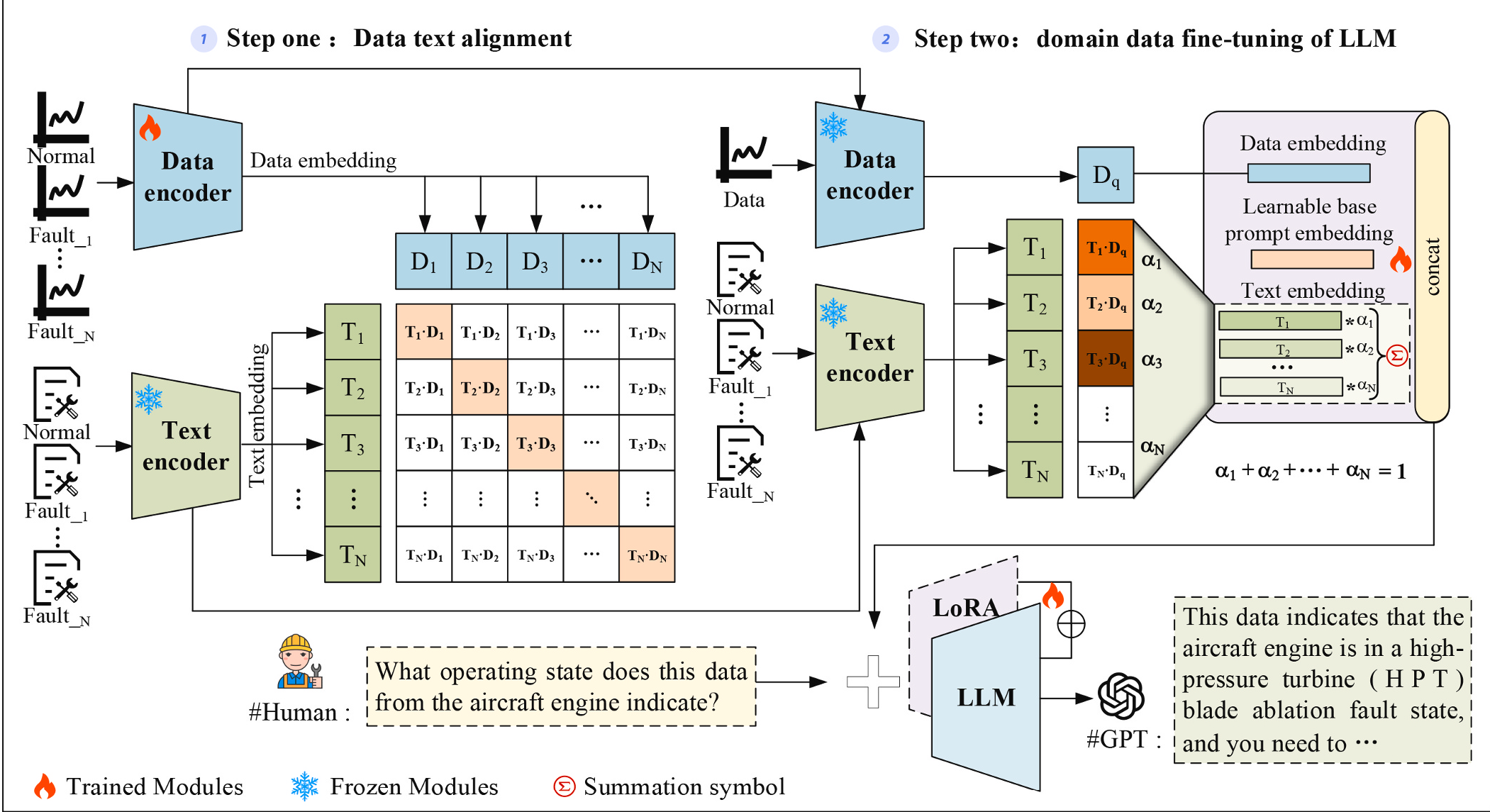
2. Fuzzy Semantic Embedding (Resolving Ambiguity)
This is the paper's most clever "trick." Instead of a "hard" classification (e.g., Category A), the model calculates a weighted fusion of all possible fault descriptions based on similarity. This "fuzzy" vector allows the LLM to see the nuances—knowing that a sample looks 70% like a bearing fault but 30% like a lubrication issue—and use its internal reasoning to break the tie.
Experimental Results: Slaying the Baselines
The researchers tested FD-LLM against the "old guard": CNNs, ResNets, and various Attention-based RNNs.
| Method | Aero-Engine Accuracy | CWRU Bearing Accuracy |
|---|---|---|
| CNN | 66.25% | 90.06% |
| Attention-GRU | 84.38% | 95.61% |
| FD-LLM (Ours) | 94.38% | 98.79% |
Across the board, FD-LLM didn't just win; it dominated. On the rock drilling rig dataset, the improvement over the second-best model was a staggering 3.53% at the very top of the accuracy curve (reaching 99.89%).
 Visual comparison of different fault categories shows the complexity of the feature space FD-LLM successfully navigates.
Deep Insight: Beyond Simple Classification
What makes FD-LLM a game-changer isn't just the accuracy—it's the Dialogue Capability. Because the backbone is an LLM, a maintenance engineer can ask: "What is the state of the engine?" and the model replies in natural language, providing a bridge between raw voltage fluctuations and actionable engineering decisions.
Limitations & Future Work
While FD-LLM is powerful, the authors note that it currently relies on Vicuna-7B, which requires significant VRAM (approx. 14GB). Future iterations might explore even more efficient quantization or smaller "Phi-series" models to enable edge deployment directly on aircraft or factory floors.
Takeaway
FD-LLM proves that the "logic" of LLMs can be applied to "unreadable" industrial data. By mapping sensors to semantics, we are moving from black-box classification to explainable industrial AI.