
Beyond the 'Friend' Monolith: Can Algorithms Decode Our Social Privacy?
Feasibility of structural network clustering for group-based privacy control in social networks
This paper explores the feasibility of using structural network clustering to automate contact grouping for privacy control in social networks. By analyzing egocentric Facebook networks and employing the SCAN algorithm, the study aims to reduce the configuration burden on users while maintaining granular access control.
TL;DR
Managing privacy on social networks is a paradox: we want granular control but hate the effort required to group "friends." This research investigates whether structural network clustering—specifically the SCAN algorithm—can automate this process by mimicking human social logic, identifying that structural outliers are the key to preventing privacy leaks.
The "Configuration Burden" Problem
In social networking, the term "Friend" is a coarse-grained monolith. Your boss, your mother, and your high school acquaintance all inhabit the same digital space, yet your willingness to share a "Friday night out" photo varies wildly across them. While platforms like Facebook introduced "Lists," the manual labor required to maintain them is a massive friction point. Most users simply default to "global" sharing or self-censorship—the "lowest common denominator" approach.
Human Intuition: The Six Pillars of Grouping
To build a better automation tool, the researchers first performed a card-sorting study to see how humans think. They uncovered six "hidden" criteria:
- Social Circles & Cliques: Tight-knit groups where everyone knows everyone.
- Tie Strength: Emotional closeness (Best friends vs. Acquaintances).
- Temporal Episodes: People associated with a specific life chapter (e.g., "Uni 2009").
- Geographical Locations: "Friends from London" vs. "Met in America."
- Functional Roles: People added for a specific transaction or service.
- Organizational Boundaries: Keeping the professional separate from the personal.
Methodology: Can SCAN Mirror the Human Mind?
The study pitted the SCAN (Structural Clustering Algorithm for Networks) against human participants.

Why SCAN? Unlike standard algorithms that just look for dense clusters (Modularity), SCAN identifies:
- Hubs: Individuals who bridge multiple groups (e.g., a colleague who is also a family friend).
- Outliers: Individuals minimally connected to a group.
Key Findings: Modularity is Destiny
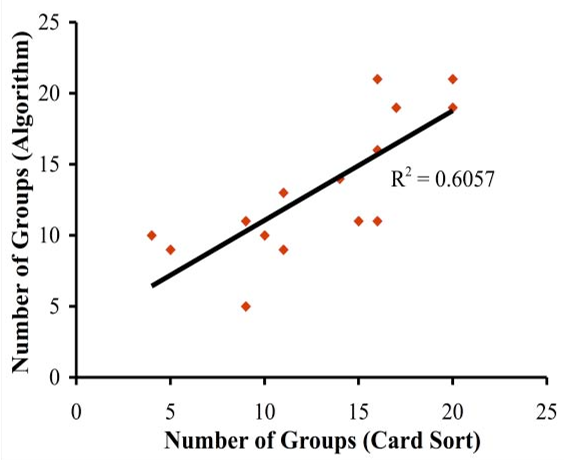
The researchers found a direct correlation between Network Modularity and algorithmic success. If your social life consists of clearly defined, separate "bubbles," the algorithm is highly effective (up to 79.5% similarity). If your social circles are a blurry mess (low modularity), the algorithm struggles, as you likely rely more on "Tie Strength" than "Social Structure."
The "Outlier" Insight
The most profound discovery was the role of outliers. The study found that:
- 75% of "hard to group" contacts were structural hubs or outliers.
- Outliers are statistically more likely to have "anomalous" privacy preferences (their willingness-to-share scores were 2 standard deviations away from the group mean).
- By simply flagging or removing these outliers from automated groups, the accuracy of privacy settings leaped to ~95%.
Critical Analysis & Conclusion
While structural clustering isn't a silver bullet—it still misses "Tie Strength" without interaction data—it provides a robust "zero-effort" baseline.
Takeaway for Designers: Don't try to automate 100% of the social graph. Instead, use clustering to handle the 90% of "obvious" social circles and use Structural Outlier Detection to flag the 10% of risky contacts that require an explicit human decision. The future of privacy isn't manual lists or total automation; it's AI-assisted curation.
Limitations: The study is based on egocentric data (Facebook "Friends"), which may not capture the ephemeral nature of modern platforms like TikTok or Snapchat where "friendship" is less formal.