
Smart City Logistics: Minimizing Detour in Citizen-Powered Urban Monitoring
A Feasibility Study on Crowdsourcing to Monitor Municipal Resources in Smart Cities
This paper presents a feasibility study and architectural design for "Smart City," a push-based mobile crowdsourcing platform in Singapore. It leverages citizen mobility patterns and predictive analytics to proactively assign municipal monitoring tasks while minimizing user detour and effort.
TL;DR
Can a city monitor its resources—like broken lamps or overflowing bins—without a massive fleet of government inspectors? This paper evaluates a "push-based" crowdsourcing framework in Singapore that uses trajectory prediction to slot municipal tasks into citizens' daily commutes, ensuring that helping the city requires no more than a 2-minute detour.
The Motivation: From Reactive Grievances to Proactive Monitoring
Most current smart city apps (like NYC311 or Singapore's OneService) operate on a reactive model: a citizen sees a problem, gets frustrated, and reports it. This is inefficient because many issues go unnoticed for weeks, and the burden of discovery is entirely on the public's serendipity.
The authors identify a critical bottleneck: The Detour Threshold. Human behavior suggests that no matter how civic-minded a person is, their willingness to help vanishes once the "cost" (extra walking distance) exceeds a few minutes.
Methodology: The "Smart City" Architecture
The researchers propose a system that flips the script: instead of waiting for reports, the city proactively recommends tasks to citizens who are already passing by the problem area.
1. The Recommendation Engine
The "heart" of the system. It ingests:
- Spatial Layout: The city's physical nodes.
- User Profiles: Predicted daily routes and detour limits.
- Task List: Valid time windows and rewards.
 Figure: The data-driven flow of the proposed crowdsourcing ecosystem.
2. Context-Aware Notifications
To prevent "notification fatigue," the system uses mobile sensors (accelerometer, gyroscope) to determine the user's state. If a user is "rushing" (detected via high-speed gait and trajectory deviations), the app refrains from sending a task alert, even if they are perfectly positioned.
3. Privacy via Obfuscation
Addressing the "Big Brother" concern, the platform utilizes localized obfuscation. Instead of sending raw GPS coordinates, the client app masks the user's true location based on global popularity and personal sensitivity, ensuring the server can still suggest relevant tasks without knowing the user's exact doorstep.
Experimental Insights: What Citizens Actually Want
The study conducted with 1,300 respondents in Singapore provided hard data on the feasibility of this model:
- Detour Tolerance: The majority of participants are only willing to spare 2 to 5 minutes (approx. 100-150 meters) for a task.
- Incentives: While younger users (18-29) overwhelmingly expect cash or in-kind rewards, older demographics view the activity as a "civic duty" and are less motivated by payment.
- Location Privacy: Surprisingly, over 50% of users were comfortable with tracking if it improved their environment, yet a significant minority (30%) remained highly concerned about data misuse.
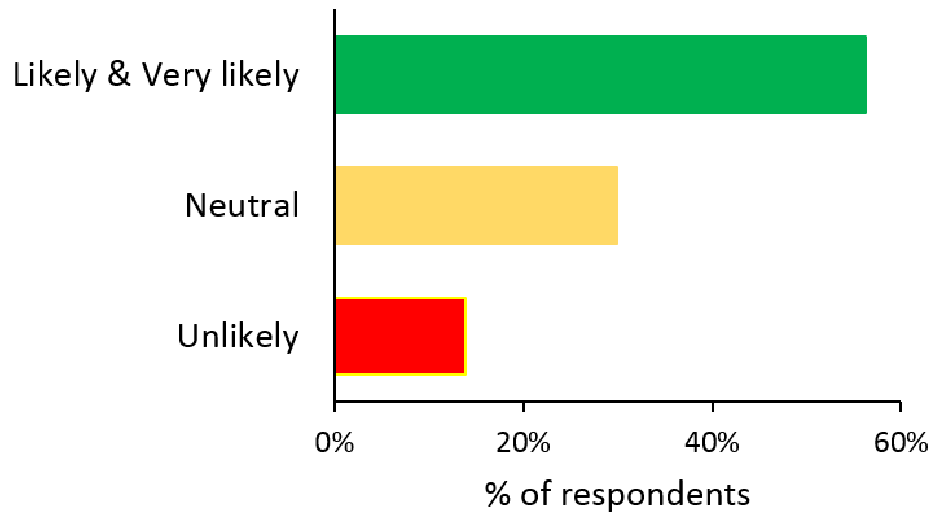 Figure: Survey results showing generally high willingness to contribute to smart nation initiatives.
Deep Insight & Conclusion
The core contribution of this work isn't just the mobile app—it's the recognition that human mobility is a resource to be harvested. By treating a citizen’s commute as a "delivery route" for data, cities can achieve high-frequency monitoring at a fraction of the cost of dedicated personnel.
The Road Ahead: The transition from experimental campus deployments (like the authors' previous TA$ker app) to nation-wide implementation hinges on solving the "battery vs. accuracy" trade-off and refining "variable pricing" models that keep different age groups engaged. As cities become smarter, the bottleneck isn't the sensors—it's the human-in-the-loop coordination.