
PcapNg Evolution: Accelerating IDS with Embedded Feature Extraction
Feature Extraction and Visualization for Network PcapNg Traces
The paper introduces a novel framework for preprocessing PcapNg network traces to extract security-relevant features without deep packet inspection (DPI). By leveraging the extensible block structure of PcapNg, it integrates extracted metadata directly into trace files to accelerate Network Intrusion Detection Systems (IDS) and forensic visualization.
TL;DR
Network security is currently trapped between the "blindness" of encryption and the "slowness" of Deep Packet Inspection (DPI). This paper presents a framework that extracts high-level flow features (Shallow Packet Inspection) and embeds them directly into the PcapNg file format. This allows downstream security tools and analysts to visualize and detect threats at lightning speed without ever needing to decrypt the payload.
Background: The Limits of Deep Inspection
As network traffic continues to scale and encryption becomes the default (SSL/TLS), traditional security methods are hitting a wall. DPI is not only resource-intensive—leading to significant latency—but also increasingly ineffective against encrypted data. Moreover, privacy regulations make DPI a legal minefield for many organizations.
The authors argue that the metadata (headers, timing, flow patterns) contains enough "signal" to identify 0-day attacks and botnet behaviors, provided we can extract and store it efficiently.
The Core Innovation: Subcaptures and Metadata Embedding
Instead of treating a network trace as a giant, monolithic file, the proposed framework breaks the trace into Subcaptures.
1. The Subcapture Mechanism
A subcapture is a valid PcapNg entity that contains only a specific subset of packets sharing a signature (e.g., same source/destination or protocol). This modularity allows for:
- Parallelism: Processing different subcaptures simultaneously across multiple CPUs and GPUs.
- Efficiency: Security analysts can focus on suspicious subsets rather than scanning millions of irrelevant packets.
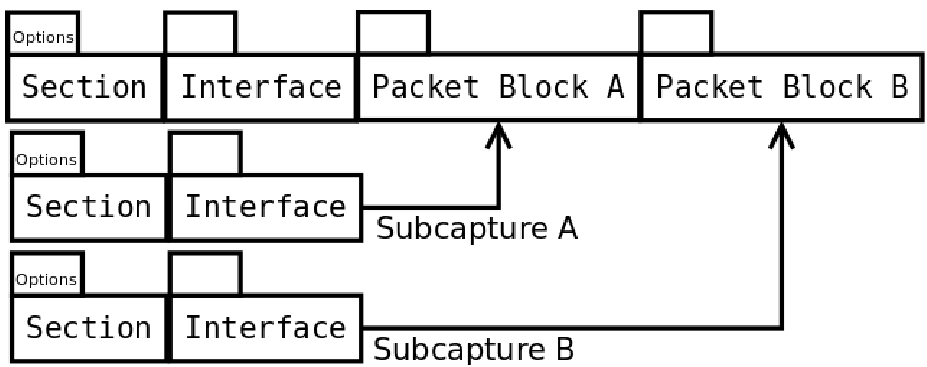 Figure 1: Subcapture logic showing how packet data is referenced or copied into new PcapNg entities.
2. Standard-Compliant Metadata Storage
One of the brilliant insights of this work is where to store the extracted data. Instead of using custom blocks that might be stripped by other tools, the authors use Optional Fields (TLV - Type-Length-Value) within critical PcapNg blocks.
This ensures that:
- Compatibility: Standard tools like Wireshark can still read the file.
- Persistence: Preprocessed features (like average time between packets or encryption flags) stay with the trace file, preventing redundant calculations in future forensics.
Methodology: Feature Extraction
The framework extracts several categories of features that are vital for Machine Learning models:
- Temporal Features: Total duration, inter-arrival statistics, and average time between packets.
- Volumetric Features: Bytes transferred bi-directionally and packet counts.
- Contextual Features: Protocol flags, boolean indicators for encryption, and even system-level metrics like CPU/Memory load at the time of capture.
Critical Insight & SOTA Comparison
By shifting the focus to Shallow Packet Inspection (SPI), the paper aligns with modern SOTA trends like BotFinder, which achieved 80% detection rates using only flow properties. The real value added here is the Engineering Utility: by making these features part of the trace metadata, the authors reduce the "fuzziness" of inputs for machine learning models and drastically speed up the convergence of unsupervised learning algorithms.
Conclusion & Future Outlook
The move toward PcapNg as a "smart" container for network data is a logical step in an era of massive data. While the paper focuses on the extraction framework, the potential for using this in Zero-shot learning for anomaly detection is vast.
However, a potential limitation remains: if an attacker intentionally alters packet timing (jitter) or sizes (padding), SPI methods must evolve to incorporate more robust statistical features. This framework provides the perfect infrastructure to store those advanced metrics for future researchers.
Takeaways for Engineers:
- Stop Re-calculating: If you're building an IDS, store your features in the trace file metadata to save compute cycles during forensic audits.
- Embrace SPI: When encryption hides the "What," look at the "How" and "When" of packet flows to find the "Who."