
Evolution in Speech: Optimizing Emotion Recognition via Evolutionary Feature Selection
Application of Feature Subset Selection Based on Evolutionary Algorithms for Automatic Emotion Recognition in Speech
This paper presents an automated speech emotion recognition system that leverages Feature Subset Selection (FSS) based on Estimation of Distribution Algorithms (EDA). By identifying the most relevant paralinguistic features from the RekEmozio bilingual database, the authors significantly enhance the performance of standard machine learning classifiers, achieving a State-of-the-Art accuracy boost.
Executive Summary
TL;DR: This study tackles the complexity of emotional speech by moving away from "brute-force" feature sets. By implementing Estimation of Distribution Algorithms (EDA) for Feature Subset Selection (FSS), the researchers curated the most relevant acoustic signals from a bilingual dataset, resulting in a staggering 15% accuracy improvement across multiple machine learning models.
Positioning: This work is a crucial methodological refinement in the field of Affective Computing. It bridges the gap between raw signal processing and high-level classification by treating feature selection as an evolutionary optimization problem rather than a simple statistical filter.
The "Curse of Dimensionality" in Affective Computing
Why is it so hard for a computer to "feel" the emotion in your voice? The problem isn't a lack of data; it's the noise. Speech signals provide a vast array of metrics—pitch, jitter, shimmer, spectral energy—but not all are relevant to every emotion or every language.
Prior works often struggled because:
- Redundancy: Features like fundamental frequency (F0) and Energy are often highly correlated.
- Language Variance: What indicates "anger" in Spanish might differ phonetically in Basque.
- Search Inefficiency: Linear "forward/backward" selection methods often get stuck in local optima, missing the synergistic effects of certain feature combinations.
Methodology: The Evolutionary Wrapper
The researchers utilized the RekEmozio Database, a bilingual (Spanish/Basque) repository, and extracted 32 core features. However, the "secret sauce" lies in the Wrapper Approach powered by EDA.
1. Feature Extraction
The team focused on several key acoustic pillars:
- Prosody: Fundamental Frequency (F0) and Speaking Rate.
- Energy: RMS Energy and Spectral Distribution across low, medium, and high bands.
- Voice Quality: Jitter (vibration perturbation) and Shimmer (energy perturbation).
- Articulation: Mean Formants and Bandwidths.
2. The EDA Search Engine
Instead of testing every possible combination (which is computationally unfeasible), they used an evolutionary algorithm. The EDA builds a probabilistic model of the "best" feature subsets found in each generation, sampling new subsets that are increasingly likely to yield higher accuracy.
 Note: The study compared ID3, C4.5, IB (Instance-Based), Naive Bayes, and NBTree.
Experiments & Quantifiable Breakthroughs
The results were categorized by gender (Male/Female) and language (Spanish/Basque). Initially, the performance of standard classifiers was mediocre, hovering around 40-50%.
The Post-FSS Transformation: Once the EDA-based Feature Subset Selection was applied, the results shifted dramatically:
- Accuracy Gain: Every single paradigm saw an improvement of at least 15%.
- The Champion: The Instance-Based (IB) learner (specifically k-NN variants) became the top performer, achieving a total average accuracy of ~64%.
- Cross-Lingual Consistency: The method proved effective for both Spanish and Basque, suggesting the selected acoustic features have cross-linguistic emotional validity.
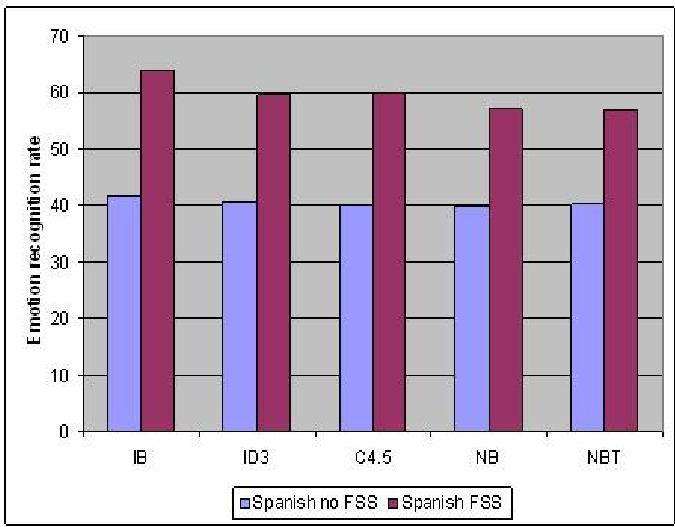 Fig 1: The delta between "Whole set" (blue) and "FSS optimized" (red) shows a consistent upward trend for all classifiers.
Critical Insight & Future Outlook
Takeaway: This paper validates that Feature Subset Selection is not just a preprocessing step—it is a core component of model architecture in Affective Computing. By pruning the feature space, the researchers reduced "Inductive Bias" issues and helped models focus on the true acoustic correlates of emotion.
Limitations: While the 15% boost is impressive, the absolute accuracy (mid-60s) suggests that speech alone may have an "accuracy ceiling."
Future Work: The authors propose a Multi-classifier model that combines these optimized speech features with visual gestures. In the era of Deep Learning, the next step would be comparing these "hand-crafted" evolutionary subsets against features learned by self-supervised models like HuBERT or XLSR.