
Beyond Words: Unlocking Personalized Mood Prediction via Social Media Activities
Features for mood prediction in social media
This paper introduces a personalized approach for mood prediction in social media by leveraging multidimensional features including psychological processes, personal activities, and temporal patterns. Using a gold-standard dataset labeled via multi-worker consensus on Amazon Mechanical Turk, the study identifies critical behavioral markers that distinguish positive, negative, and neutral emotional states.
TL;DR
Researchers from the University of Colorado Boulder have developed a multi-faceted feature set for predicting user mood on Twitter. By moving beyond simple text analysis and incorporating psychological processes, personal concerns, gender, and temporal patterns, they demonstrate that mood is not just about what we say, but when and about what we post.
Context: Why "One-Size-Fits-All" Sentiment Analysis Fails
Most sentiment analysis tools treat every user as a uniform data point. However, a tweet about "sleeping all day" might indicate relaxation for one person but a depressive episode for another. Current SOTA challenges involve reducing false positives by understanding the individual context. The authors argue that high-accuracy mood prediction requires a personalized lens that accounts for specific user habits and psychological profiles.
Methodology: The Anatomy of a Personalized Feature Set
The researchers analyzed a massive Twitter dataset, narrowing it down to a high-quality labeled set through Amazon Mechanical Turk. They categorized features into four primary dimensions:
- Linguistic Baseline: Standard n-grams, word length, and emoticons.
- Psychological Processes (LIWC): Utilizing 25 dimensions (Social, Affective, Cognitive, etc.) to map the internal state of the tweeter.
- Personal Activities: A unique look at 19 dimensions related to occupation, leisure (music, sports), and biological needs (sleep, eating).
- Temporal Dynamics: Analyzing when people are most vocal about their feelings—diurnal (time of day) and weekly patterns.
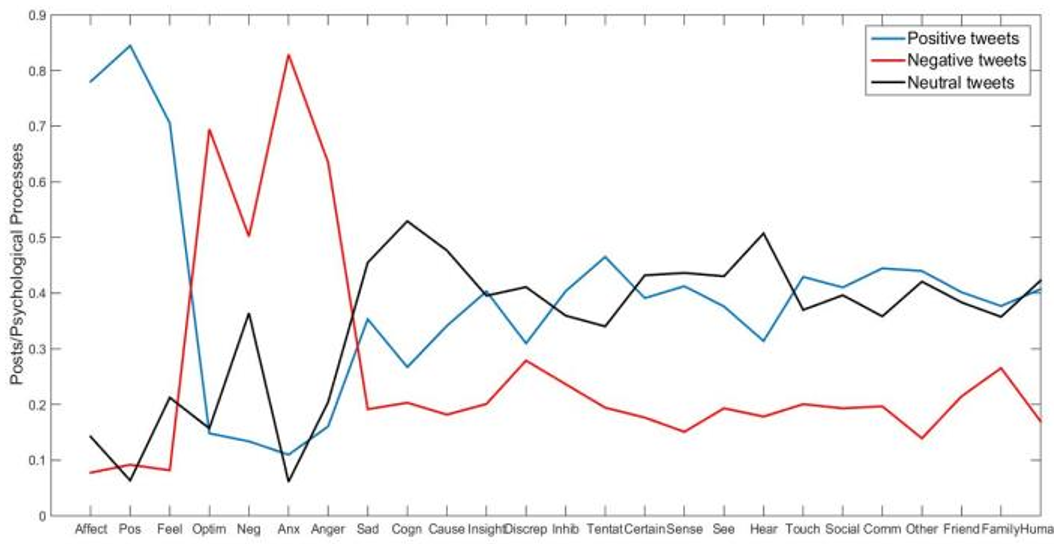 Figure 1: Trends for normalized psychological process values across positive, negative, and neutral classes.
Key Insights: What Your Habits Say About Your Mood
The findings offer a fascinating look into the "digital twins" of our emotional lives:
1. Activity-Mood Correlation
The study found that negative tweets are highly correlated with activities like Death and Sleep. Interestingly, the classification of "Occupation" varies; for some, it’s a source of positivity, while for others, it’s neutral or negative, highlighting the necessity of Personalized Classifiers.
2. The Temporal Fingerprint
Each user has a "temporal signature." One user might peak in negativity on Fridays, while others are most positive during evening hours. These temporal habits are consistent for individuals but vary wildly across the population.
3. The Gender Factor
The data revealed that females tend to have more "emotional periodic behavior." Women in the study were found to share emotions more frequently and clearly in public social contexts compared to males, who showed more stable (or perhaps more repressed) posting patterns.
 Figure 2: Trends for normalized personal concerns show how mood manifestation is highly individualized.
Experimental Results & Performance
By leveraging these features, the researchers established a groundwork for classifiers that can identify positivity/negativity with higher accuracy and lower false-positive rates than linguistic-only models. The use of a majority-agreement ground truth (4 out of 5 human labels) ensures that the model is trained on high-fidelity subjective data.
Critical Analysis & Conclusion
This work shifts the paradigm from "Sentiment Analysis" (what is the tone of this text?) to "Mood Prediction" (what is the state of this person?).
Takeaway: The integration of LIWC dimensions and temporal data provides a robust "Inductive Bias" for models trying to understand human emotion.
Limitations: The study relies on a relatively small group of users for the deep personalized analysis (18-36 users for Turk labeling). Future work should scale this to thousands to see if these specific activity-mood correlations hold across diverse cultures.
Future Outlook: We are moving toward "Personalized AI" that understands our specific emotional baselines, potentially leading to better mental health interventions and more empathetic digital assistants.