
The Anatomy of "Why": Features of Causal Statements in Large-Scale Social Discourse
What we write about when we write about causality: Features of causal statements across large-scale social discourse
This research performs a large-scale computational analysis of causal statements on Twitter, utilizing a corpus of ~1M causal tweets and a temporal control group. It employs NLP techniques, including POS tagging, NER, and LDA, to identify the linguistic and emotional architecture of how humans communicate cause-and-effect in social discourse.
TL;DR
Why do we bother attribute causes to events? By analyzing nearly a million tweets, researchers have found that causal statements are not neutral observations; they are emotionally charged, significantly more negative than daily chatter, and predominantly focused on tragedies, health crises, and relationship drama. This study provides a linguistic blueprint for how we construct "why" in the digital age.
Background Positioning
This work sits at the intersection of Computational Social Science and NLP. It moves beyond the laboratory settings of Michotte’s perception experiments and into the messy reality of Twitter, providing empirical evidence for the "Valence Bias"—our innate tendency to look for causes more frequently when things go wrong.
1. Problem & Motivation: The Bias of the "Why"
In traditional statistics, causality is a matter of . But in human language, causality is a narrative. Existing research suggests that our language structure and emotional state dictate how we assign weight to the "Agent" (the cause) and the "Patient" (the effect).
The authors aimed to solve a key gap: Does the brevity of social media suppress or exaggerate these cognitive biases? Specifically, they looked at whether online discourse reflects the "if it bleeds, it leads" mentality inherent in human causal reasoning.
2. Methodology: Decoding the Causal Corpus
The researchers curated a dataset of 965,560 "Causal" tweets and an equal number of "Control" tweets from 10% of the 2013 Twitter "Gardenhose" stream.
Architecture of Analysis
- Tagging (POS & NER): Using NLTK and Stanford CoreNLP to see if causal speakers use different parts of speech.
- Sentiment Mapping: Dual-layer analysis using the labMT dictionary (word-level) and Stanford Sentiment Treebank (sentence-level).
- Cause-Trees: A novel visualization technique to see which word sequences (n-grams) most frequently follow or precede a "cause-word."
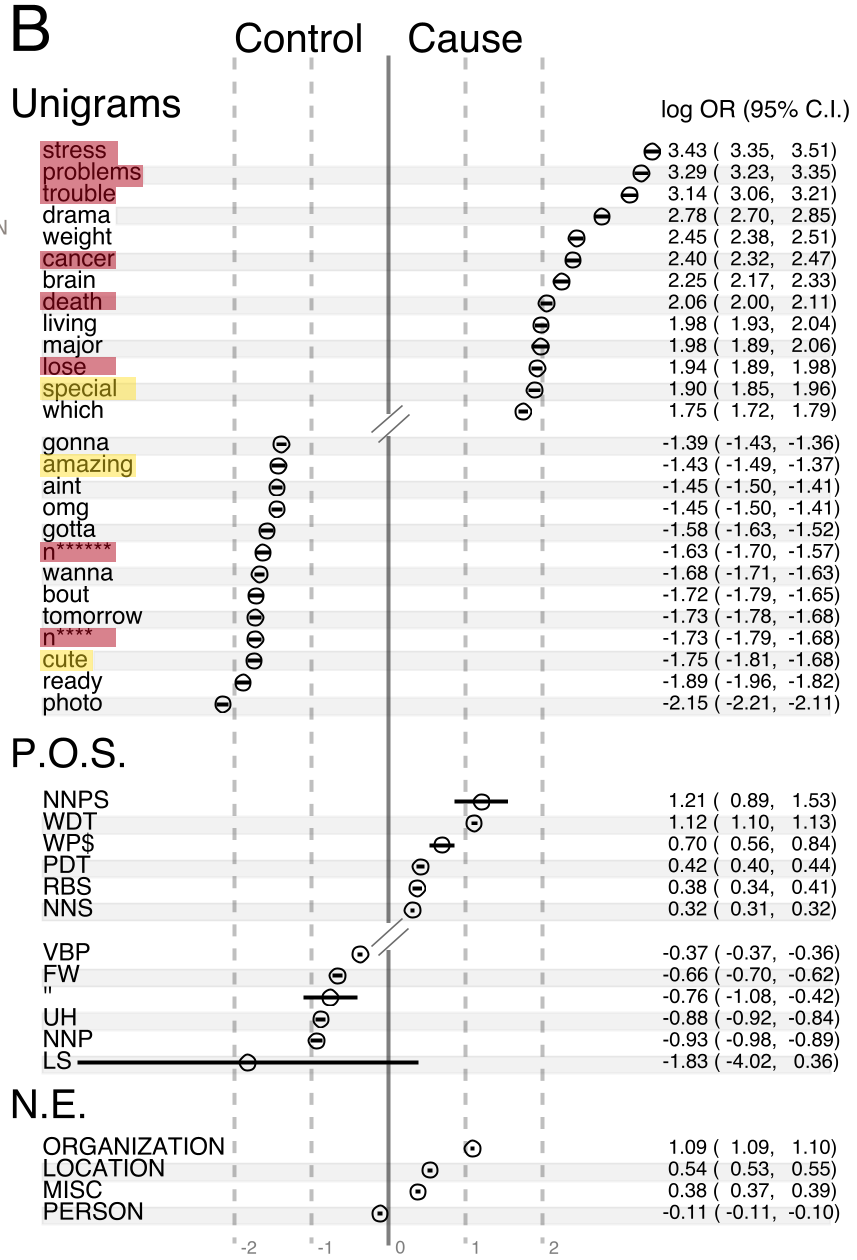 Figure 1: Odds Ratios showing that causal statements favor plural nouns and predeterminers but avoid specific person names.
3. The Methodology of "Cause-Trees"
One of the most intuitive contributions is the Cause-Tree. By building a binary tree of the most probable sequences starting from "causes" or "caused," the authors could see the literal patterns of human thought.
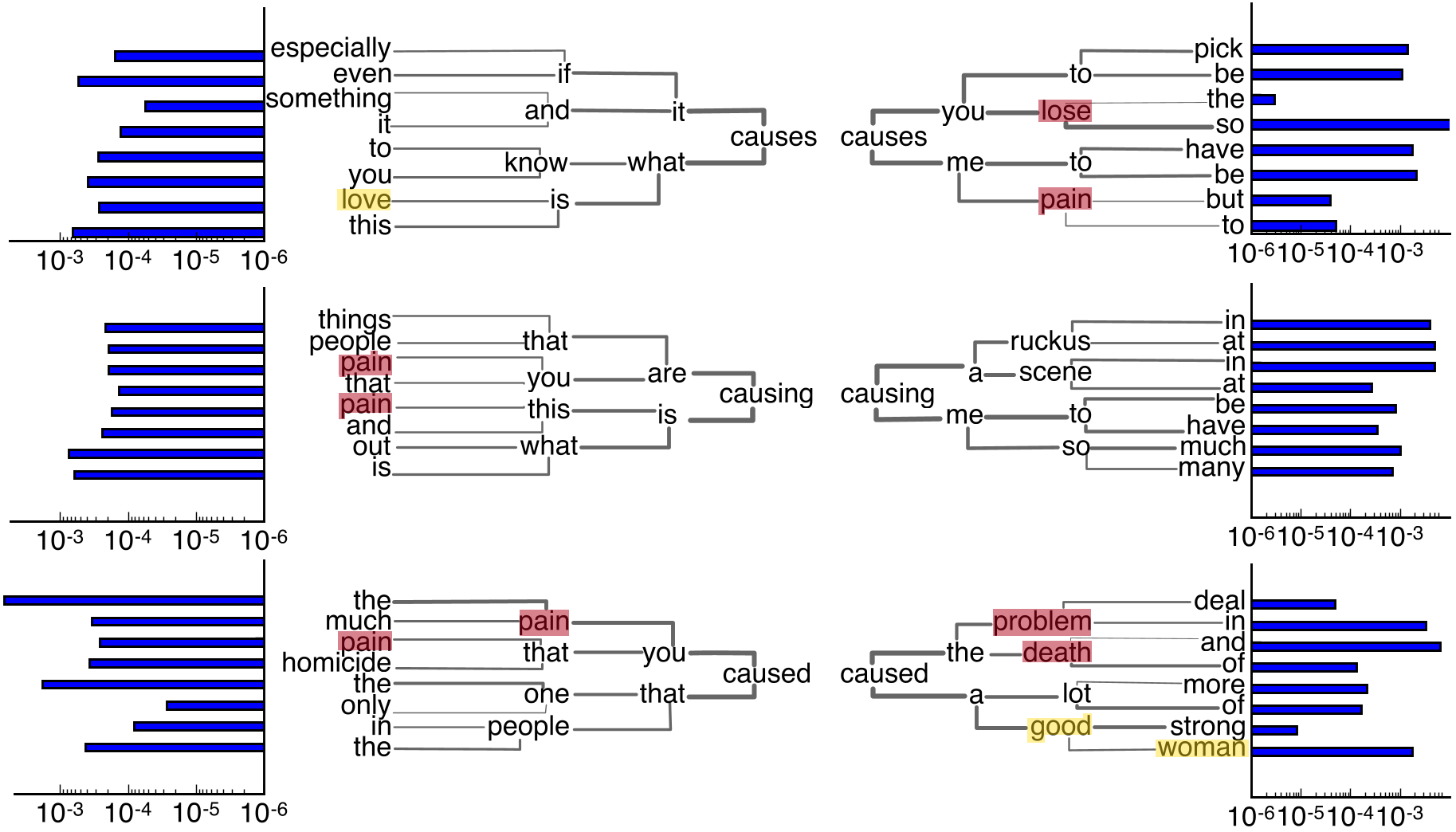 Figure 2: The branching logic of causality. Note the prevalence of "pain you are causing" or "tragedy that caused the death."
4. Key Results: Negativity is the Primary Driver
The findings are stark: Causality is synonymous with negativity.
- Sentiment Shift: Causal tweets are significantly more negative than control tweets across all categories (nouns, verbs, and adjectives).
- Grammatical Markers: Causal statements use more Predeterminers (e.g., "all," "both"), indicating an attempt to generalize the impact of a cause (e.g., "all the problems it caused").
- Topical Focus: Using Latent Dirichlet Allocation (LDA), the study identified 10 key topics. Causality thrives in "News" (disasters), "Medical" (diseases), and "Drama" (relationship issues).
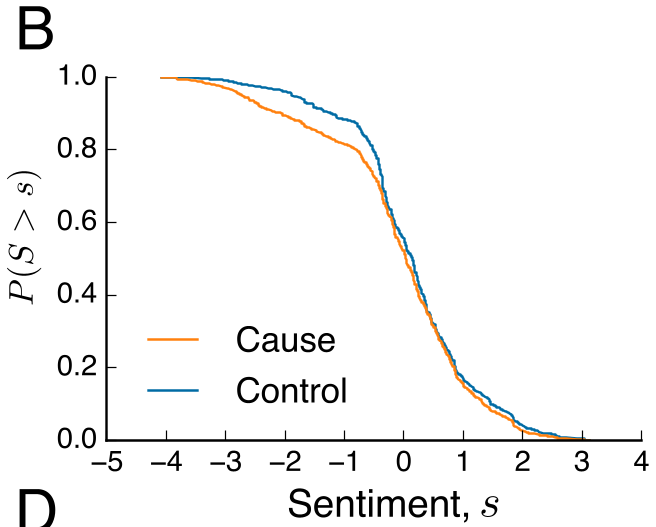 Figure 3: Sentiment scores showing a clear shift toward the negative spectrum for causal documents compared to controls.
5. Critical Analysis & Conclusion
Takeaway
The study confirms that our online causal attributions are heavily influenced by Valence Bias. We don't just write about causality; we write about it when we are stressed, hurt, or witnessing a disaster. This provides a quantitative backbone to why rumors and misinformation—which often center on "hidden causes" for negative events—spread so virally.
Limitations
- Keyword Limitation: The study focused only on "caused/causes/causing." It missed "since," "because," or "as a result of."
- Verification: The study does not verify if the causal statements are factually true, only how they are expressed.
Future Outlook
As we move toward 2026, these findings serve as a baseline for training AI to detect "causal intent." By understanding the linguistic markers of causal attribution, we can better identify the seeds of conspiracy theories before they bloom into global misinformation campaigns.
Senior Editor’s Insight: This paper elegantly validates philosophical and cognitive theories using big data. It proves that on social media, the word "cause" is less of a scientific tool and more of an emotional cry.