
FedCONST: Harmonizing Federated Learning via Global Convex Constraints
Federated Learning for Feature Generalization with Convex Constraints
This paper introduces FedCONST, a novel Federated Learning (FL) framework that improves global model generalization using linear convex constraints during local client training. By adaptively modulating update magnitudes based on global parameter strength, it achieves state-of-the-art performance across various heterogeneous datasets and architectures, including CIFAR-10/100 and ResNet-18.
TL;DR
FedCONST is a powerful new approach to Federated Learning (FL) that tackles the "overfitting-during-local-training" problem. By applying adaptive convex constraints—specifically centralization and orthogonality—it ensures that local updates don't destroy well-learned global features. The result is a significant boost in generalization, with accuracy gains of up to 14% in highly heterogeneous environments.
Problem & Motivation: The Distortion of Good Features
In Federated Learning, we often see a "tug-of-war." The global model wants to learn a universal representation, but individual clients are biased by their local, often sparse, data.
The authors identify two fatal flaws in current SOTA:
- Local Overfitting: Models chase local noise instead of global signals.
- Aggregation Distortion: Even if a client manages to learn a "good" (transferable) feature, the averaging process at the server can warp or cancel it out if other clients haven't aligned their gradients similarly.
While methods like FedProx or MOON try to force local models to stay "near" the global model, they don't distinguish between which features to keep and which to update.
Methodology: Physics-Inspired Convex Constraints
The core insight of FedCONST is that Weight Magnitude = Feature Strength. Inspired by Domain Generalization (DG) theories, the authors argue that large weights represent "strong" features (high GSNR) that are already well-learned, while small weights represent "weak" features that need more work.
The Two Pillars of FedCONST:
- Centralization Constraint: It keeps the gradient mean at zero. This stabilizes local training and ensures the total update impact is unbiased.
- Orthogonal Constraint: It forces updates to be orthogonal to the initial global parameter vector. This prevents the model from "over-reinforcing" features that are already strong, shifting the optimization effort toward underdeveloped parameters.
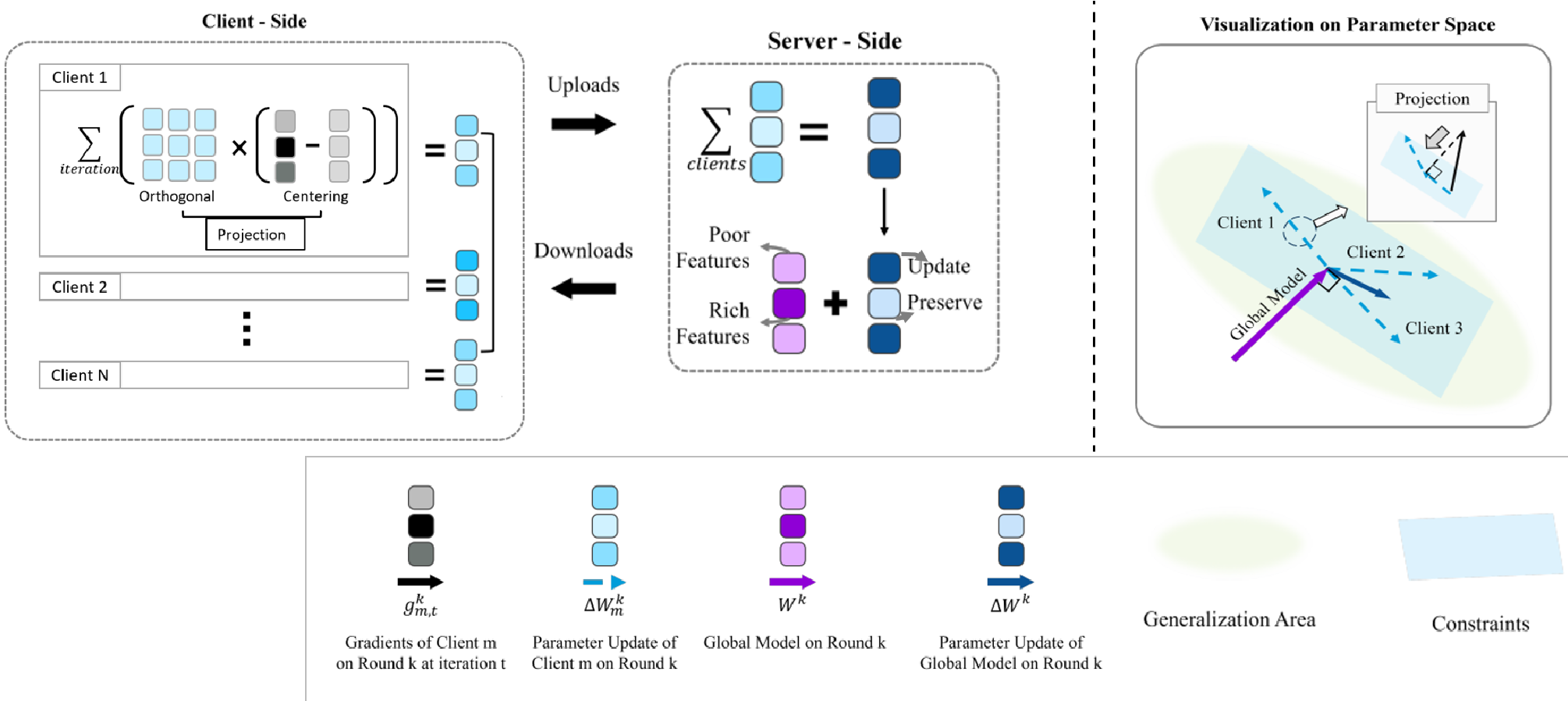 Figure 1: Comparison of optimization paths. FedCONST (3) ensures that both local training and the subsequent aggregation remain within the 'Generalization Area'.
Because these constraints are linear and convex, they possess a magical property in FL: Aggregation Invariance. If every client respects the constraint, the averaged global model will also respect the constraint.
Experimental Validation
The authors put FedCONST to the test against a suite of heavy hitters like FedAvg, FedProx, SCAFFOLD, and FedDyn across CIFAR-10/100.
Performance Leap:
As seen in the table below, adding "CONST" (the FedCONST mechanism) to existing algorithms consistently yields a massive performance delta. For ResNet-18 on CIFAR-10, accuracy jumped from 54.07% to 66.51%.
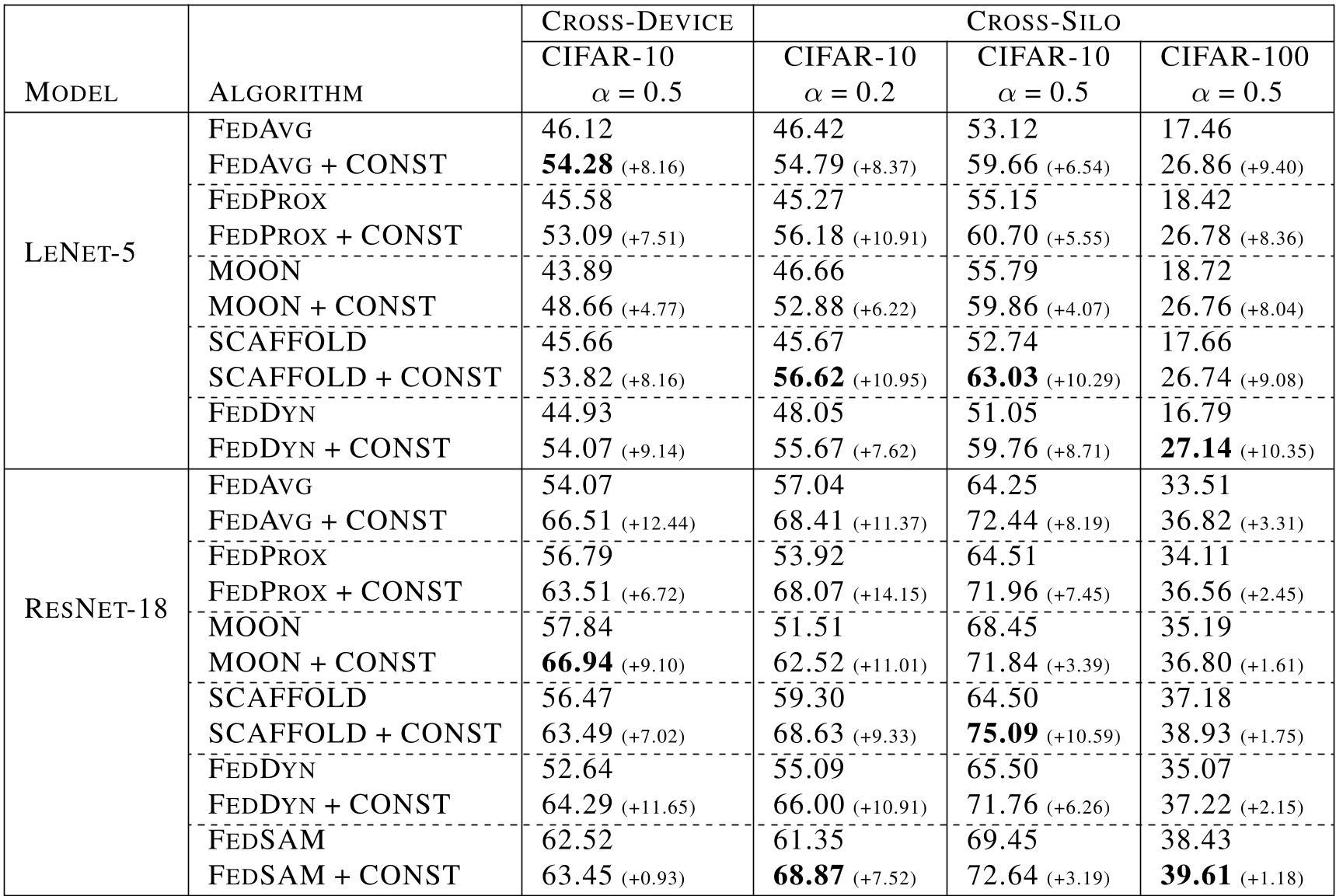 Table 1: Performance across Cross-Device and Cross-Silo settings. Note the consistent (+X.XX) gains when constraints are added.
Why it Works: Convexity and Stability
A key technical contribution is the analysis of the Loss Landscape. By calculating the Hessian matrix, the authors showed that FedCONST shifts the model away from "saddle points" (areas where the model gets stuck) toward more convex regions.
 Figure 2: The loss landscape becomes significantly more convex with constraints, allowing for more stable convergence.
Final Insights & Takeaways
FedCONST proves that we don't need complex, communication-heavy "correction" terms to fix Federated Learning. Instead, by understanding the geometry of the parameter space and applying simple convex constraints, we can:
- Align Clients without extra metadata exchange.
- Preserve Knowledge by protecting high-magnitude weights.
- Scale Efficiently across devices and silos.
Future Outlook: The reliance on weight magnitude as a proxy for GSNR is brilliant for its simplicity, but it may have limitations in models with highly dynamic weight scaling (like quantized networks). Extending this to Transformer-based LLMs in FL settings would be the next logical frontier.