
FedHealth: Bridging Privacy and Personalization in Wearable Healthcare via Federated Transfer Learning
FedHealth: A Federated Transfer Learning Framework for Wearable Healthcare
FedHealth is the first federated transfer learning framework designed specifically for wearable healthcare, integrating Federated Learning (FL) with Deep Transfer Learning. It achieves state-of-the-art personalization in activity recognition and Parkinson’s diagnosis while ensuring data privacy across isolated organizational islands.
TL;DR
FedHealth addresses the dual challenge of data privacy and model personalization in wearable devices. By combining Federated Learning (FL) for secure data aggregation with Transfer Learning (TL) for individual adaptation, it achieves professional-grade accuracy in human activity recognition and Parkinson’s disease diagnosis without ever accessing raw user data.
Problem & Motivation: The "Data Island" and the "One-Size-Fits-All" Trap
In the era of smart wearables, our devices collect goldmines of health data. However, two major hurdles block the path to a truly intelligent AI doctor:
- Privacy Walls: Regulations like GDPR prevent medical institutions and device manufacturers from pooling data into a central cloud.
- User Diversity: A gait recognition model trained on a 20-year-old athlete will likely fail when analyzing a 70-year-old Parkinson’s patient. General models lack the "fine-grained" nuance required for individual health profiles.
Existing SOTA methods usually choose one: either focus on privacy (FL) but sacrifice individual accuracy, or focus on personalization (TL) but require local data that is often too sparse to train a deep model from scratch.
Methodology: The Best of Both Worlds
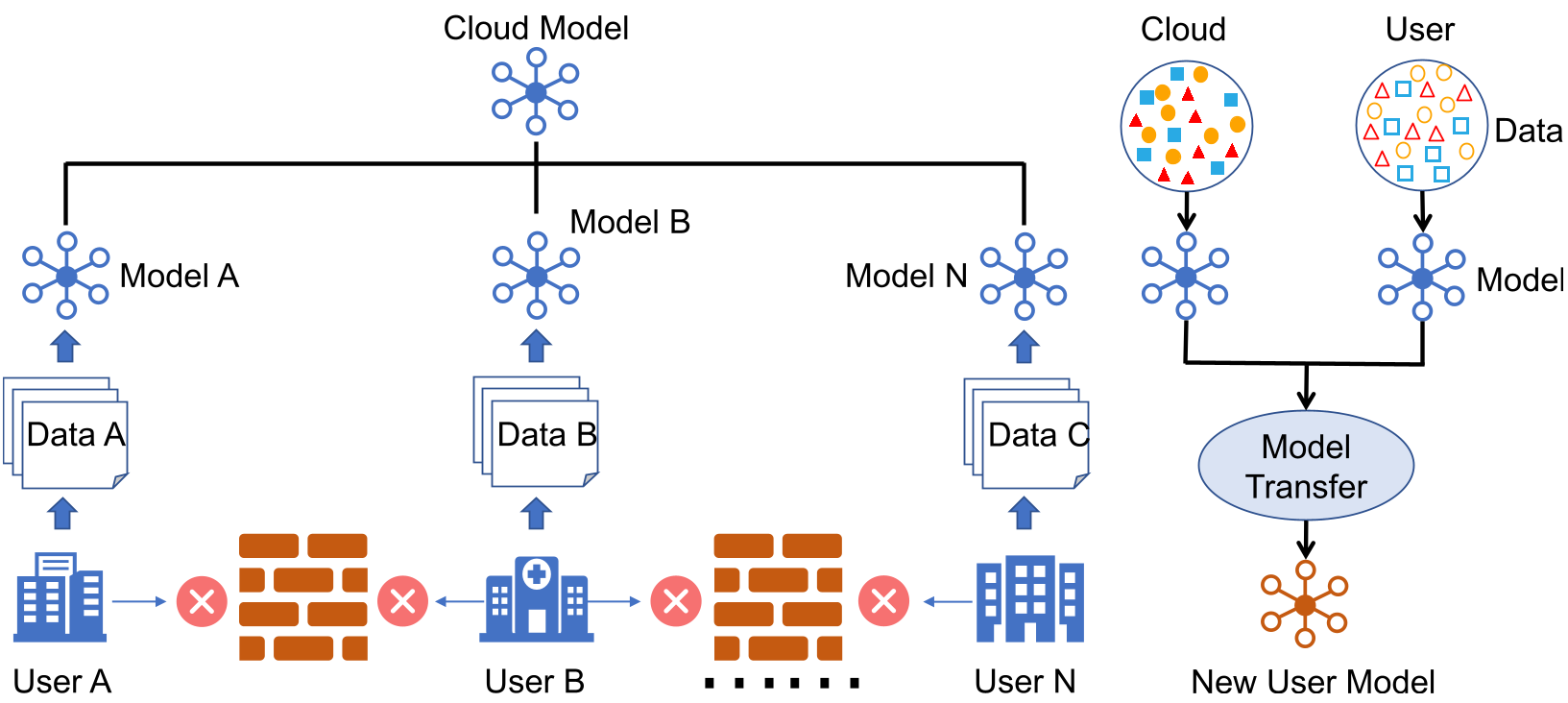
FedHealth introduces a synergistic framework that treats the cloud as a "Global Knowledge Base" and the user device as a "Personalized Specialist."
1. Framework Architecture
The process follows a sophisticated loop:
- Global Pre-training: The server learns general features from public datasets.
- Encrypted Aggregation: Using Homomorphic Encryption, the server aggregates model weights from various organizations to update the global model without seeing the underlying data.
- Personalized Transfer: This is the "Secret Sauce." Instead of just using the global model, FedHealth applies transfer learning locally.
2. The Transfer Mechanism
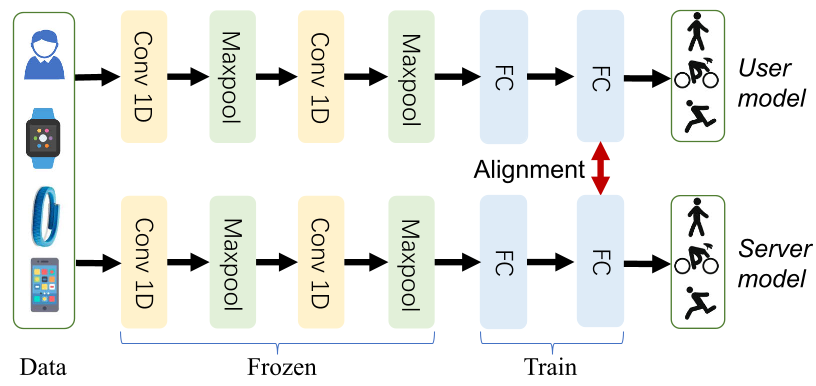
The authors utilize a Convolutional Neural Network (CNN) architecture. They posit that lower layers (Conv/Pool) capture universal signal patterns (e.g., frequency, basic motion), while higher layers (FC) capture user-specific traits. By freezing the lower layers and adding a Correlation Alignment (CORAL) layer, FedHealth minimizes the distribution divergence between the "Cloud Domain" and the "User Domain."
Experiments & Performance
The researchers validated FedHealth on two distinct fronts:
Case 1: Human Activity Recognition (HAR)
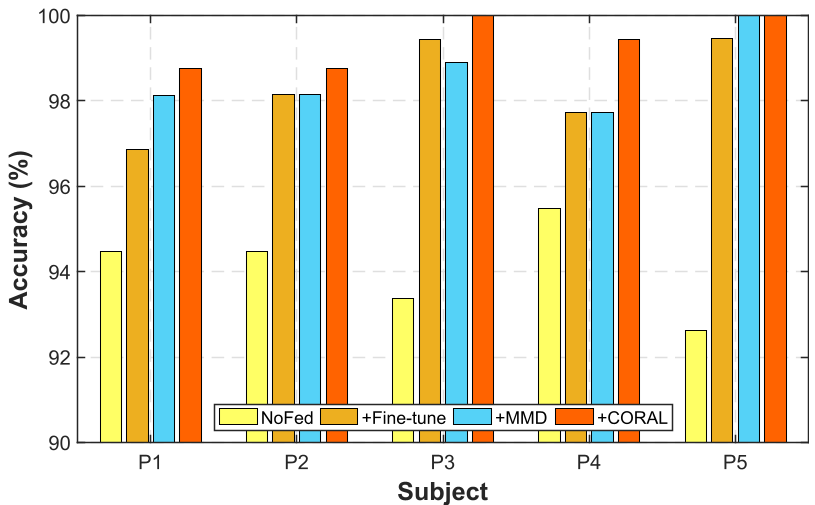
Using the UCI Smartphone dataset, FedHealth achieved an average accuracy of 99.4%, outperforming standard Deep Learning (94.1%) and traditional SVMs (94.1%). The key takeaway here is that the "Federated" part provides the robust feature extractor, while the "Transfer" part nails the individual gait.
Case 2: Parkinson’s Disease Diagnosis
This is where the framework proves its clinical value. In auxiliary diagnosis tests (Arm Droop and Postural Tremor), FedHealth outperformed existing baselines by over 16%.
Ablation Study: Why both?
The ablation studies confirmed a vital hierarchy:
- FL alone improves the general model but lacks "personal touch."
- TL alone lacks the "collective intelligence" of other users' data.
- FedHealth combines them to reach near-ideal "Upper Bound" performance (where all data is centralized).
Critical Analysis & Future Outlook
FedHealth is a seminal work because it acknowledges that in healthcare, privacy is not a trade-off for performance—both are mandatory.
Limitations:
- Communication Overhead: While homomorphic encryption is secure, it can be computationally expensive for low-power wearables.
- Static vs. Dynamic: The current model focuses on distribution shifts between users, but not the shift within a single user over time (e.g., a patient's condition progressing).
Future Directions: The authors suggest integrating Incremental Learning, which would allow the model to evolve as the user’s health status changes, potentially predicting disease progression before it becomes symptomatic.
Conclusion
FedHealth provides a scalable, extensible template for the future of "Federated Computing." By moving the intelligence to the edge and respecting the sovereignty of personal data, it sets a high bar for AI applications in the sensitive domain of digital medicine.