
Tweeting a Finch: Democratizing Robot Control through Social Media NLP
Feeding a Finch with social media: A bird that responds to tweets!
The paper introduces a novel framework for controlling robots via natural language commands sent through social media platforms, specifically Twitter. Using a Python-based NLP pipeline and the Finch robot as a hardware interface, the system translates tweets into executable JavaScript code to manipulate sensors and motors.
TL;DR
This research bridges the gap between complex robotics and the general public by leveraging Twitter as a control interface. By combining Natural Language Processing (NLP) with affordable hardware, the system allows anyone to command a robot using simple tweets, effectively turning a social networking platform into a remote-control hub for the physical world.
Background & Motivation: Moving Beyond the Terminal
Robotics has traditionally been a "high-barrier" field. To make a robot move, one usually needs to master C++, Python, or ROS (Robot Operating System). The authors argue that while robots are becoming more powerful, they remain inaccessible to the average person.
Their Research Intuition was simple: People already know how to use social media. If we can treat a robot like a "follower" or a contact on Twitter, we can use the existing habit of text messaging to lower the cognitive load required for human-robot interaction (HRI).
Methodology: From Tweet to Torque
The architecture is a pipeline designed to transform unstructured, often messy human language into strict logic.
1. The Processing Pipeline
The system consists of four distinct modules:
- Twitter Processor (Python): Uses the Twython module and REST API to monitor @-mentions.
- Translator (NLP): The "brain" of the project. It uses Part-of-Speech (POS) tagging to identify verbs (actions) and nouns (parameters). It uses chunking to group commands like "turn 180 degrees left" into a coherent instruction set.
- Finch Controller (Java): Executes the converted JavaScript code on the hardware.
- Response Processor (Django): Generates a feedback report, including images captured by the robot's camera, then tweets a shortened TinyURL back to the user.
2. The Logic of Default Behaviors
One critical insight in the paper is the handling of vague commands. If a user says "turn," the system doesn't crash; it applies an Inductive Bias through predefined defaults (e.g., turning left at speed 2) unless specific refinements are detected in the tweet's chunked text.
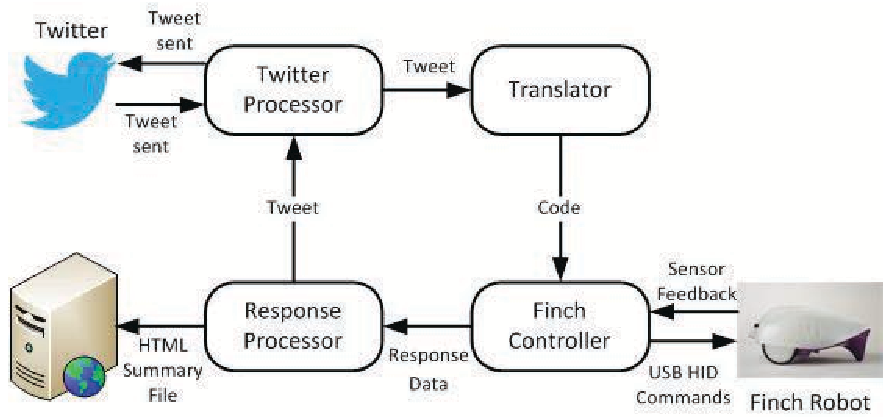 Figure 1: The high-level process flow showing the transition from a digital Tweet to physical movement.
Experimental Validation
The authors utilized the Finch Robot, an educational platform equipped with accelerometers, light sensors, and an RGB LED.
The evaluation focused on the feasibility of the translation:
- Task Execution: Successfully parsed commands for movement, sensing (temperature), and multimedia (photo capture).
- User Accessibility: Proved that no prior programming knowledge was needed—the user simply tweets @robotTweeter42.
- Feedback Loop: The system provides a full loop by uploading a summary to an HTTP server and replying with the URL.
Critical Insight & Future Outlook
While this 2013-era work relied on rule-based chunking, it anticipated a major trend in AI: Natural Language as the Universal Interface.
Limitations
- Rigidity: The keyword-based search is far less flexible than modern Transformer-based models.
- Latency: Relying on the Twitter REST API and external URL shorteners introduces significant delay, making it unsuitable for real-time safety-critical tasks.
The Future of Social Robots
The authors suggest that this framework could be extended to control home appliances (e.g., a coffee machine) or query databases. In the modern era, we see this evolution in "Teletest" platforms and LLM-powered agents that can write and execute code on the fly. This paper serves as an early, successful proof-of-concept for the "Human-Robot-Social Cloud" ecosystem.