
Feel the Burn: Can Physical Sweat Help Children Understand Climate Change?
Feel the burn: exploring design parameters for effortful interaction for educational games
This paper explores "effortful interaction," a novel HCI paradigm where physical exertion is used as an output modality to communicate quantitative data (e.g., climate change impacts) to children. The researchers tested how duration, intensity, and physical modality affect the Ratings of Perceived Effort (RPE) in an immersive "polar bear" simulation.
TL;DR
Researchers from the University of Illinois at Chicago are moving beyond "point-and-click" to "huff-and-puff." By testing an embodied interaction game where children role-play as polar bears, this study explores how effortful interaction—the intentional use of physical exertion—can act as a medium to communicate complex scientific data, such as the rising energy costs for animals due to melting sea ice.
Motivation: Why Make Users Work Harder?
In most HCI contexts, "frictionless" is the gold standard. However, in educational settings, especially regarding climate change, purely analytical data (like CO2 graphs) often fails to resonate with children. The authors argue that humans have a highly reliable "Rating of Perceived Effort" (RPE). If we can calibrate game mechanics to make a user feel exactly 2.6 times more tired when swimming than walking, we can communicate the biological reality of a polar bear's struggle without ever showing a single chart.
Methodology: The Polar Bear Simulator
The team developed an exhibit where players wear accelerometer-equipped "bear gloves" and "pressure-plate slippers." To simulate the disparate energy costs of movement:
- Walking: Stepping on pressure plates.
- Swimming: Rotating weighted gloves in a swimming motion.
The study varied Duration (30s vs. 90s) and Intensity (228g vs. 560g wrist weights) to see how these factors shifted the users' internal "effort meter."
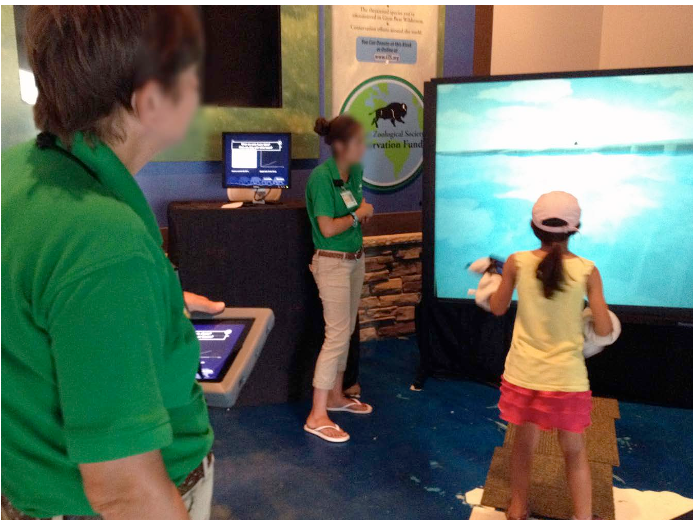 Figure 1: A child interacting with the immersive "polar bear" environment using arm-based swimming motions.
Key Insights: Children vs. Adults
The experiment revealed fascinating differences in how our bodies perceive "hard work" based on age:
- The Arm-Leg Gap: Both children and adults were sensitive to the duration of arm exercises (swimming). However, for leg exercises (walking), children’s perceived effort barely moved between 30 and 90 seconds, even though their heart rates significantly increased.
- Adult Effort Regulation: Interestingly, adults showed a "regulation effect." When faced with high-intensity swimming for a short time, they instinctively moderated their effort (lower heart rate), whereas children simply "pushed through," leading to a direct heart rate spike.
 Table 1: The quantitative relationship between swimming duration and Reported Perception of Effort (RPE).
Experimental Convergence
The data suggests that for high-throughput environments like museums, increasing weight/intensity is a better design choice than increasing time. Children don't "feel the burn" from short increases in duration as much as they do from immediate physical resistance.
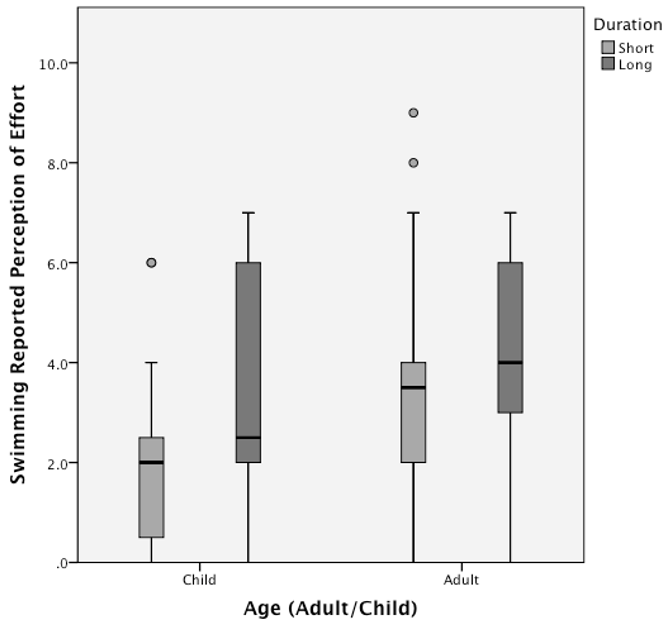 Figure 2: Graphical representation showing the significant jump in perceived effort as duration increases for the swimming modality.
Critical Analysis & Conclusion
This paper opens a new door for Embodied Metaphors. Instead of using the body just as a "joystick," the body becomes the "display."
Limitations: The study notes that the 90-second limit might be too short to reach a "fatigue threshold" for leg-based activities in children. Furthermore, the goal of achieving a precise 2.6:1 ratio of perceived effort remains a challenge, as perception is not perfectly linear with physical weight.
The Takeaway: If you want a child to understand the magnitude of a scientific problem, don't just show them a bigger bar on a graph—make the interaction physically heavier. Proprioception is a powerful, underutilized channel for data visualization.