
FEMwiki: Balancing Crowdsourced Agility with Editorial Rigor in Medical Taxonomies
FEMwiki: crowdsourcing semantic taxonomy and wiki input to domain experts while keeping editorial control: Mission Possible!
This paper introduces FEMwiki, a collaborative platform for field epidemiologists that combines wiki-based content creation with semantic taxonomy maintenance. It leverages a novel "Dual Versioning" model and user-editable navigation structures to achieve high-quality crowdsourcing within a specialized medical Community of Practice (CoP).
TL;DR
FEMwiki is a specialized collaborative platform designed for the field epidemiology community. It solves the tension between open crowdsourcing and clinical accuracy using a Dual Versioning model and a Self-Evolving Semantic Taxonomy. This allows domain experts to not only write articles but also reorganize the domain's knowledge structure without needing technical expertise in ontology engineering.
The Professional Crowdsourcing Dilemma
In medical and high-stakes professional fields, the "Wikipedia model" is often viewed with skepticism due to the lack of formal quality assurance. Yet, traditional expert committees are too slow to maintain repositories for rapidly evolving fields like epidemiology.
The authors identify two core pain points:
- Quality Conflict: How do you allow anyone to edit while ensuring the reader sees only validated information?
- Navigation Fatigue: As content grows, flat wiki structures fail. Experts need a hierarchical, semantic way to browse knowledge, but maintaining such a taxonomy is usually a manual, high-effort task for IT specialists.
Methodology: Two Versions, One Truth
The core innovation of FEMwiki lies in its structural design, which treats the Taxonomy as content and the Editorial Status as a parallel track.
1. The Dual Versioning Model
Instead of hiding drafts or blocking edits until approval, FEMwiki maintains two versions of each page simultaneously. This ensures "Editorial Control" without stifling the "Mission Possible."
- Approved (Green): The version vetted by senior epidemiologists.
- Draft (Yellow): The latest community contribution. A clear navigation bar allows users to toggle between the "trusted" truth and the "latest" insight, fostering transparency and trust.
2. Live Semantic Taxonomy
Unlike complex OWL/RDF editors, FEMwiki allows users to set a "Parent Page" directly in the edit metadata. This generates a Semantic Navigation Hierarchy on the fly.
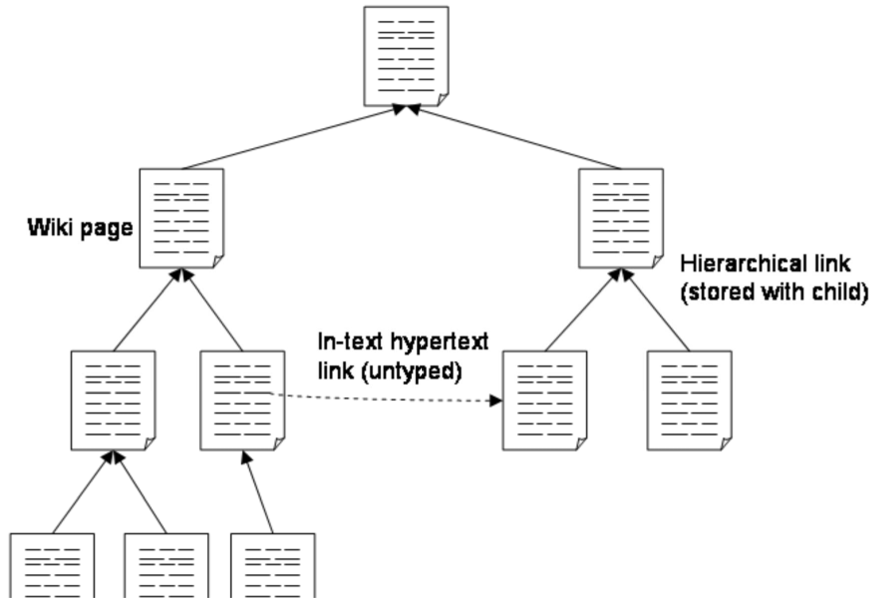 Figure: Schematic diagram of content organization where pages act as nodes in a semantic tree.
Real-World Evolution and Results
The project transitioned from a linear training manual (EPIET) to a dynamic knowledge base. The evaluation showed that the community naturally "flattened" and "tallied" the hierarchy to make it more intuitive.
| Metric | Jan 2012 | May 2012 |
|---|---|---|
| Total Nodes | 283 | 278 |
| Stub Nodes (Empty) | 90 | 75 |
| Inheritance Richness | 3.77 | 3.65 |
The reduction in "stub nodes" (marked in Red in the browser) proved that visual nudges effectively mobilize experts to fill knowledge gaps.
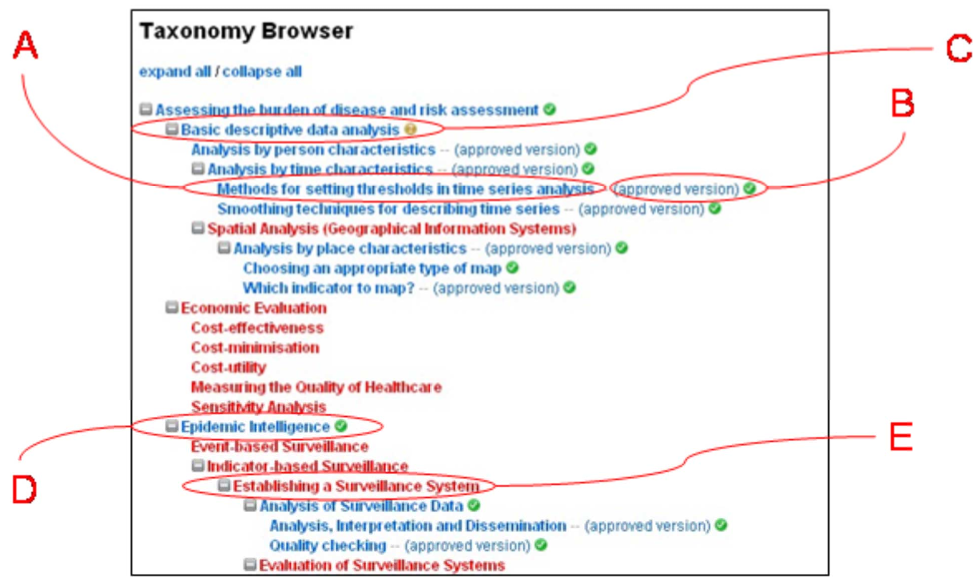 Figure: The Taxonomy Browser using color-coding to prompt user action on specific pages.
Critical Analysis & Takeaways
FEMwiki demonstrates that Editorial Control and Crowdsourcing are not mutually exclusive. By lowering the barrier to entry for taxonomy maintenance—turning it into a simple "parent-selection" task—the authors successfully decentralized the architecture of the domain knowledge.
Limitations:
- The 1% Rule: Like most wikis, a small core of users (about 4%) performs most of the heavy lifting.
- Ambiguity: Users sometimes created nodes with duplicate names in different contexts, requiring manual "mapping" exercises to resolve semantic overlaps.
Future Outlook: The success of FEMwiki suggests that future "Communities of Practice" should focus on Incentive UI: using color-coded progress bars (like the "Stubs" in this paper) to gamify the completion of scientific repositories. This framework is highly applicable to any specialized field requiring both rapid updates and peer-reviewed stability, such as AI safety documentation or climate change protocols.