
FetLife: Decoding the Structural Topology of the World’s Largest Kink Network
An Exploration of Fetish Social Networks and Communities
This paper presents the first large-scale structural analysis of FetLife, the world's largest anonymous social network for BDSM and fetish communities. By analyzing 504,416 European members and 1.9 million connections, the authors characterize the network as a unique "sexual market" that blends social organization with explicit sexual interests.
TL;DR
This study provides the first academic "under the hood" look at FetLife, a massive anonymous social network for the BDSM and fetish community. Analyzing over 500,000 European users, the researchers uncover that while the network mimics traditional OSNs (Online Social Networks) in its scale-free properties, it functions as a highly specialized sexual market where social interaction and sexual experimentation are inextricably linked.
Contextual Positioning
In the landscape of social media research, we usually see two extremes: the "clean" social graphs of Facebook/Twitter or the "transactional" graphs of dating apps like Tinder. FetLife sits in a fascinating middle ground. It is an OSN where sexual interest is the primary driver, yet it lacks the "search" features of dating sites, forcing users to rely on local events and community groups.
The Problem: The "Hidden" Social Graph
Why is this difficult to study?
- Stigma and Anonymity: Traditional surveys on sexual behavior suffer from self-reporting bias. Anonymized OSN data provides a more honest view of actual interactions.
- Multidimensional Roles: Unlike LinkedIn (professional) or Facebook (social), FetLife connections are based on a mix of gender, sexual orientation, and BDSM roles (Dominant, Submissive, Switch).
- The "Lurker" Problem: The study found a massive number of isolated nodes—mostly heterosexual males—who consume content but fail to integrate into the social fabric.
Methodology: Community Detection with Node Attributes (CESNA)
To understand the "Why" behind the connections, the authors didn't just look at who followed whom. They used the CESNA model, which assumes that links are created based on shared membership in latent communities defined by attributes.
They mapped 10 binary attributes:
- Genders: Male, Female, Trans, Genderqueer (GQ).
- Orientations: Straight, Bisexual, Gay.
- BDSM Roles: Dominant, Submissive, Switch.
The Structural Resilience
One of the most striking findings was the network's resilience. By analyzing the k-core decomposition, the researchers found that the network is not just held together by a few "superstars."
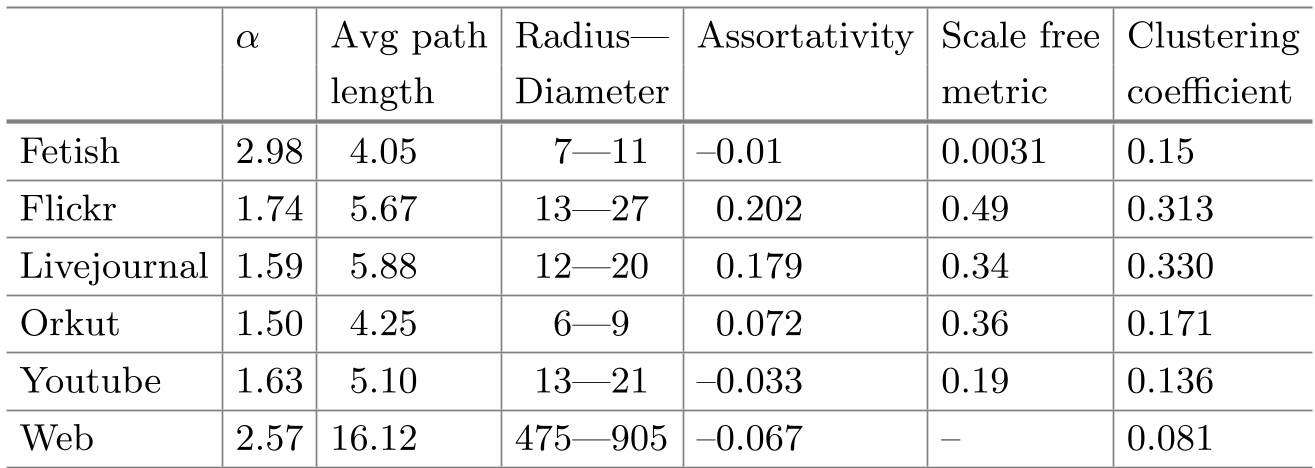 Table: Comparison of FetLife with YouTube, Flickr, and Orkut. Note the high alpha (2.98) and clustering coefficient (0.15), indicating a dense, resilient local structure.
Key Insights: Sexual Market vs. Platonic Socializing
The study reveals a sharp gender divide in how the platform is used:
- Heterosexual Male Competition: Straight males showed a strong bias towards connecting with females (61.2% of friends), but had very low "congruence" with other males. This mathematically points to a competitive sexual market—males are less likely to be friends with their romantic rivals.
- Female Platonic Power: In contrast, the community detection algorithm (CESNA) identified several "Super-Communities" (SC3, SC4, SC5, SC6) that were almost exclusively female.
- The Transgender Hub: SC8 and SC11 highlight the transgender community as a central, highly active component of the network, showing significant interaction with cis-females, far exceeding what is seen in traditional OSNs.
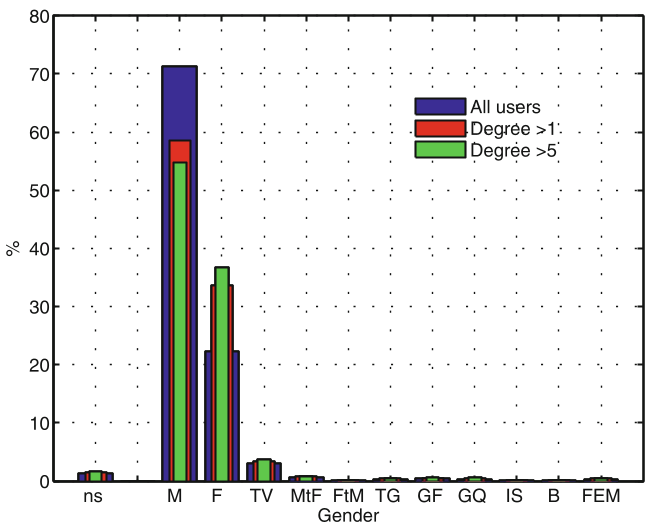 Figure: The "Lurker" effect. Note how the male (M) population drops significantly when filtering for users with >5 friends, revealing that most "friendless" accounts are heterosexual men.
Critical Analysis & Takeaways
The research concludes that FetLife is more than just a "kinky Facebook." It is a tool for bootstrapping real-world interactions. Because the site lacks a search bar, users must join groups and attend local events to find partners. This creates a network composed of "local clusters" centered around workshops and parties rather than global influencers.
Limitations: The study is based on 2014 data and is limited to European users. Furthermore, because it relies on self-defined "roles," it may not capture the fluidity of these identities over time.
Future Outlook: Understanding these networks is vital for public health (modeling the spread of STIs) and for social psychologists seeking to understand how "secret" subcultures maintain safety and privacy in a digital age. The "platonic" nature of female-led communities on FetLife suggests that niche OSNs provide a safer "third space" for marginalized groups that mainstream platforms fail to offer.