
Boldly Going Where No Code Has Gone Before: Star Trek’s Influence on 40 Years of Computer Science
The Fiction in Computer Science: A Qualitative Data Analysis of the ACM Digital Library for Traces of Star Trek
This exploratory study, titled "The Fiction in Computer Science," presents a qualitative data analysis of 232 relevant publications within the ACM Digital Library (1975–2017) that reference "Star Trek." The authors categorize these citations into ten thematic areas, mapping how science fiction serves as a bridge between speculative imagination and Human-Computer Interaction (HCI) research.
TL;DR
Is sci-fi just entertainment, or is it a blueprint for R&D? This paper analyzes over 40 years of the ACM Digital Library to prove that Star Trek isn't just a fan favorite—it’s a foundational driver for Computer Science. From the "Tricorder" to the "Holodeck," researchers have been using the Trek universe to frame problems, inspire interfaces, and set the North Star for SOTA (State-of-the-Art) development.
Contextualizing the Final Frontier
For decades, the tech industry has suffered from a "imagination gap"—the difficulty of explaining why a prototype matters before the infrastructure exists. Star Trek bridged this gap. The series didn't just predict the future; it mandated it. Whether it is George Lucas or NASA engineers, the "Technological Determinism" of the Federation has leaked into our real-world peer-reviewed journals.
The Pain Point: Fiction as a Research Tool?
Why does a PhD candidate at SIGGRAPH cite a 1960s TV show? The authors argue that science fiction acts as a "rhetorical device" or "analogy" that allows researchers to bypass complex conceptual explanations. If you say you’re building a "Universal Translator," everyone—from peer reviewers to investors—instantly understands the UX requirements and the intended utility.
Methodology: Coding the Galaxy
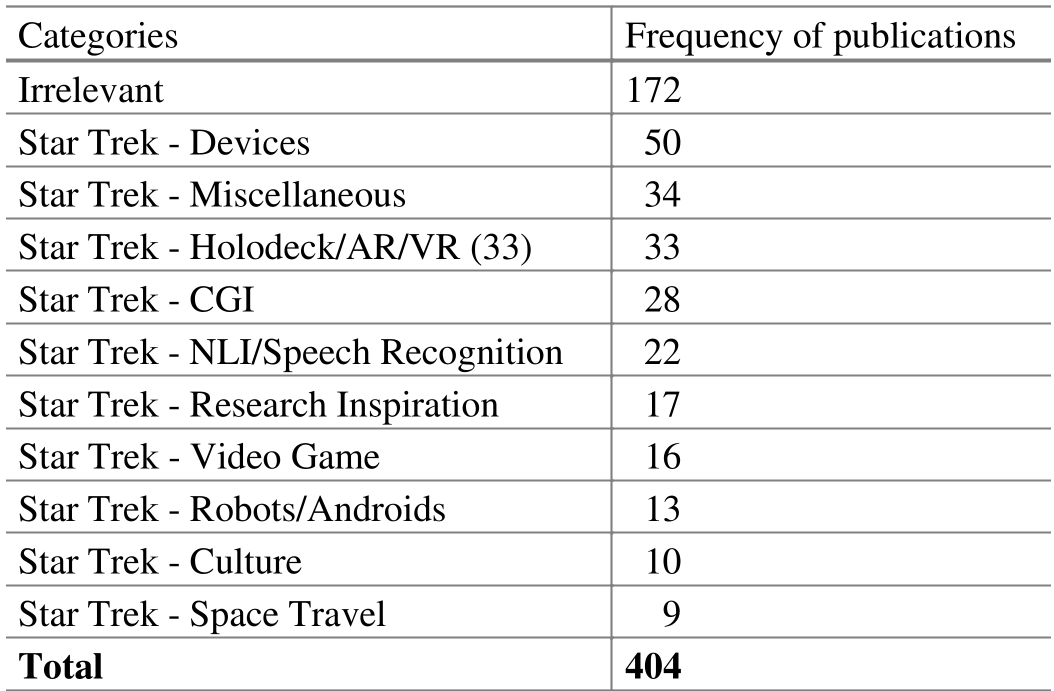
The authors performed a rigorous "Open-Coding" of the ACM Digital Library. Starting with 763 hits, they narrowed it down to 404 high-quality publications. Each paper was manually read to see how the fiction was used.
The Taxonomy of Trek
The study identified ten broad categories where the series intersects with hard science. Interestingly, the "Computer Generated Imagery (CGI)" and "BASIC Games" categories dominated the 70s and 80s, while "Robot Ethics" and "Digital Fabrication" (The Replicator) dominate the 2010s.
Key Technological Intersections
1. The Holodeck (VR/AR)
The most cited visionary technology in HCI is the Holodeck. Papers starting from 1992 use it to describe the "ultimate interface." Modern projects like Microsoft’s Holoportation explicitly cite Trek to define the sensation of "presence" in virtual spaces.
2. Natural Language Interfaces (The "Computer")
Before Siri and Alexa, there was the "Enterprise Main Computer." Researchers use this reference to define the "invisible interface"—a computer that is always listening, understands context, and responds in natural human syntax.
3. The Tricorder (Mobile Sensing)
The "Virtual Tricorder" appeared in ACM papers as early as 1995. Today, with smartphones capable of heartbeat detection and environmental scanning, we are essentially carrying 23rd-century sensors in our pockets. The paper highlights the Qualcomm Tricorder XPRIZE as a literal instance of fiction-to-fact engineering.
Critical Insights: Why This Matters
The study reveals a "revolving door" of inspiration:
- Stage 1 (Inspiration): Scientist sees a "Communicator" on screen.
- Stage 2 (Visionary Prototyping): Researcher writes a paper using the TV show as an analogy for their interface.
- Stage 3 (Realization): Industry builds the Motorola StarTAC or the Apple Watch.
The paper concludes that science fiction is not a distraction from "real" science; it is the Inductive Bias of the entire tech industry. It provides the "Future Vision" that allows fragmented research groups to work toward a coherent, unified user experience.
Conclusion & Limitations
While the study is limited by the subjectivity of qualitative coding and a focus solely on the ACM library, the takeaway is clear: Engineering is the art of making fiction real.
For researchers today, the lesson is simple: If you want to build the next generation of HCI, don't just look at the latest SOTA on arXiv—re-watch an episode of The Next Generation. Your next breakthrough might already be on the screen.