
FIBIFS: Revolutionizing File Sharing in Mobile Social Networks via Physical Field Intuition
A Field Intensity Based Model for Initiative File Sharing in Mobile Social Networks
The paper introduces FIBIFS, a Field Intensity Based Initiative File Sharing model for Intermittently Connected Mobile Social Networks (ICMSNs). It leverages physical field theory to guide message forwarding for both query and reply phases, significantly improving delivery efficiency in Delay Tolerant Networks (DTNs).
TL;DR
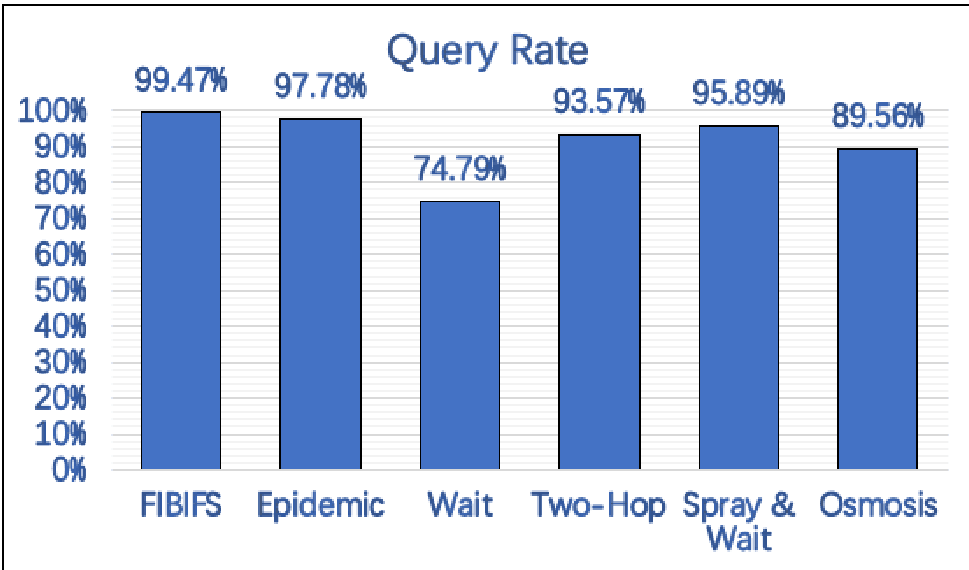
In the fragmented world of Intermittently Connected Mobile Social Networks (ICMSNs), finding and delivering files is often a game of "wait and hope." This paper introduces FIBIFS, a model that treats mobile users as sources of "Resource" and "Interest" fields. By following the "gravity" of these fields, messages reach their destinations with 90% less delay and a 99.47% success rate, effectively turning passive routing into an initiative, high-performance system.
The Problem: Success by Accident
In a Delay Tolerant Network (DTN), there is no stable path between a sender and a receiver. Most existing protocols rely on:
- Epidemic Routing: Flooding the network with copies (high cost, high overhead).
- Wait/Spray-and-Wait: Holding messages until a direct encounter (high latency).
The fundamental flaw? These methods are passive. They don't account for the social intent of the nodes or the quality of the resources they carry. The network acts like a dark room where nodes stumble into each other by chance.
The Insight: Fields as Directional Guidance
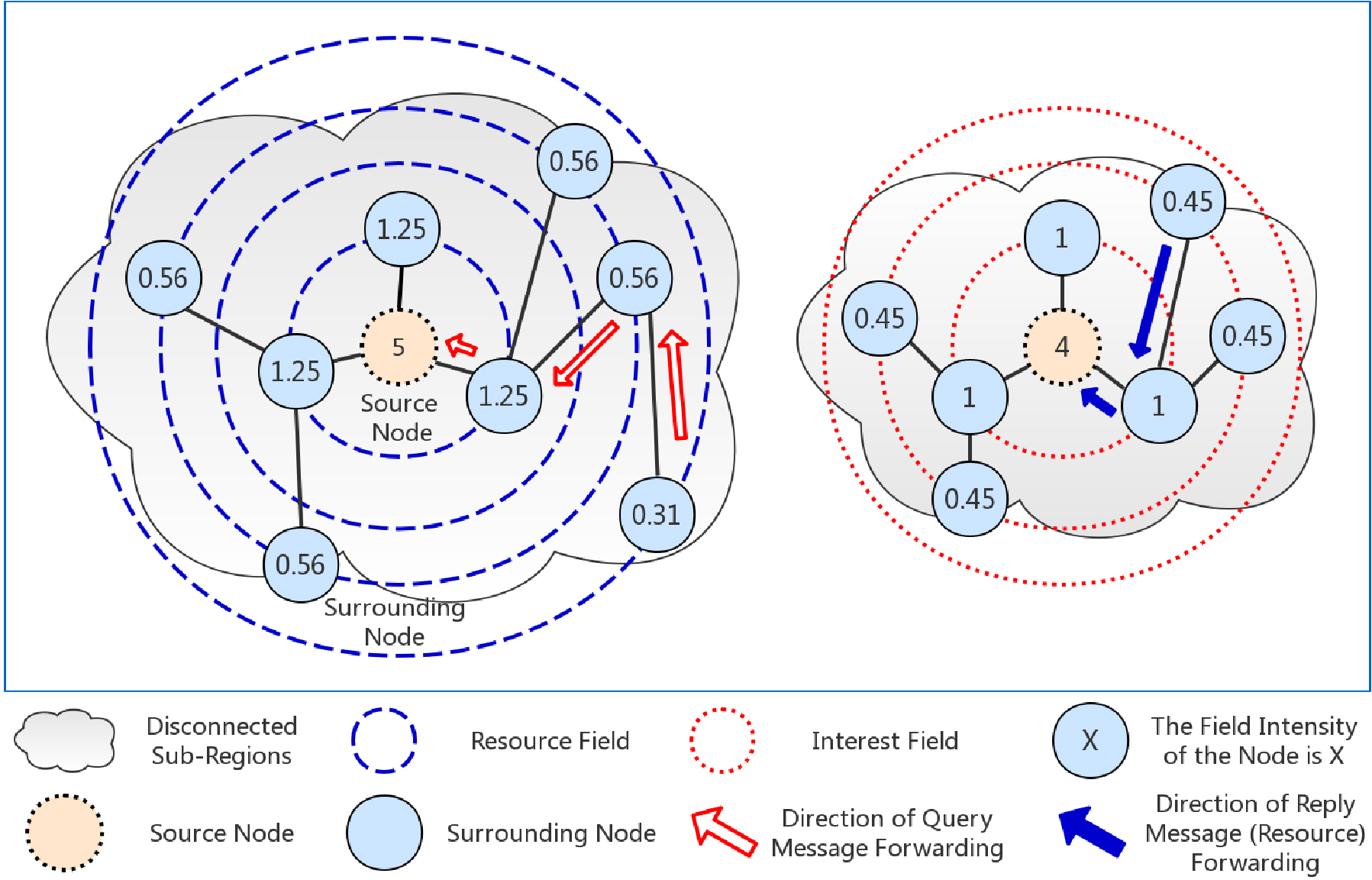
The authors propose that every node should radiate a "field" based on its contents. If a node has a high-quality sports video, it generates a Resource Field for the "Sports" category. If a user is seeking literature, they generate an Interest Field.
Inspired by Coulomb’s Law, the field intensity decreases as the hop count (d) from the source node increases:
This mathematical mapping allows every node to calculate its "Total Field Intensity." When two nodes meet, the message moves toward the node with the higher intensity—effectively "falling" toward the center of the field where the probability of finding the resource (or the requester) is highest.
Core Innovation: The Field Container
One might argue that broadcasting field information for every file would cause a "message storm." To prevent this, the authors designed a Field Container.
- Aggregation: Instead of tracking every individual source, nodes aggregate fields with the same category and diffusion length.
- Probabilistic Maintenance: Using encounter probabilities (), the model maintains a lean summary of the surrounding "force field" without exhausting the mobile device's limited storage.
Experimental Results: Precision over Power
The team tested FIBIFS against industry standards like Epidemic and Osmosis using the Infocom06 trace (real-world movement) and Gauss-Markov mobility models.
Key Performance Wins:
- Latency: FIBIFS achieved a delay that is a mere fraction (approx. 1/10th) of the Epidemic algorithm.
- Communication Cost: While Epidemic floods the network (36x the cost), FIBIFS remains nearly as efficient as the "Wait" protocol, which only sends one copy.
- Initiative Delivery: Unlike passive systems, the resource (reply) proactively seeks out the requester by following the Interest Field.
Critical Analysis & Takeaways
Why does it work? FIBIFS succeeds because it provides an Inductive Bias based on human social behavior. People with similar interests cluster together, and resources tend to move within those clusters. By quantifying this as a physical field, the routing becomes a deterministic optimization problem rather than a random walk.
Limitations:
- Dynamic Interests: The paper assumes interests and resources are relatively static during the session. Rapidly shifting user preferences might "jitter" the field.
- Security: The model assumes nodes truthfully report their field intensities. A malicious node could pretend to be a "High Intensity" center to intercept data (Sinkhole attack).
Future Outlook: This "Field" approach is a precursor to modern Content-Centric Networking (CCN). As we move toward 6G and decentralized edge computing, using physical metaphors to manage data flow in sparse networks will be a critical tool for minimizing energy consumption while maximizing reliability.